Research - 20.11.2026 - 10:00
How do AI systems decide which brands to mention and recommend? And which Swiss companies feature particularly prominently? This is precisely what the new Swiss AI Brand Ranking from the Institute for Marketing and Customer Insight (IMC-HSG) investigates. For the study, the researchers:
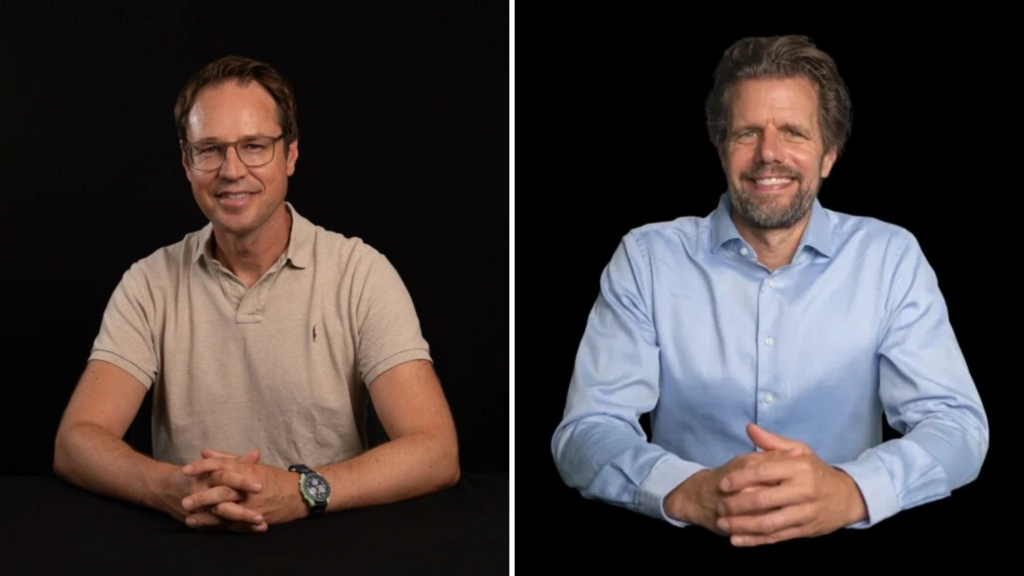
In this interview, two HSG professors Dennis Herhausen and Reto Hofstetter, explain how the new platform works, what insights it provides for businesses and where the limitations of the rankings lie.
With the Swiss AI Brand Ranking, you have developed a new platform. What does it reveal? And how did you go about the study?
Prof. Dr. Dennis Herhausen: With the Swiss AI Brand Ranking, we systematically investigate how Swiss brands are perceived, portrayed and recommended by leading AI systems. Our platform highlights these differences and enables companies to understand their position relative to the competition. The ranking covers 46 industries across six economic sectors. For each industry, we developed ten typical customer queries ranging from searches for leading providers to specific purchasing and decision-making scenarios. We posed these questions to ChatGPT, Gemini and Claude, in each case with and without web search enabled and each query was repeated five times. In total, we analysed around 25,000 AI responses.
Prof. Dr. Reto Hofstetter: On our website, brandranking.ch, companies can search for their brand, compare it with competitors and filter the results by AI system, language and location profile, as well as web search.
A brand may be frequently mentioned by AI systems without actually being recommended. How does your ranking reflect these differences?
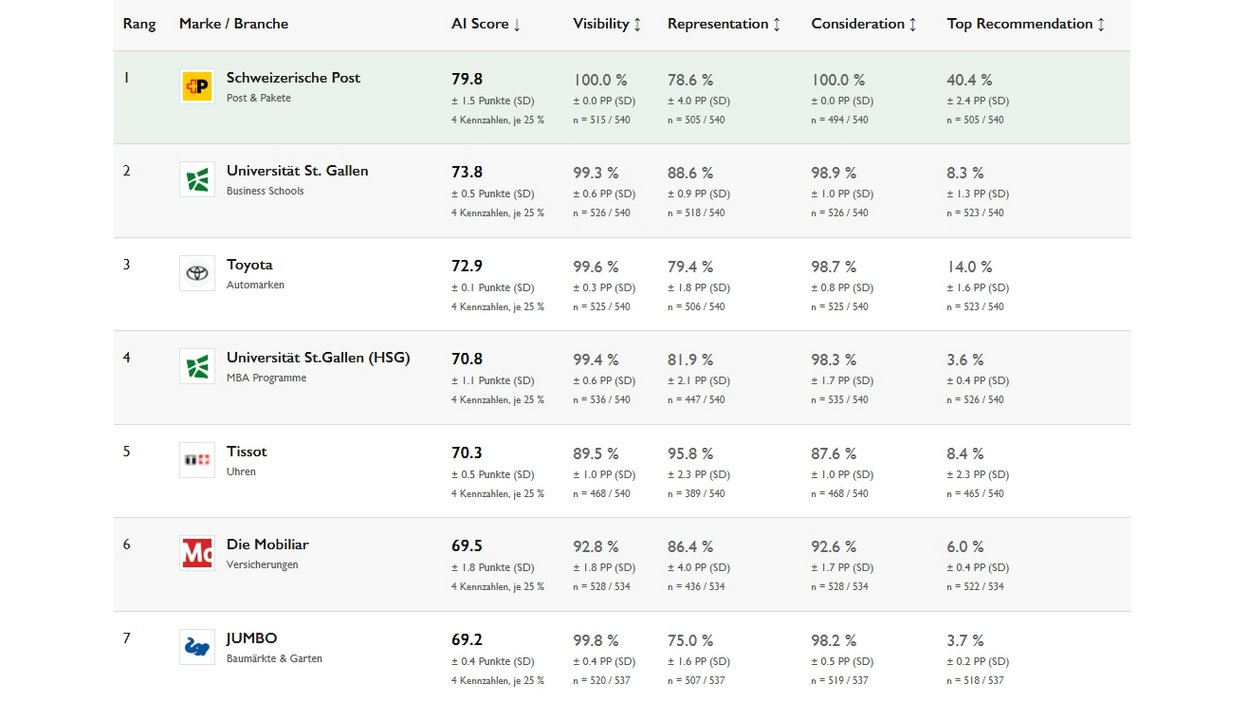
Prof. Dr. Dennis Herhausen: The ranking distinguishes between four metrics: how often is a brand mentioned in AI responses, portrayed positively, considered as a suitable option for a specific customer requirement, or recommended as the first choice? We calculate an overall score from these four metrics, with each metric subjected to equal weighting.
Prof. Dr. Reto Hofstetter: If, for example, an AI lists five banks, all five are visible. If it explicitly recommends one of them for a specific customer need, we list that company as the "first choice". That is why, in addition to the overall score, it is always worth looking at the individual metrics. Two brands may perform similarly in the ranking, even though one is frequently mentioned while the other is more often recommended as the first choice.
If we look at Swiss Post, which ranks first in the cross-industry provider ranking. What can we glean from this example about perception and recommendations by AI systems?
Prof. Dr. Dennis Herhausen: In our study, Swiss Post is mentioned in practically all evaluable questions relating to postal and parcel services and is considered a suitable option. It is portrayed positively in just under 79 per cent of the evaluable descriptions. Nevertheless, it is recommended as the clear first choice in only around 40 per cent of the relevant cases.
Prof. Dr. Reto Hofstetter: The remaining 60 per cent or so do not, however, automatically mean that a competitor is recommended. An AI system can also name several suitable providers without favouring any one of them. In the case of Swiss Post, this therefore raises the question of for which specific customer needs it becomes the first choice. For brand management, it would be particularly insightful to compare the cases with a clear recommendation with those without a recommendation: Which requirements make the difference, and which of Swiss Post's strengths do the AI systems highlight in this context?
Why is it important for companies to know how AI systems portray and recommend their brands?
Prof. Dr. Dennis Herhausen: AI systems are increasingly becoming a new interface between companies and customers. As such, AI systems influence which brands even make it onto the shortlist.
Prof. Dr. Reto Hofstetter: According to the global market research institute NielsenIQ, a majority of consumers in the US have already used AI to assist with shopping. With ChatGPT, this development goes one step further: once authorised by users, the AI can also process purchases, albeit initially only in the US. This brings product research, recommendations and purchasing closer together.
What insights can companies gain from the ranking for their own brand management?
Prof. Dr. Dennis Herhausen: The ranking shows where companies stand in comparison to their competitors. Is their brand rarely mentioned? Is it mentioned frequently, but described in a less than positive light? Or is it portrayed positively without being recommended as the first choice? Companies should therefore examine what information about their brand is available to AI systems, how credible this information is, and whether it addresses key customer needs. It is not only the company's own information that plays a role here, but also independent reviews, comparison websites and other external sources. The key insight is this: brands must not only communicate promises but also provide verifiable evidence to back them up.
Prof. Dr. Reto Hofstetter: We would like to make the ranking useful for monitoring marketing and will therefore repeat the study periodically. This will enable companies to check whether their position has improved following measures relating to Generative Engine Optimisation, or GEO for short: is their brand being recommended more frequently, and is it gaining ground against competitors? A brand may improve while its competitors are making even greater gains. Furthermore, changes to AI systems must be taken into account.
The University of St.Gallen also featured three times in the top 10 of the overarching category of provider ranking – for instance, as a business school and with its MBA and Executive MBA programmes. How do you explain these multiple placements?
Prof. Dr. Dennis Herhausen: The University of St.Gallen is assessed in three different competitive contexts: as a business school, as an MBA provider and as an Executive MBA provider. The fact that it ranks among the leading providers in all three categories suggests that its positioning in management education is also firmly anchored in the responses from the AI systems.
However, the distinction between visibility and recommendation is also evident here: HSG is frequently considered but is recommended as the clear first choice significantly less often. The multiple rankings are therefore not a triple victory in the same competition but rather demonstrate that a strong brand can be present in several relevant decision-making situations.
Prof. Dr. Reto Hofstetter: One possible explanation is HSG's broad digital presence. Many institutes and programmes maintain their own channels and publicise their topics, courses and activities. Added to this are reports, articles and pieces from students and alumni. However, the extent to which this explains the specific rankings would need to be investigated separately. Even when a machine makes the recommendation, people's experiences and assessments can form an important basis. This is because AI search systems draw on third-party content, including media reports and publicly available testimonials.
What is your conclusion: how is artificial intelligence changing the rules of the game in the marketing of the future?
Prof. Dr. Dennis Herhausen: Until now, marketing has primarily been about reaching customers directly, shaping their perceptions and convincing them of a brand's merits. In future, AI systems will increasingly act as intermediaries. They will search for information, compare offers and make recommendations. With the development of autonomous AI agents, they could even take over parts of the purchasing process independently.
Brands are no longer competing solely for people's attention, but increasingly also for consideration and recommendation by AI systems. The crucial question for the future is therefore no longer just: "What do customers think of our brand?", but also: "What does the AI know about our brand, and why should it recommend us?"
Prof. Dr. Reto Hofstetter: In market research, for example, synthetic data and digital twins of customers can help to test ideas in advance, simulate potential customer reactions and speed up research. Agent-based AI can also automate entire workflows, from information gathering and analysis through to the preparation and implementation of marketing measures. This also changes the tasks and competences of staff. As AI takes on more operational work, defining the right objectives, evaluating results and managing the systems become increasingly important.
Prof. Dr. Dennis Herhausen is professor of Marketing Management at the University of St.Gallen.
Prof. Dr. Reto Hofstetter is professor of Executive Education and Marketing at the University of St.Gallen.