Background - 04.06.2026 - 13:15
How can Eastern Switzerland remain attractive? This question was at the heart of the EcoOst St. Gallen Symposium 2026. The discussion was overshadowed by the upcoming referendum on a 10-million-strong Switzerland. Beat Ulrich, outgoing CEO of the St. Gallen Symposium, welcomed the audience with a look back at the 55th St. Gallen Symposium, which took place in early May, held under the motto “Disrupted Age”. Geopolitics, technology and demography were the central themes. This was evident, for example, in the programme “Sternstunden Philosophie”, produced on site, featuring the British demographer Paul Morland, who warned of an “Armageddon” in relation to population decline and ageing.
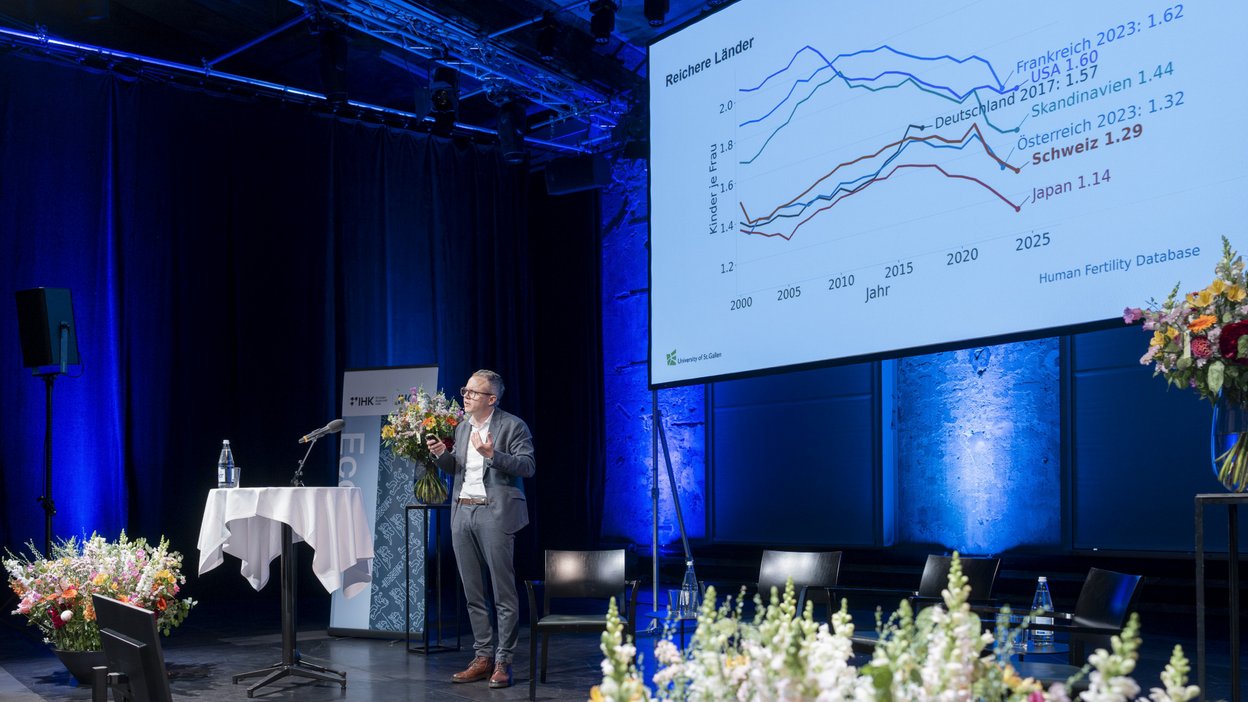
Prof. Dominik Sachs did not put it quite so dramatically. However, he demonstrated just how sharply birth rates are falling worldwide. This has been a trend since the 1980s. According to the UN, the global fertility rate, at 2.21 children per woman, is currently still just above the so-called replacement level, but is likely to fall further in the coming decades. Switzerland, at 1.29 children, is well below this. Although the figures are better in eastern Switzerland, the difference is only marginal. It is therefore important for Switzerland to take a closer look: the decline has so far been less driven by an increasing number of women remaining childless permanently. What is striking, rather, is that mothers are having fewer children on average and that single-child families have increased.
The most common reasons why women or families in Switzerland decide against having another child are the anticipated difficulties in balancing family and work, as well as insufficient or expensive childcare options. He referred to causal evidence suggesting that maternity leave and childcare centres can be important levers in making it easier for families to decide to have another child. When it comes to maternity leave, Switzerland is not very generous compared to other countries; at the same time, supplementary childcare is very expensive here. The aim is to create better framework conditions so that having a second or third child becomes a realistic option for more families.
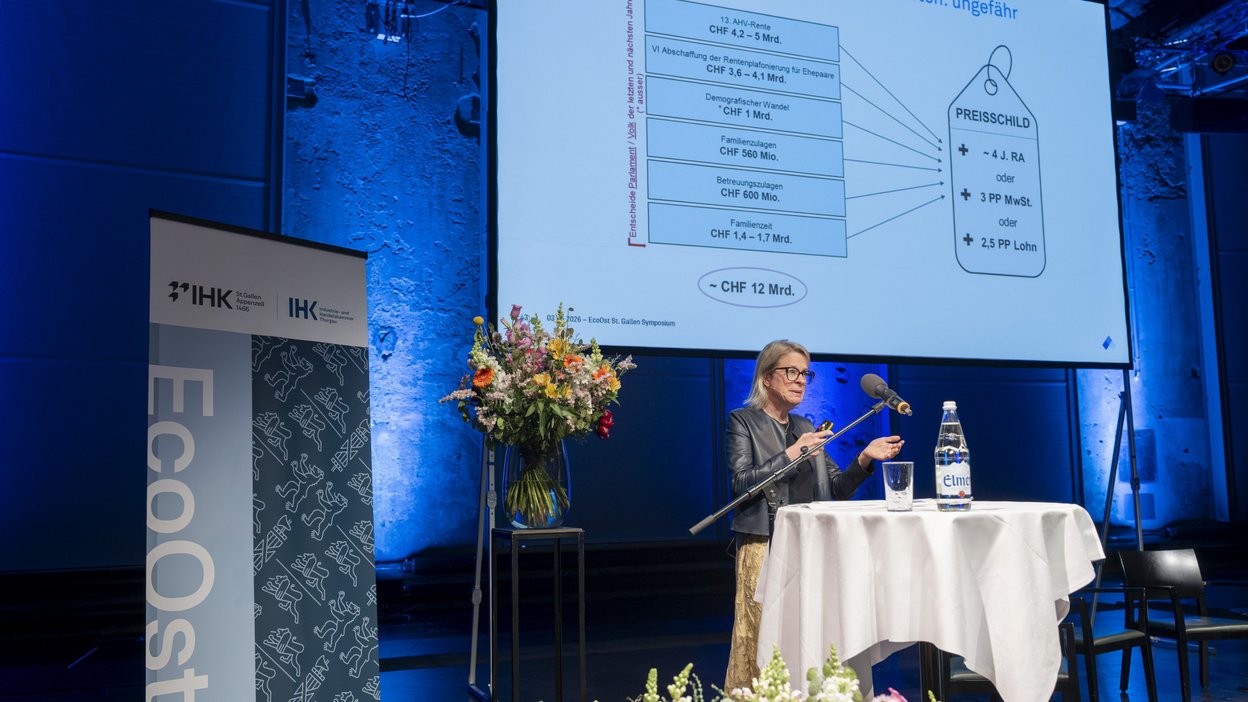
Barbara Zimmermann-Gerster, head of Education and Employer Policy at the Swiss Insurance Association (SIA), spoke about the need for reform and the political reality. An ageing society affects not only the pension provision but also competitiveness, the tax and contribution base, and the country’s overall attractiveness as a business location. "Demographics is a question of economic sustainability." 2025 marked a tipping point, as for the first time, there were more people over 65 than under 20 living in Switzerland. This puts pay-as-you-go financing under severe pressure and highlights the need for reform.
In this context, she pointed out that the financing of the 13th AHV pension remains unresolved. Yet this is not even the most pressing problem: “The IV or the retirement system, is virtually bankrupt,” she warned. "Expanding benefits is more likely to secure a majority than financing them," she said, summing up the dilemma. This is precisely why it is important to consider package solutions rather than individual measures. “However, we will have no choice but to raise the retirement age,” she warned.
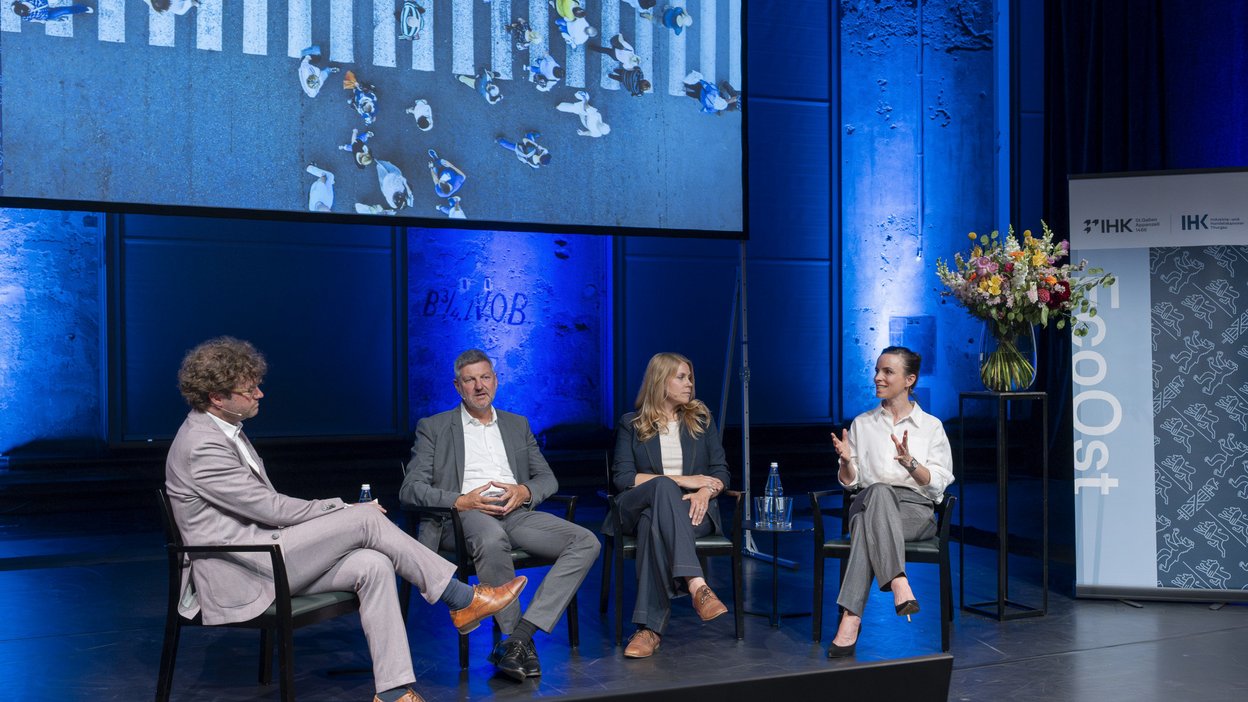
Stefan Schmid, editor-in-chief of the Tagblatt and host of the evening, chaired the panel discussion. He asked Urs Ryffel, CEO of Huber + Suhner AG, whether he was still receiving enough applications. Even though it takes an average of just 60 to 90 days to fill a vacancy, the effort involved in finding the right people has increased. Nevertheless, thanks to the high quality of life, Eastern Switzerland is not a disadvantage as a location. Angela Meier, managing director of Outvision GmbH, agreed, but mentioned industry-specific differences. Another advantage of Eastern Switzerland is that there is a strong focus on local talent. But how can young people be attracted to the region? According to Judith Scherzinger, head of Human Resources at the Bauwerk Group, working in manufacturing companies is appealing to many. This is where Eastern Switzerland has a strong advantage. The region’s border location and the international focus of many firms are also attractive. "Down-to-earth, yet cosmopolitan," she summarised. And what about pay? There is pressure on this front for various reasons, but applicants know not to expect Zurich-level wages – the cost of living is lower here.
With regard to international competitiveness, Urs Ryffel warned that Switzerland needs to catch up with the “powerhouse” that is the USA in terms of innovation. This requires an increase in productivity. Judith Scherzinger added that this also necessitates investment in staff. This applies, for instance, to the field of AI, which affects many sectors. She advocated for liberal labour laws that allow for flexibility. "Politicians should not intervene too heavily and try to solve companies’ problems." This includes the possibility of continuing to employ staff even at the age of 65. However, such options must be discussed at an early stage, Urs Ryffel pointed out. Angela Meier confirmed this based on her own surveys: people over 55 are often flexible and open to such discussions. When asked about the 10-million initiative, Urs Ryffel urged people to avoid polemics. "An upper limit is the wrong approach to the problems we want to solve." He is campaigning for a "no" vote. "We are already unable to meet our needs on the Swiss market. If we cannot bring in the necessary workforce, we will shift value creation abroad."
Students from the University of St.Gallen (HSG), who had co-organised the 55th Symposium as members of the International Students’ Committee (ISC), shared their impressions of their travels. Antonia Mau observed in northern and eastern Germany that demographic change is affecting different sectors in very different ways.
In regard to an ageing population, one might ask whether every vote should continue to count equally in democracies in the future. As supervisor of the Leader of Tomorrow programme, Lorenzo Ayala-Bombino’s aim was to attract the brightest minds in North America to take part in the essay competition. In doing so, he learned how young, educated people view demographic change. At elite US universities, intensive work is being done on technological solutions to address this. Yet the "American Dream" is crumbling, and for many talented individuals, a future in the US is uncertain. This presents an opportunity for Switzerland in the global talent race. Benjamin Beck shared his impressions from India. Demographic change there is characterised by young, well-educated people entering the labour market. How can this potential be harnessed in a highly competitive environment? Given the different challenges in Europe and India, he sees great potential for closer cooperation.
To conclude, IHK Director Markus Bänziger summarised the key messages of the event. To resolve the demographic crisis, he said, every possible lever must be pulled, as social systems are designed for growth: "The solutions are uncomfortable, and we must not place too great a burden on young people."” By the way: for the federal votes on 14 June, the St.Gallen-Appenzell Chamber of Commerce and Industry has issued the following recommendations: No to the Chaos Initiative and Yes to childcare and the Civil Service Act. Both should at least help to ensure that the demographic time bomb does not tick any louder.
The EcoOst St. Gallen Symposium is a joint event organised by the Chambers of Industry and Commerce of St.Gallen-Appenzell and Thurgau, as well as the St. Gallen Symposium, in partnership with the University of St.Gallen (HSG). The aim of the event is to transfer the symposium’s findings and intergenerational dialogue to Eastern Switzerland.
Images: St. Gallen-Appenzell Chamber of Industry and Commerce