Research - 27.04.2026 - 12:00
Researchers at the Institute of Responsible Innovation, Sustainability and Energy (RISE-HSG) conducted a representative survey to examine the St.Gallen population’s views on wind energy. The study investigated which factors influence local acceptance of a hypothetical wind farm in the St.Gallen region, whether a wind dividend would have a positive effect, and what role emotional dynamics play in this context.
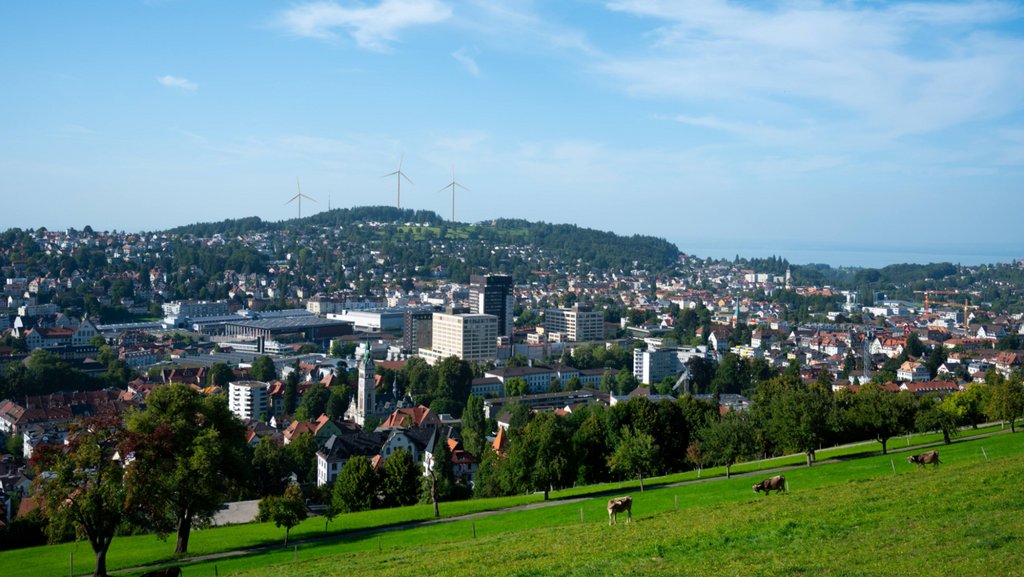
Respondents were presented with the hypothetical “Petra and Paula” wind farm on the outskirts of the city of St.Gallen using a realistic photomontage. They were then asked whether they would support the project if a vote were held next Sunday. Across the study, three-quarters of respondents (75.4 %) would agree or tend to support the idea of a hypothetical "Petra and Paula" wind farm. Directly in the city of St.Gallen, approval was even slightly above that at 79.7 %.
The study and its results were presented today at a press conference in the assembly hall of the local citizens' community in St.Gallen.
As part of the study, participants were also asked about their emotions upon seeing the hypothetical “Petra and Paula” wind farm. On a scale from “very negative” to “very positive,” they could indicate how they emotionally evaluated the project. This reveals a strong correlation between this emotional assessment and support for the wind farm: Those who clearly reject the wind farm express negative feelings; those who clearly support it tend to be emotionally positive as well. Those who are more undecided express neutral to somewhat positive emotions.
In a second question, respondents were asked to rate the intensity of their feelings on a temperature scale ranging from zero (“chilly”) to 30 degrees Celsius (“hot”). Here, the staunch opponents differed significantly from all other groups: they rated their emotional arousal about three degrees higher.
One of the study’s leaders, Martina Rothenberger, said, “We observe asymmetrical emotional arousal – only 11 % of respondents would reject the Petra and Paula wind farm. However, this group expresses strong feelings, which often garner them a disproportionate amount of attention.”
An election experiment was used to analyse which characteristics of the hypothetical wind farm influence its social acceptance. The key finding: The country of origin of the wind turbine manufacturer has the greatest influence. Wind turbines from a Danish manufacturer make the project significantly more popular than if technology from a U.S. or Chinese manufacturer were used.
Rolf Wüstenhagen, co-director of RISE stated that, “The war in the Middle East underscores the importance of domestic energy. Wind energy can make a significant contribution to diversifying our energy supply and enjoys widespread support among the population of St.Gallen.”
A second factor that increased acceptance of the wind project was the material of the tower. Most wind turbines today have a steel tower, but there are also concrete towers and the first innovative suppliers manufacturing towers out of wood. When comparing these three technologies, concrete fared the worst in the respondents’ perception. If, on the other hand, steel or wood is used, acceptance increases.
Diversified ownership structures, such as a partnership between the local municipality, a bank, and an energy utility, also had a positive effect on acceptance. The same applies to a “wind dividend,” which could compensate the host municipality or residents for the change in the landscape. However, the influence of this factor was less pronounced than, for example, the origin of the technology supplier.
Regarding the use of funds from such a wind tax, respondents could choose between various projects. The most popular was planting trees in the city of St.Gallen for climate adaptation, followed by recreational infrastructure in the forest and grants for the “Peter and Paul” wildlife park. Creative ideas also met with a positive response, such as a viewing platform on the wind turbine or a cable car to the wildlife park.
While the study surveyed the population’s preferences regarding a hypothetical wind farm on the outskirts of the city of St.Gallen, insights for the development of actual projects can also be derived from it. It should be noted that the Canton of St.Gallen has already identified 15 wind suitability zones in its structural plan, including two near the city of St.Gallen.
Furthermore, the study results show that while emotional factors play a significant role, it is equally important to convince the public of the positive cost-benefit ratio of a wind project.
The study is part of the HSG research project “PARTI-DYNACCEPT” (“The Influence of Financial Participation on the Dynamics of Social Acceptance of Wind Energy”), which is funded by the Swiss Federal Office of Energy (SFOE) as part of the Energy-Economy-Society and Wind Energy research programs and supported by the Canton of St.Gallen. Scientific leadership is provided by Prof. Dr. Rolf Wüstenhagen and Martina Rothenberger of the Institute of Responsible Innovation, Sustainability and Energy (RISE-HSG). An international advisory board comprising experts from academia and industry supports the project with its expertise.
Co-Director RISE-HSG
Research Associate & PhD Candidate