Research - 28.10.2026 - 14:42
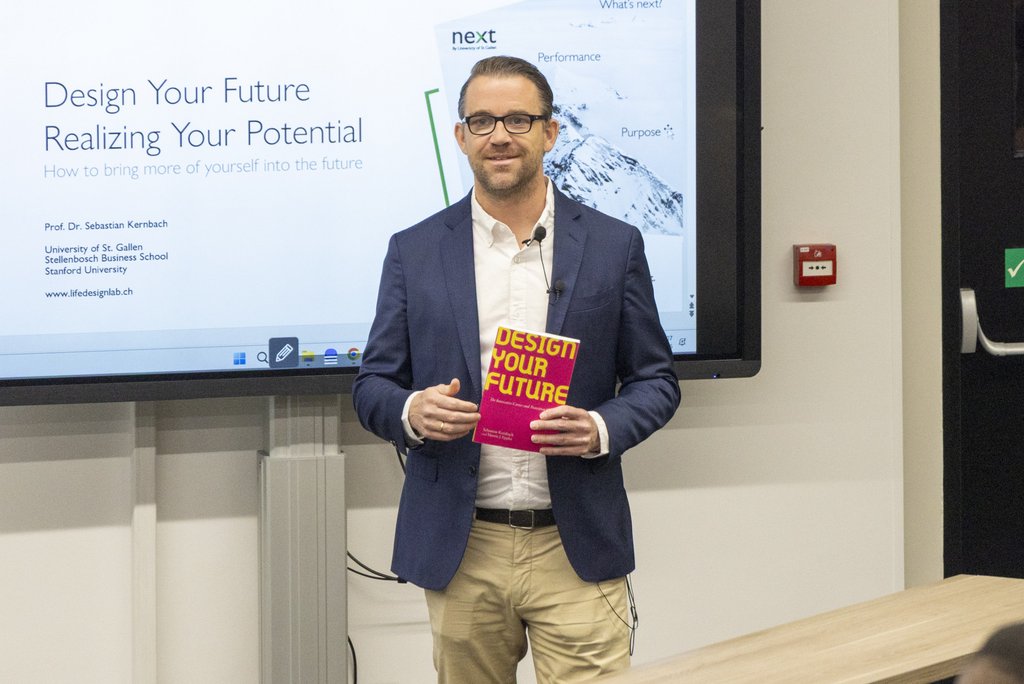
Sebastian Kernbach and the University of St.Gallen's Life Design Lab, explore how insights from behavioural science, psychology and design can help people move from uncertainty to action. This includes working through major transitions from entering working life and changing careers to redesigning life in midlife and beyond.
Professor Kernbach, we are living longer than previous generations. Why does that change the way we should think about our lives?
The traditional model was remarkably linear: education, work, retirement. Increasingly, that model no longer describes people's lives. We may change professions several times, return to education, become entrepreneurs, take care of family members, move between employment and independent work or completely rethink what we want to contribute in our 50s or 60s. That means one capability becomes increasingly important: being able to navigate transitions.
What exactly do you mean by "transition competence"?
Transition competence is the ability to move constructively from one chapter of life into another – particularly when the destination isn't yet clear. It involves understanding yourself, dealing with uncertainty, imagining alternatives, mobilising your resources and relationships and, crucially, taking small actions to explore what could come next. Some people are remarkably good at this. Others remain stuck for years. One of the questions driving our research is: Can we understand what makes people transition-ready - and can these capabilities be developed?
Why is this becoming so important now?
Several developments are happening simultaneously. We live longer. Careers are becoming less predictable. AI is changing professions and skills. Traditional life stages are becoming less clearly defined. And people have more freedom to shape their lives – but also more responsibility for making those choices. That creates tremendous opportunity, but it also creates uncertainty. We have spent decades developing technical skills and professional expertise. I think we now need to pay much more attention to the human capability to navigate change itself.
Aren't humans naturally good at adapting?
Yes and no. Humans are extraordinarily adaptable, but psychologically we also prefer certainty. We tend to hold on to identities, routines, and expectations that have worked for us. That is one reason transitions can be surprisingly difficult even for extremely successful people. A senior executive may be excellent at making strategic decisions for a company but suddenly feel completely lost when asking, "What do I want the next ten years of my own life to look like?"
You work with students, executives and people approaching retirement. Are their transitions really comparable?
The circumstances are very different, but the underlying questions are often remarkably similar.
A student might ask, "Who do I want to become?" An executive might ask, "Is this still the life I want?" And somebody approaching retirement might ask, "If my professional identity disappears, what comes next?" Across these groups we repeatedly encounter questions of identity, uncertainty, possibility and action. That is why I increasingly think we should study transitions across the entire life course, rather than treating education, careers, midlife and retirement as completely separate subjects.
Where does Life Design fit into this?
For me, Life Design is less about creating the perfect life plan and more about learning how to move when the future is uncertain. Traditional planning works well when you know both your destination and the route. But in many important life transitions, you know neither. The question changes from "What is the right decision?" to "What could I try in order to learn more?" That is a profound shift.
Can you give an example?
What is interesting is that the same Life Design logic can help at very different stages of life. Students often have a surplus of options. They might have several interests they are passionate about. The challenge is convincing them to make a good decision without believing that this one choice has to determine the rest of their life. Life Design helps make those options visible. Someone in their 30s, to early 50s may be in a different situation: they know very clearly what they no longer want, but they are caught in an either-or question – "Do I stay in the corporate world or do I quit and do my own thing?" Life Design helps open the space in between. And someone in their late 50s or 60s may face an identity transition. After decades of being known through a profession or leadership role, the deeper question may become: "Who am I when this title disappears?" Here, the work is less about finding the next job and more about redesigning identity, contribution, relationships and meaning for the next chapter of life.
In Life Design you speak about a portfolio career or portfolio life. What does that mean?
The idea of a portfolio career challenges people to combine several meaningful roles simultaneously- for example, working three days in an organisation, teaching one day, advising a start-up, writing, or developing a small entrepreneurial venture. I like to extend that idea into a portfolio life. Our lives are made up of more than paid work: relationships, learning, health, community, creativity and contribution also matter. A good life is not necessarily about maximising one dimension; it is about consciously composing a portfolio that works for a particular stage of life.
You use the term "Transition Readiness." What does that mean?
We are currently exploring the idea that people differ in how prepared they are for major transitions. Someone may have excellent self-knowledge but struggle to act. Another person may be highly proactive but have difficulty imagining alternatives. Someone else may know exactly what they want but lack the social or financial resources to experiment. If we can better understand these different dimensions, we may eventually be able to identify where someone needs support – almost like a profile of transition readiness. That could have implications far beyond individuals, including universities, employers and public policy.
What responsibility do organisations have? Isn't navigating a career ultimately the individual's job?
I think that is one of the most important questions. We cannot tell people that careers are becoming less predictable and then put the entire burden of adaptation onto the individual. Organisations increasingly need to ask: How do we help people prepare for transitions before they are forced into them? That might mean creating opportunities for experimentation, internal mobility, lifelong learning or later-career redesign. The best transition is often the one that starts before a crisis makes change unavoidable.
What would you like to understand five or ten years from now that we don't understand today?
I would love us to have a genuine science of transitions. We should be able to understand why some people navigate major changes successfully while others become stuck; which capabilities can be developed; which interventions actually work; and how universities, organisations and societies can create environments that make successful transitions more likely. Today, pieces of that knowledge exist across psychology, career research, behavioural science, education, longevity research and design. Bringing those perspectives together could become a fascinating field of research.
Is that where you see your own work going?
Very much so. The next step is to connect this work more systematically with research on longevity, careers, adult development, behavioural science and education. My ambition is that St.Gallen can contribute not only to helping individuals design their next chapter, but also to understanding how people, organisations and societies can become better at navigating transitions.
If readers remembered only one idea from this conversation, what should it be?
That uncertainty about your future is not necessarily a problem that needs to be eliminated. It is a condition we increasingly need to learn how to work with. In a world of longer lives and less predictable careers, the ability to navigate transitions may become as fundamental as many of the professional skills we currently spend years learning. And the encouraging thing is we can get better at it.
Assistant Professor Sebastian Kernbach is a researcher, lecturer and consultant in the areas of Knowledge Visualization, Design Thinking and Life Design at the University of St.Gallen and associated with Stellenbosch University and Stanford University. His latest book Design Your Future, co-authored with Martin Eppler, was published by Cambridge University Press.