Research - 10.06.2026 - 08:30
According to a recently published study by the Boston Consulting Group, Hong Kong has overtaken Switzerland as the largest hub for cross-border wealth management. This is due to capital inflows from mainland China. Nevertheless, Switzerland remains a leading location for wealth management, with corresponding significance for the national economy. Single Family Offices (SFOs) play a key role; these are organisations whose purpose is to manage the private wealth of the owner family. Alongside the origins of the families in question, political stability and legal certainty are the most important reasons for their presence in Switzerland. These must be maintained if Switzerland is to hold its own in the future against competitors such as Milan, Dubai, Singapore or Hong Kong. A resilient banking sector is also of importance.
In the wake of the successful performance of the capital markets, the assets managed by SFOs have risen significantly. While the previous study estimated that around CHF 600 billion was managed by SFOs in Switzerland in 2023, this figure had risen to around CHF 785 billion by 2025. Professor Markus Schmid, author of the study "The Swiss Single Family Office Landscape", explains this as follows: “This increase of around 30 per cent is attributable not only to a slightly higher estimate of the number of single family offices in Switzerland but, above all, to the positive capital market returns of the past two years.”
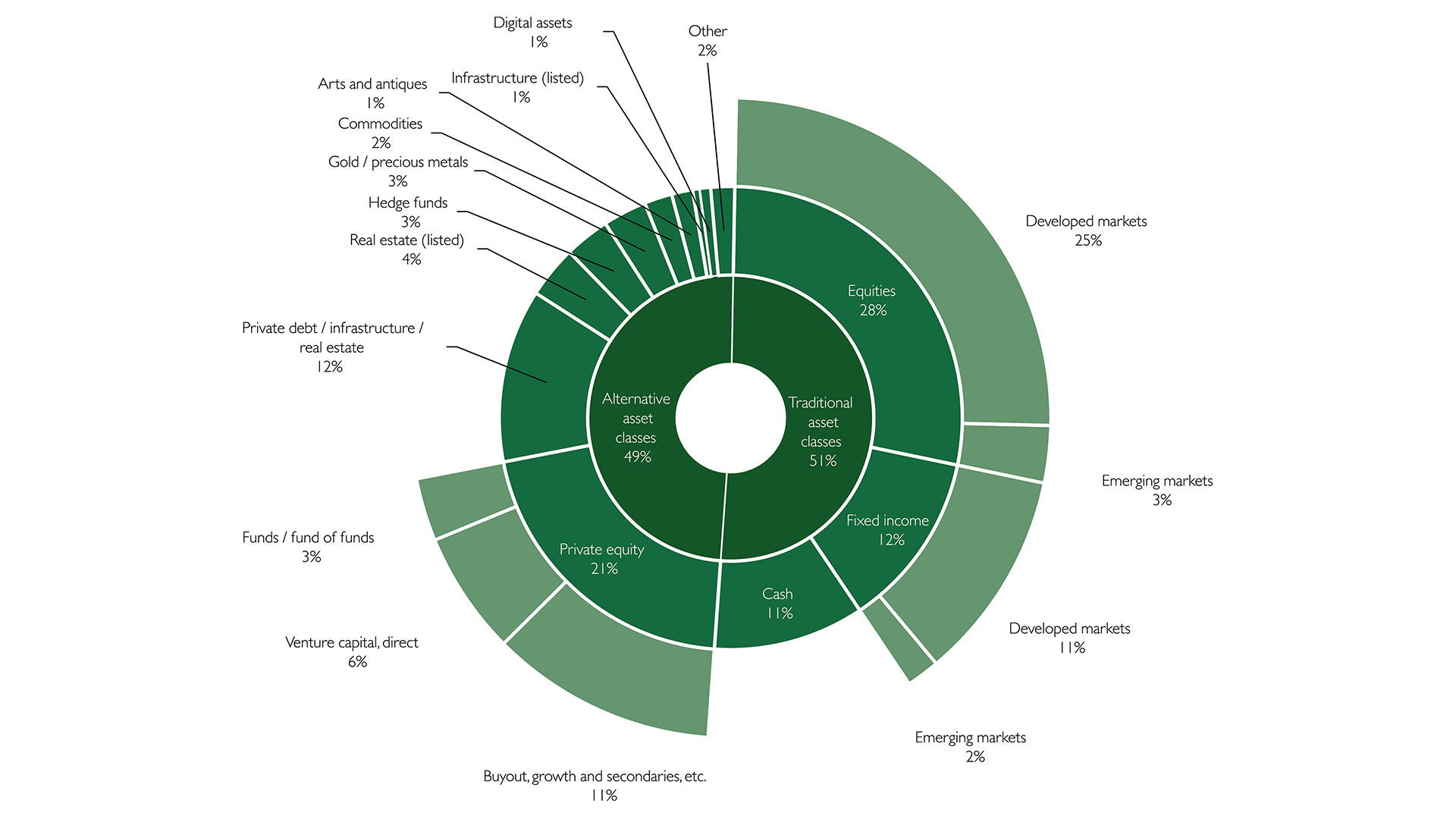
On average, asset allocation among SFOs is split roughly equally between traditional and alternative investments. In the former case, these consist of equities and equity investments (28 per cent) and fixed-income securities (11 per cent) – both predominantly in developed markets – as well as cash (11 per cent). Alternative investments are more broadly diversified, comprising private equity (21 per cent), private debt, infrastructure and real estate (12 per cent), as well as hedge funds, precious metals, commodities, and art and antiques, amongst others. The biggest changes from 2023 to 2025 are a reduction in venture capital of around 6 per cent, whilst listed equities from developed countries increased by 5 per cent. This is an expected development, given the stock market environment of the last two years, and one that, according to the study, is likely to become more pronounced in 2026. A “home bias” is evident here.
33 per cent of SFO investments are in Switzerland. This is the largest share alongside North America (also 33 per cent). Western Europe follows with 23 per cent, whilst Asia-Pacific (excluding China) accounts for just 6 per cent. “The strategic investment priorities of Swiss SFOs demonstrate a balanced relationship between caution and growth,” says Markus Schmid. “The focus is on capital preservation through an acceptable risk-return profile.”
Assets under management by SFOs range from less than CHF 250 million to over CHF 10 billion. The median stands at around one billion Swiss francs. Most SFOs comprise one or more family businesses, with real estate (34 per cent), hospitality and catering (16 per cent) and consumer and luxury goods (16 per cent) among the most important sectors. Around half of the assets under management (approx. 450 million Swiss francs) are tied up in these family businesses. The study is based on estimates suggesting that the companies controlled by all Swiss single-family offices employ over 650,000 people worldwide. However, a small number of above-average-sized family businesses account for the majority of these. Over 50 per cent of the family businesses managed by SFOs have 10 or fewer employees in Switzerland and fewer than 200 abroad. On average, the ratio of jobs in Switzerland (233) to those abroad (2,713) is just under 1:12.
Had voters approved the inheritance tax in November 2025, this would likely have sent shockwaves through the sector. Indeed, 48 per cent of the SFO firms surveyed stated that their owner families had evaluated scenarios for relocating in the event of a “yes” vote. 15 per cent of these had already developed concrete plans. Other 5 per cent of SFO had already relocated in anticipation of the referendum. Furthermore, asset structures were optimised and succession timelines defined. Consideration was also given to lifetime gifts, early business transfers or the establishment of foundations and trusts. Family offices have therefore positioned themselves proactively so as to be able to react to political decisions should the need arise. It can thus be assumed that inheritance tax would have led to a noticeable outflow of wealth from Switzerland.
The study was conducted for the second time since 2024. The researchers evaluated responses from 82 family offices, representing around 27 per cent of the estimated 300 family offices in Switzerland. The study by Professor Markus Schmid and Dominik Redemann of the Swiss Institute for Banking and Finance SBF-HSG at the University of St.Gallen was produced in close cooperation with UBS Global Wealth Management and the Swiss Single Family Office Association (SFOA).
Download the study "The Swiss Single Family Office Landscape"
Photo: Zug Tourism, Martin Bissig
Weitere Beiträge aus der gleichen Kategorie