Research - 28.07.2026 - 08:00
At what stage should children in the Swiss education system be streamed into different educational pathways? This question has been a focus of attention for politicians, schools and educational researchers for years – and is becoming increasingly important in light of discussions on equal opportunities, skills shortages and the need for well-qualified workers in Switzerland.
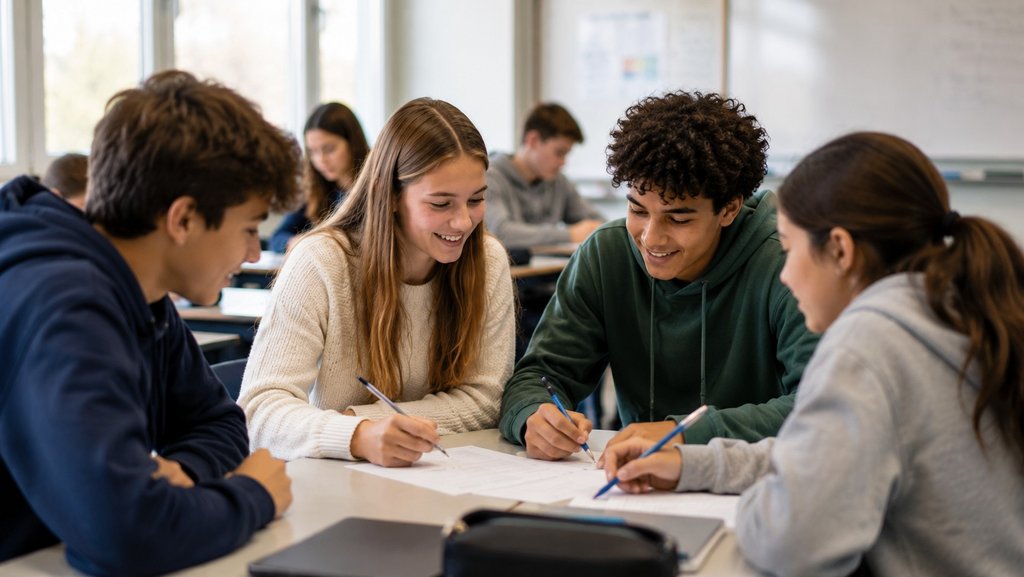
A new study by the University of St. Gallen (HSG) now provides empirical evidence that academic achievement and equality of opportunity need not be mutually exclusive. On the contrary: if classes at secondary level are mixed across ability levels, whilst pupils continue to be taught in the core subjects according to their ability level, it is young people from less advantaged backgrounds who benefit most. Young people from socio-economically disadvantaged families benefit just as much as their higher-achieving classmates.
“The results show that individualised curricula and mixed-ability classes can complement each other effectively,” says study author Valentina Sontheim of the Swiss Institute for Empirical Economic Research (SEW-HSG). “Pupils from less privileged families, in particular, gain better educational opportunities as a result.”
The study is based on a school reform implemented in the canton of Neuchâtel in 2015. Prior to the reform, secondary school pupils in the canton of Neuchâtel were assigned to completely separate classes according to their ability level, as is also the case in many other cantons. Following the reform, only French and mathematics remained streamed by ability. In all other subjects – accounting for around two-thirds of teaching time – pupils of different ability levels learn together.
Crucially, neither the financial resources nor the number or qualifications of teaching staff were altered. Performance assessments also remained unchanged. This allows the impact of the new class organisation to be examined with particular precision. For her analysis, Sontheim used register data containing all pupils in Switzerland between 2012 and 2022 and compared developments in Neuchâtel with those in cantons that continued to adhere to the traditional system in a difference-in-differences framework.
The results are clear: overall, the probability of starting a general education programme that enables access to tertiary education has risen by around ten percent. The probability of successfully graduating from this programme with a gymnasium or vocational matriculation certificate has also increased.
Young people whose parents do not hold a tertiary education or who did not grow up speaking the regional national language benefit particularly strongly. For pupils who meet both of these criteria, the reform actually increases the likelihood of pursuing further education by more than a third. At the same time, the analyses shows no evidence that high-achieving pupils suffer as a result of the more mixed classes. On the contrary, they too achieve slightly better educational outcomes.
The study makes it clear that it is not only individual support that is crucial, but also the social learning environment. Following the reform, young people from different social and linguistic backgrounds spend significantly more teaching time together. It is precisely this greater mixing that appears to contribute significantly to reducing educational inequalities.
The findings form part of a growing body of research at the University of St. Gallen. HSG economist Beatrix Eugster and Professor at the University of St.Gallen has for years emphasised the importance of socially mixed classes for fair educational opportunities: "Diverse classes ultimately benefit all pupils." The new study now provides robust empirical evidence of the conditions under which this effect actually occurs.
In Switzerland, the organisation of secondary education is the responsibility of the cantons. Consequently, the models of academic selection vary. However, the study shows that reforms do not necessarily require additional financial resources to be effective. Simply reorganising the way lessons are structured can improve educational opportunities. Particularly for young people such as pupils whose parents are not tertiary educated or whose first language is French, German, Italian or Rumantsch.
The findings are therefore likely to be of interest to other cantons that are currently reviewing their transition and selection models. They provide a scientifically sound basis for addressing the question of how individual support and equality of opportunity can be better combined.
Title: Locked-in vs. Locked-out: Detracked Classes, Individualized Curricula, and Educational Inequality
Author: Valentina Sontheim, Swiss Institute for Empirical Economic Research (SEW-HSG), University of St. Gallen
Method: Analysis of register data for all pupils in Switzerland (2012–2022). The school reform in the canton of Neuchâtel was examined using a difference-in-differences approach.
Key findings:
• More mixed-ability classes increase the chances of all young people progressing to further general education
• Young people from socio-economically disadvantaged families, as well as pupils whose first language is not the regional national language, benefit particularly
• High-achieving young people and those from socio-economically better-off families do not suffer any disadvantages.
• The reform was implemented without the need for additional teaching staff or increased financial resources.
More articles from the same category
This could also be of interest to you
Discover our special topics