The MIA curriculum combines and integrates perspectives from political science, economics, business administration, and law.
Moving beyond the classic distinctions of the four core disciplines and promoting integrated thinking, critical analysis and holistic learning, our multi-disciplinary programme is centred around four arenas, in which change-making individuals meet and decisions are taken. Through innovative graduate courses, you will be prepared for your role as future leaders in these arenas:
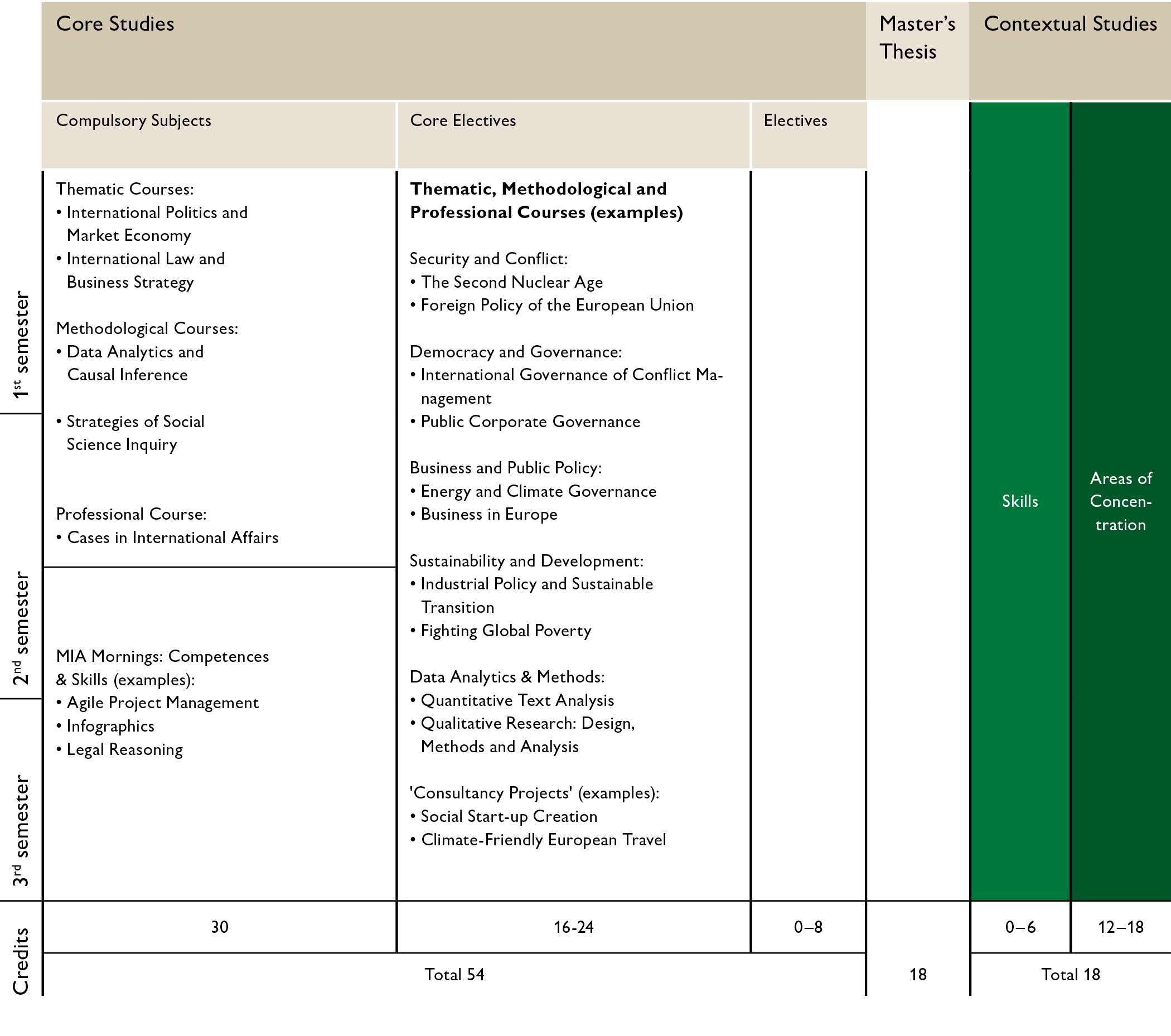
Being structured around three pillars – thematic, methodological, and professional – the MIA programme comprises six compulsory subjects, covering central concepts, issues, and skills in International Affairs.
The MIA offers a diverse and flexible range of elective core courses that allow you to pursue your personal interests and develop your own academic and professional profile. The MIA’s electives (24-36 ECTS) are structured around the same three pillars and serve to deepen the thematic, methodological and practice-oriented subject knowledge acquired in the compulsory courses.
The independent electives (up to 8 ECTS) can be completed with courses from other master’s programmes or with additional MIA core electives.
The two core courses combine theory and empirical research with a focus on investigating challenges in international affairs. They are designed to provide you with a common scholarly orientation in the four arenas Polities, Markets, Firms, and Courts.
| Course | ECTS | Lecturer | Language | Semester |
| International Politics and Market Economy Lecture + Tutorials | 6 | Prof. James Davis, PhD. Prof. Dominik Sachs, PhD. | EN | Autumn |
International Law and Business Strategy | 6 | Prof. Winfried Ruigrok, PhD. Prof. Dr. Thomas Burri | EN | Autumn |
This course offering corresponds to the current planning status. You can find the entire course offering in the Course Catalogue.
The two core courses cover social science research techniques (qualitative and quantitative) and teach relevant data science tools. You will acquire critical expertise regarding their relevance and the quality of data used.
| Course | ECTS | Lecturer | Language | Semester |
| Data Analytics and Causal Inference Lecture + Tutorials | 6 | Prof. Beatrix Eugster, PhD. | EN | Autumn |
Strategies of Social Science Inquiry | 6 | Prof. Dr. Patrick Emmenegger | EN | Spring |
This course offering corresponds to the current planning status. You can find the entire course offering in the Course Catalogue.
The two core courses focus on the practical application of the material studied in the first two pillars. They combine academic and practitioner perspectives and help you make connections between disciplines. The case-based and problem-oriented teaching will help you develop your analytical and integrated thinking skills as well as reflective judgment.
In the MIA Mornings workshops you will gain specific skills and competences, closing potential disciplinary, methodological and professional gaps. Examples of workshop topics include "Legal Thinking", “Data Handling” or “Foundations of Project Management”.
| Course | ECTS | Lecturer | Language | Semester |
| Cases in International Affairs | 4 | Prof. Elsa Massoc, PhD. | EN | Spring |
MIA Mornings: Skills and Competencies* | 2 | various | EN | Autumn & Spring |
This course offering corresponds to the current planning status. You can find the entire course offering in the Course Catalogue.
This cluster focuses on traditional International Affairs topics such as conflict prevention, peace enforcement, nuclearisation, trade wars, humanitarian intervention, international criminal tribunals, and refugee crisis management but also on foreign policy of nation-states and external action of regional or international organisations. Topics such as diplomacy but also the (global) private security market and cybersecurity are included, too.
This cluster seeks to understand the foundations of democratic and responsive decision-making at various levels, be it in the realm of politics or business. Courses tackle related topics, such as authoritarianism, corruption, digital democracy, corporate management, electoral integrity, citizenship, arms trade, and (global) justice.
This cluster addresses the complex nexus of economic conditions and trends, international and national politics and institutions, business and financial interests and civil society. It focuses on international trade relations and more specifically on the international flow of goods, services, and production factors, which capture migration and international capital flows. Public policy issues such as tax competition and evasion are also addressed.
| Course | ECTS | Lecturer | Semester |
| Industrial Policy and Sustainable Transition | 4 | Massoc, Elsa Clara, Prof. PhD. | Autumn |
| Political Economics | 4 | Hodler, Roland, Prof. Dr. | Autumn |
| International Econimic Law | 4 | Ziegler, Andreas, Prof. Dr. | Autumn |
| Geopolitics and Business Strategy | 4 | Albino-Pimental, João, Prof. PhD., Massoc, Elsa, Prof. PhD. | Autumn |
| World Trade Law | 4 | Delimatsis, Panos, Prof. Dr. | Autumn |
| Asia Compact: International Management in the New Asia Pacific | 4 | Ambos, Björn, Prof. PhD. | Autumn |
| Asia Compact: Social and Sustainable Entrepreneurship in Singapore and South-East Asia | 4 | Bergmann, Heiko, Prof. Dr. | Autumn |
| Business Regulation and Advocacy | 4 | Gava, Roy, Prof. PhD. | Autumn |
| Political Economy of Welfare and Work | 4 | Emmenegger, Patrick, Prof. Dr. | Autumn |
| Rethinking Organizations in a Complex World | 4 | Blagoev, Blagoy, Prof. Dr. | Autumn |
| Economics of Central Banking | 4 | Kondziella, Markus, Prof. PhD. | Spring |
| Politics of Financial Regulation | 4 | Gava, Roy, Prof. PhD. | Spring |
| Blockchain Markets | 4 | Haefner, Samuel, Dr. | Spring |
| Organizational Economics | 4 | Hoffmann Magnus, PhD. | Spring |
| Dynamics of Government and Non-Government Organisations | 4 | Schedler, Kuno, Prof. Dr. | Spring |
| Drivers and Consequences of Trust | 4 | Weibel, Antoinette, Prof. Dr. | Spring |
| Beyond Homo Oeconomicus | 4 | Kolmar, Martin, Prof. Dr. | Spring |
| International Macroeconomics | 4 | Wolf, Martin, Prof. PhD. | Spring |
| International Trade in a Fragmenting World | 4 | Föllmi, Reto, Prof. Dr. | Spring |
| Public Policy, Taxation and Inequality | 4 | Sachs, Dominik, Prof. PhD. | Spring |
| Urban Economics | 4 | Rauch Ferdinand, Prof. PhD. | Spring |
| Climate Change Course and Model UNFCCC | 5 (!) | Vuichard, Pascal, Dr. | Spring |
| Grand Challenge: Corporate Sustainability Management | 4 | Ströhle, Judith, Prof. PhD. | Spring |
| European Financial Law | 4 | Grünewald Seraina, Prof. Dr. | Spring |
This cluster considers the economic, political, social and environmental dimensions when addressing development and sustainability issues, including (economic) growth, environmental problems such as climate change, health, fair trade, social entrepreneurship, corporate social responsibility, foreign aid, and sustainable consumption. Issues pertaining to intellectual property are viewed as an integral part of development, too.
These courses aim to strengthen your methodological competencies, equipping you with the skills needed to thrive in an increasingly data-driven world. They focus on advanced data science and research design skills. You may complete up to four courses in this pillar, but there is no minimum requirement.
| Course | ECTS | Lecturer | Semester |
| Text-as-Data | 4 | Gava, Roy, Prof. PhD. | Autumn |
| Database Systems for Business Analytics | 4 | Venturini, Marco, PhD. | Autumn |
| Learning with Big Data | 4 | Grigoryeva, Ludmila Prof. PhD. | Autumn |
Courses within this pillar are designed as "consultancy coursies" and allow you to work on real-life problems and translate your disciplinary knowledge into practice while cooperating with relevant practitioners and potential future employers. You attend between one and three professional courses.
| Course | ECTS | Lecturer | Semester |
| Rebuilding Security in Europe | 4 | Hänggi, Heiner, Prof.Dr., Greminger, Thomas, Dr. | Autumn |
| Geopolitical Consulting | 4 | Emmenegger, Patrick, Prof.Dr., Blenk, Timo, Dr. | Spring |
| EU External Relations | 4 | Lehmkuhl, Dirk, Prof. PhD., Albani, Martin, M.A. | Spring |
| Course | ECTS | Lecturer | Semester |
| Financial Regulation | 4 | Gava, Roy, Prof. PhD. | Autumn |
| Innovative Service Models im öffentlichen Sektor | 4 | Guenduez, Ali, Prof. PhD. | Spring |
| EU External Relations | 4 | Lehmkuhl, Dirk, Prof. PhD., Albani, Martin, M.A. | Spring |
| Course | ECTS | Lecturer | Semester |
| Financial Regulation | 4 | Gava, Roy, Prof. PhD. | Autumn |
| Economic Crisis and Crisis Management | 4 | Andritzky, Jochen, Dr. | Autumn |
| Sustainability Consulting in the Age of AI | 4 | Thaler, Philipp, Dr. | Autumn |
| Innovative Service Models im öffentlichen Sektor | 4 | Guenduez, Ali, Prof. PhD. | Spring |
| Geopolitical Consulting | 4 | Emmenegger, Patrick, Prof.Dr., Blenk, Timo, Dr. | Spring |
| Responsible Banking | 4 | Gava Roy, Prof. PhD. | Spring |
| Course | ECTS | Lecturer | Semester |
| Economic Crisis and Crisis Management | 4 | Andritzky, Jochen, Dr. | Autumn |
| Sustainability Consulting in the Age of AI | 4 | Thaler, Philipp, Dr. | Autumn |
| Responsible Banking | 4 | Gava Roy, Prof. PhD. | Spring |
Courses offerred in Contextual Studies are complementary to your core studies and are awarded with 18 ECTS credits.
Contextual Studies is another key aspect of the programme's curriculum. It integrates knowledge across disciplinary boundaries and strengthens your social and cultural competencies in a special way. By taking courses offered in Focus Areas as well as in the Skills Area you will learn to think holistically and "outside the box". You will also learn presentation and negotiation techniques or programming languages. The cross-cultural and cross-social science programme courses offered in the focus areas are extremely diverse and can be tailored to the MIA degree programme. In the skills area, you will learn complementary competencies and practical skills needed for a successful carreer in the public and private sector.
The MIA is taught in English.
The MIA is a full-time programme with a standard duration of three semesters that is worth 90 ECTS credits. The study time can be extended up to eight semesters. The programme only starts in the autumn semester of each academic year.
Professorin für Umweltökonomie
Executive Director, International Affairs Programmes