Background - 17.07.2026 - 13:00
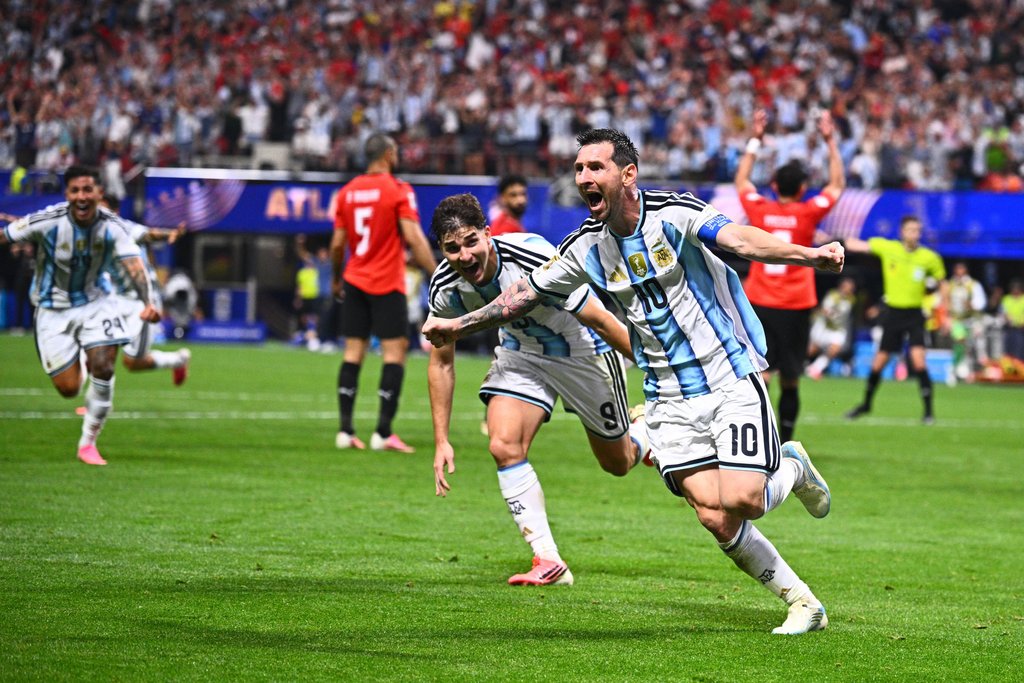
Argentina's route to a second successive Men’s World Cup final has been dogged by claims of favourable refereeing. A Video Assistant Referee (VAR) review overturned an Egyptian goal for a foul on an Argentinian defender in the build-up. Against Switzerland, VAR again reversed a call against Argentina, dismissing Swiss forward Embolo for simulation. Argentina have won every knockout tie narrowly, most recently edging England to reach the final. To a chorus online, this is by design: FIFA and president Gianni Infantino, the theory holds, have rigged the tournament to hand Messi and Argentina the trophy.
It is easy to dismiss all this as fantasy. But most conspiracy theories are not ludicrous narratives divorced from reality; they posit rather tempting, believable stories. More than half the American public, for instance, believes in conspiracy theories concerning JFK’s assassination; a near majority accept the core logic – that hidden groups orchestrate major events. Conspiracy theories provide comfort, meaning and agency: clean, accessible stories that assign culprits for events hard to understand or stomach. Claims of corrupt officiating are indeed common in football. In the 2002 Men’s World Cup, for instance, there were accusations that FIFA aided South Korea’s run to the semi-finals.
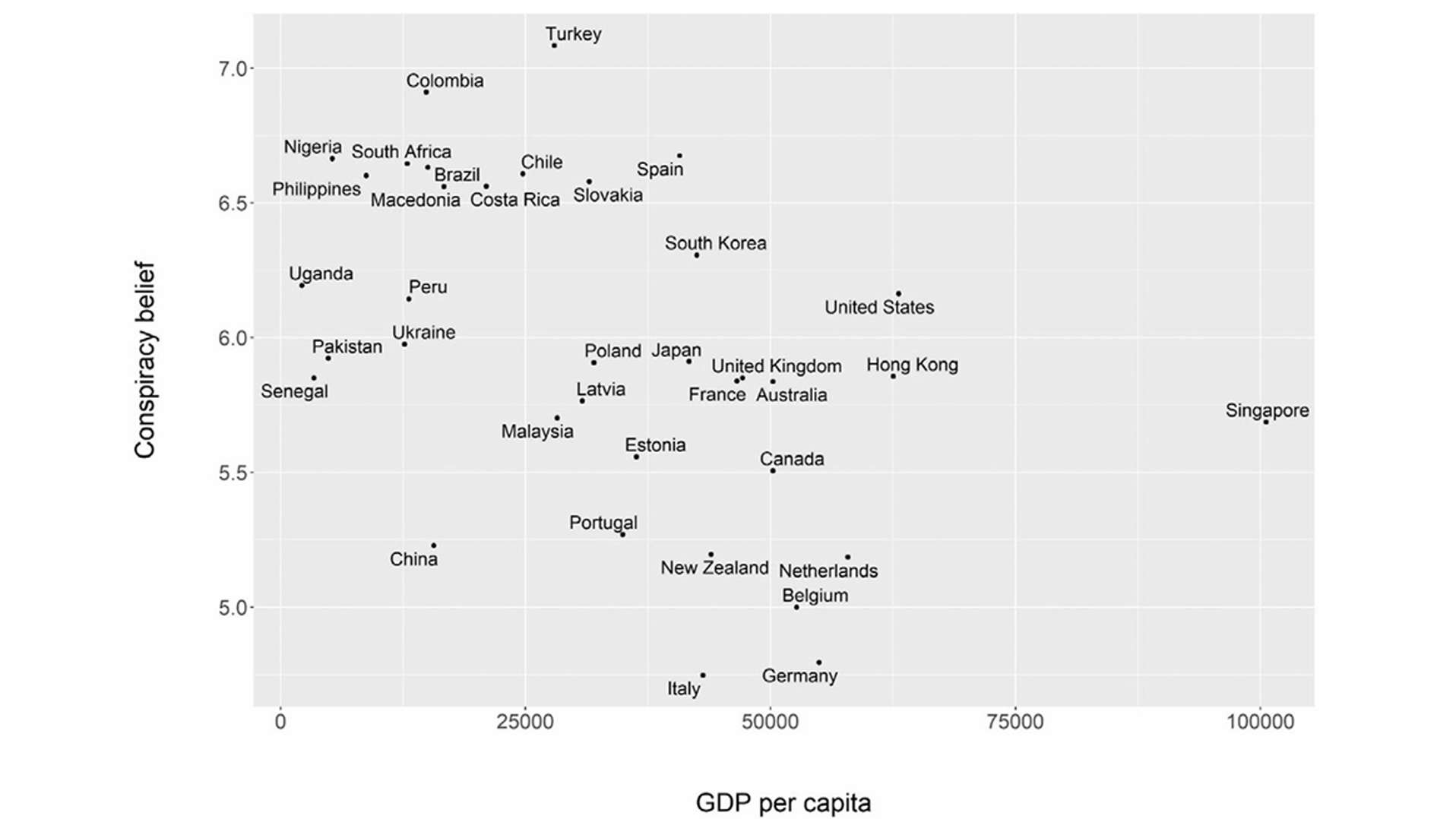
Conspiracy theories have conventionally been associated with psychological patterns of thinking: weaker analytical reasoning, and various cognitive biases and shortcuts. But conspiracist thinking varies across societies, and research increasingly links them to political conditions too. Among these are corruption, democratic quality, inequality, GDP per capita, and populism. A 2022 study reports that conspiracist thinking is more common in countries scoring higher on the Corruption Perceptions Index (CPI). Countries with higher GDP per capita also exhibit lesser conspiracy beliefs (Fig. 1, source: Hornsey et al., 2022).
Both accounts are compatible. Conspiracy beliefs are partly a function of how we reason. Political conditions, however, determine the fertility of their breeding ground. When institutions appear credibly corrupt or self-serving, political skepticism is heightened, rendering conspiracy theories more plausible, attractive, and palliative. They may be understood as messy generalizations based on gut feelings containing a kernel of truth.
FIFA has engaged in a series of activities denounced as corrupt. In 2015, U.S. prosecutors indicted 14 FIFA officials for racketeering, fraud and money laundering, alleging bribes exceeding $150 million. Swiss authorities opened a parallel investigation into FIFA’s decision to award the 2018 and 2022 tournaments to Russia and Qatar; then President Sepp Blatter was subsequently banned from football.
The suspicion runs deeper still, as the FIFA Men’s World Cup has never been politically neutral. Mussolini’s fascist regime instrumentalized the 1934 tournament, hosted in Italy, to project the image of a resurgent, muscular nation. The 1978 edition was staged by an Argentine military junta amid its 'Dirty War', as thousands were tortured and disappeared. Argentina's 6-0 win over Peru – a game they needed to win by a four-goal margin – represents one of the sport's most enduring suspicions of a fix. More recent tournaments in Russia (2018) and Qatar (2022) revived familiar concerns over 'sportswashing' – the use of a global spectacle to launder a state's reputation. The 2026 edition, co-hosted by a U.S. mired in domestic and geopolitical controversies, fits squarely within this troubled lineage.
This backdrop heightens people’s receptivity to conspiracy theories. Trump, adding fuel to the fire, lobbied FIFA to overturn US forward Balogun's red-card suspension – a privilege rarely extended in the sport.
For many, this likely confirmed the logic underlying the narrative: the political actors overseeing the 2026 World Cup are corrupt. The inferential leap thus narrows: since FIFA and the U.S. are corrupt, it is likely they are colluding to further Argentina’s run in the World Cup. The most recurrent motive for this appears to be financial – keep Messi in the tournament, boost revenue. Less discussed variants run more baroque, tying the alleged plot to a Trump–Milei–Netanyahu axis and the geopolitics of the war in Gaza.
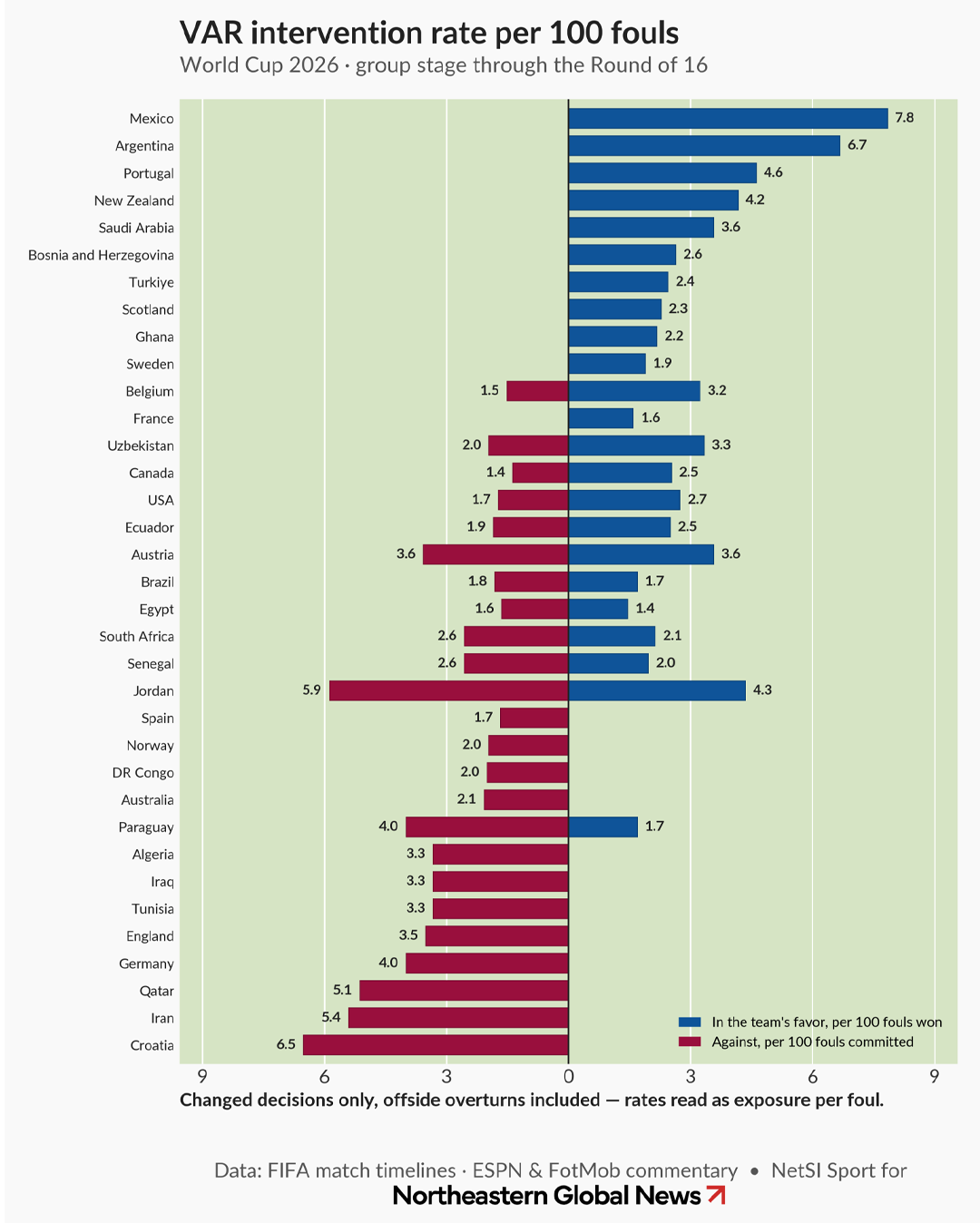
VAR – football's enforcement body – looms large here. A graphic visualizing the rate of favourable-to-unfavourable VAR interventions has since gone viral (Figure 2, source: NetSI Sport); Argentina ranks second and only below co-host Mexico.
Though successful in other sports, VAR's arrival in football has been immensely controversial. Unlike line calls in tennis or baseball, football's most consequential VAR decisions still hinge on human judgement, exercised in a closed room shielded from the public eye – which only feeds the suspicion baked into the conspiracy theories it fuels.
Taken together, these explain why this World Cup has drawn such a web of charged conspiracy theories. Differences in how people reason may act as the immediate trigger, but as long as the institutions at the heart of the game appear self-serving and unaccountable, they will keep providing conspiracy theories their kernel of truth. Until this changes, such narratives are likely to keep re-emerging.
Pradeep Krishnan is a doctoral researcher at the School of Economics and Social Sciences (SEPS-HSG).
Photo: Copyright Keystone
Weitere Beiträge aus der gleichen Kategorie
Das könnte Sie auch interessieren