Research - 25.06.2026 - 16:00
Rising uncertainty, rapid technological developments and the use of artificial intelligence (AI) are fundamentally transforming companies. Many organisations are responding by increasing the pace of work and intensifying performance pressure. For their leaders, this means greater control, higher targets and, ultimately, hopefully greater success. Yet this path often leads into the so-called “acceleration trap” where performance rises in the short term. At the same time, exhaustion, disengagement and staff turnover increase. So how can sustainable peak performance be achieved without burning people out?
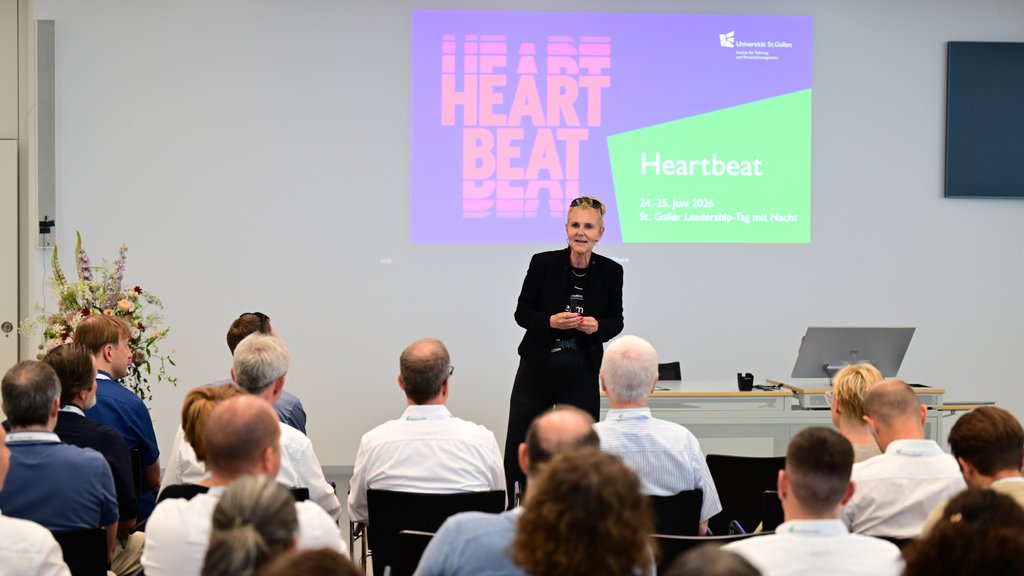
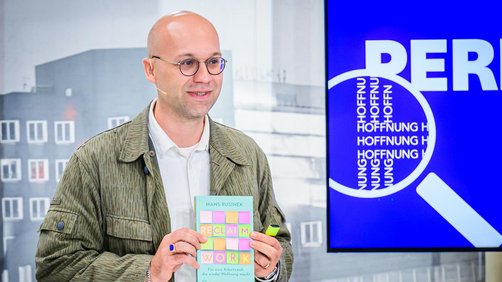
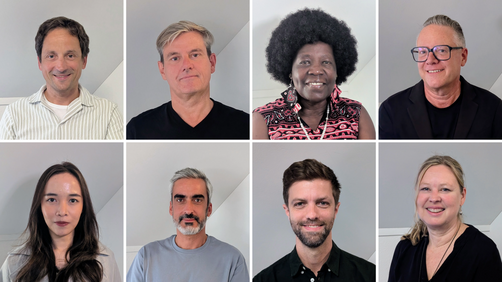
The 14. St.Galler Leadership-Tag and Night by the Institute for Leadership and Human Resource Management (IFPM-HSG) on 24 and 25 June 2026 clear “heartbeat” is maintained when companies manage pressure together with their staff – rather than at their expense. Alongside Adi Bucher, Prof. Franziska Severin, Norbert Janzen, Dr Cedric El-Idrissi, OLY, Kay von Mérey, Prof. Simone Kauffeld and Lukas Görtler, leading figures from business, academia and sport discussed what makes organisations innovative and successful. Research by Prof. Dr. Heike Bruch and Marvin Neu based on a longitudinal study involving data from over 160 companies and 28,000 employees, identifies companies that consistently combine high performance with high energy levels and healthy employees.
“Productive energy is characterised by high intensity and quality, whilst maintaining a pleasant working atmosphere,” said Heike Bruch in her keynote speech. The question of “collective energy” in organisations has occupied her since the start of her academic career. Since then, she has carried out numerous research projects on the subject and built up a comprehensive database. “The proportion of high-energy organisations has fallen sharply since 2022,” as she demonstrates using the data. How can this figure be raised again? Leadership is key. “Yet many managers are currently exhausted, becoming disengaged from their work or no longer wishing to lead.” Heike Bruch identifies the greatest shortcomings in the areas of focus (on what matters most) and letting go (stop doing). Managers must create space for employees, not in the sense of “laissez-faire”, but with clear goals and responsibilities.
Top performance begins with trust: this was the conviction expressed by speaker Franziska Severin during her talk “Applause is no coincidence”. The professor of opera at the Stuttgart University of Music and Performing Arts said: “Whether on the opera stage or in a company: people only reveal their potential when they are allowed to make mistakes and experimentation is not penalised.” Structure, she argued, is not an obstacle but a prerequisite for emotional expression: according to Severin, clear roles, expectations and boundaries lay the foundation for creativity and authenticity.
Ambiguity, on the other hand, breeds uncertainty: “Ambiguity saps energy and conveys no credibility.” Severin views leadership as a matter of creating resonance. People always orient themselves towards the strongest energy in the room – regardless of whether it is constructive or destructive. That is why, both on and off stage as well as within organisations, the following applies: “The audience is more likely to forgive mistakes than emotional detachment.” Authenticity and presence are more effective than perfection.
Recent research by the IFPM-HSG shows that successful companies do not primarily focus on increasing their resilience, but rather specifically design their organisation in such a way as to strengthen motivation, collaboration and performance.
Three factors are crucial in this regard:
“Today, more than ever, leadership determines whether companies unleash energy or drain it,” says Heike Bruch. Taken as a whole, high-energy companies have a system that reduces friction and excessive demands, provides relief and creates the conditions for positive energy. Key starting points include well-established hybrid working, avoiding silos and excessive centralisation, and the effective management of the AI transformation. In his research presentation, IFPM-HSG expert Marvin Neu added: “Charismatic leadership is not an innate talent, but a skill that can be learnt. However, it is not the individual leader who is decisive, but the system behind them: inspiring leadership has the greatest impact where companies build trust, enable flexibility and actively foster positive energy.”
The proportion of high-pressure companies has risen sharply in recent years. However, around half of companies are in an undefined mode, showing signs of an initial acceleration trap but, so far, little negative energy. For them, there is an opportunity to develop purposefully towards a high-energy mode. This is a leadership task that is increasingly becoming a core responsibility. The pressure is here to stay. Marvin Neu summarises: “Rather than training individual people to cope with stress and build resilience, the focus will increasingly be on changing working practices and systems and consciously choosing between high-energy or high-pressure mode.”
Research by the IFPM-HSG clearly shows that the success of AI implementation depends less on the technology than on culture and leadership. Companies that use AI successfully have a clear strategy, invest in digital skills and create an environment in which employees can try out new applications. Managers play a key role in this by providing guidance and actively supporting the change process. These findings are consistent with another recent study on “AI and Cultural Change” by Heike Bruch, Anna Stolle und Mara Jordan.
The Employer Attractiveness Trend Barometer, focusing on Germany, shows that the introduction of AI is primarily a leadership and cultural challenge. Trust, a willingness to learn and a corporate culture that enables innovation are crucial. Technology alone does not transform an organisation. “AI only realises its full potential when people are prepared to work together to further develop their working methods,” says Heike Bruch. This is the case at SBB, as demonstrated by Adi Bucher, Head of HR and a member of the Group Executive Board: when it comes to AI, SBB aims to explore, experiment and develop within its core ‘rail’ business. For standard processes, on the other hand, the focus is on tried-and-tested market solutions. To manage the change, “AI Business Partners” support SBB staff in testing and implementing AI solutions. “After all, there are no one-size-fits-all solutions. We must invest time and give staff the opportunity to gain experience with these applications,” concluded Adi Bucher.
Alongside AI strategy and employee empowerment, “digital leadership”is also crucial. This means that managers see themselves as drivers of digital transformation, recognise specific opportunities and risks, develop a clear digital vision for their area, continuously identify the need for change, and keep an eye on the impact of AI on staff. “In high-performing companies, this applies to at least a third of managers; in others, the figure is significantly lower,” said Heike Bruch.
The differences are particularly pronounced among the younger generation. Whilst Generation Z employees in high-pressure companies are significantly less likely to identify with their employer and are more frequently emotionally exhausted, high-energy companies are far more successful at retaining young talent in the long term and boosting their motivation. “The future of work is determined not by the number of new tools, but by the quality of collaboration,” emphasises co-author and IFPM-HSG researcher Marvin Neu.
The findings illustrate that sustainable competitiveness depends less on short-term efficiency than on the ability to build organisational energy. Companies that consider culture, work organisation and technological transformation as a unified whole create the conditions for innovation, performance and well-being.“The key management task today is to consciously steer companies from ‘high-pressure’ mode into ‘high-energy’ mode,” summarises Heike Bruch. “The crucial point here is that energy is not a solitary endeavour. It arises where people work together to develop a shared sense of direction, responsibility and confidence.” Lukas Görtler, captain of FC St. Gallen, also emphasised in his talk that successful teams are built on shared responsibility. “If leadership rests solely on one person, it leads to dependency and passivity. Our aim is to empower our teammates – because leaders create leaders, not followers.”
Zurich City Hospital and the two companies Flaconi and Schaeffler were awarded the 2026 St. Gallen Leadership Award. They were chosen by the audience via live voting during the event. The jury members praised, for example, the exemplary role played by senior managers, as well as the tangible values and sense of community amongst the workforce across different sites and hierarchical levels.
More on this topic can also be found in the July issue of the Personalmagazin in the article “Heartbeat – Between high-performance energy and the spiral of pressure” by Heike Bruch and Marvin Neu. Furthermore, a cover story in SPIEGEL (featuring an interview with Heike Bruch, «Raus aus der Komfortzone») highlights the far-reaching changes in the labour market.
Picture: Sandra Blaser
More articles from the same category
This could also be of interest to you
Discover our special topics