Background - 28.08.2026 - 10:00
The hot summer of 2026 shows just how vulnerable the infrastructure on which our economy relies really is. This is particularly evident on the Rhine: historically low water levels are severely restricting the loading of cargo ships; a disruption to the uninterrupted freight link between Switzerland and the North Sea has become a realistic scenario. For Switzerland, this is not a distant German problem. Around ten per cent of imports reach the country via the Rhine ports in Basel-Kleinhüningen, Birsfelden and Muttenz. Energy sources, food and animal feed, building materials, raw materials and containers reach Switzerland via this key supply route. In 2025 alone, the volume of goods handled by waterway transport amounted to 4.7 million tonnes.
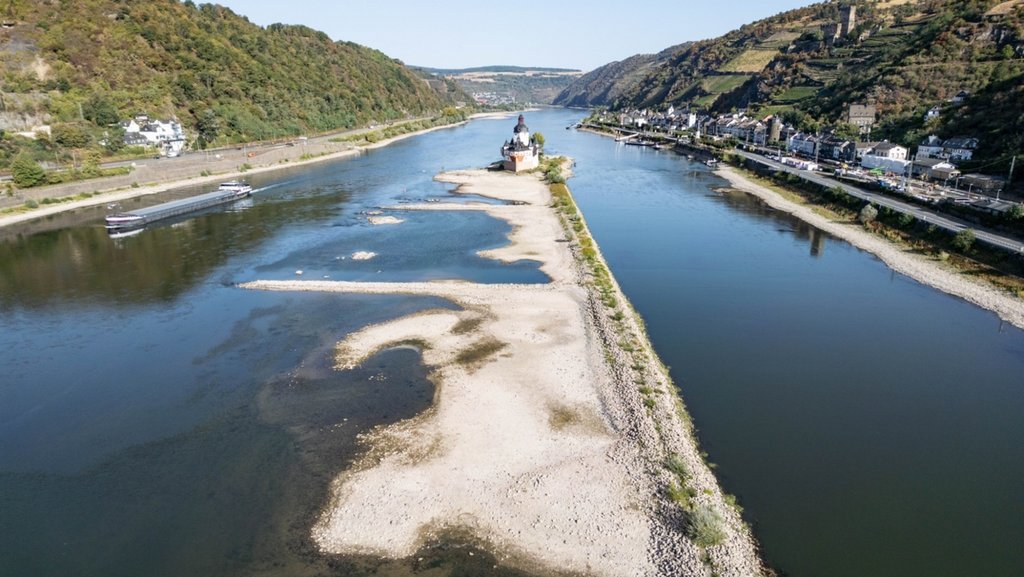
Restrictions on freight transport began long before this year. When the water level falls, ships must reduce their draught and thus their cargo. In August 2026, ships on parts of the Rhine were at times loaded to only around one-fifth of their usual capacity. At the bottleneck near Kaub, there was at times a risk of the Rhine effectively being "split in two", thereby severing the uninterrupted link between the North Sea ports and the Upper Rhine. For supply chains, it is not just a question of whether a ship can still sail, but how much transport capacity remains along the entire corridor. If significantly more ships are required to carry the same volume of goods, costs rise – until there are simply not enough additional ships available.
2018 demonstrated the economic consequences that low water levels can have. According to calculations by the Kiel Institute for the World Economy, German industrial production falls by around one per cent if the water level at Kaub remains below 78 centimetres for 30 days.
In November 2018, the impact reached around 1.5 per cent. Raw materials and intermediate products at the start of industrial value chains are particularly affected. In 2018, BASF had to reduce production at its Ludwigshafen site after the supply of raw materials by ship had almost grounded to a halt for much of the third and fourth quarters. The company estimated the impact on earnings at around 250 million euros. The connection behind the headline is therefore to be taken quite literally: if the water level falls, transport capacity decreases. If this results in a shortage of raw materials and intermediate products, production output falls and, ultimately, so does economic output.
Part of the lost shipping capacity can be shifted to rail and road. However, the reserves for alternative transport routes are limited. On the roads, vehicles and drivers must be available; on the railways, free train paths, locomotives, wagons, train drivers and transhipment capacity are required. If large volumes are shifted simultaneously across an entire corridor, many companies will compete for the same resources.
The scale of this is illustrated by a comparison with a single vessel: typical Rhine vessels can carry around 3,000 tonnes of cargo – roughly the same as 120 fully loaded lorries, each with a payload of 25 tonnes. At the same time, considerable volumes are in transit every day: on the Lower Rhine near Emmerich, close to the German Dutch border, around 105,000 cargo vessel passages were recorded in 2024 – an average of just under 290 per day. On the Upper Rhine between Basel and Karlsruhe, there were a good 50 passages per day. Rail and road can absorb part of these volumes, but a complete replacement of Rhine shipping is hardly possible in the short term.
In addition to available capacity, economic viability also sets limits. This is because the less a ship can carry and the more it has to rely on scarcer alternatives, the higher the transport costs rise. In the case of bulk goods with a comparatively low value, the economic breaking point may be reached before transport becomes physically impossible. In the summer of 2026, the first steel and chemical companies reported production and logistics constraints – due to a lack of raw materials, limited transport options or sharply rising costs. Low water levels therefore do not become a problem only when transport becomes physically impossible: the economic breaking point may well have been reached beforehand.
In addition to alternative transport routes, the climate-resilient upgrading of existing infrastructure is therefore gaining in importance. On the Middle Rhine, the navigation channel is to be deepened by 20 centimetres in particularly shallow sections. During low water levels, this would enable an inland vessel to carry up to 200 tonnes more cargo. Such adaptations do not prevent extreme low water levels, but they can limit their impact on transport capacity. For Switzerland's national supply chain, therefore, the focus on critical infrastructure does not end at the national border. Its reliability also depends on how efficient and climate-resilient key transport corridors in other European countries are.
Heat and drought affect transport routes, water and energy supplies, the availability of raw materials and labour productivity – and thus the economic viability of businesses. The extent to which a company is exposed depends on the water and energy intensity of its production, the heavy and transport-cost-intensive intermediate products it requires, their origin, and its dependence on specific transport corridors. In the construction and agricultural sectors in particular, heat has a direct impact on productivity.
Bottlenecks propagate along the value chain. If a chemical company lacks a raw material, this will subsequently affect plastics, pharmaceuticals or machinery. In addition to higher transport and procurement costs, further costs arise from reduced plant output, underutilisation and restarting operations; delivery delays strain customer relationships. Maintaining additional stock therefore remains an important risk management measure. It can safeguard delivery capability, but increases capital tied up in stock and warehousing costs, thereby putting pressure on margins and competitiveness.
Reducing this situation to a choice between maximum efficiency and the highest possible level of redundancy is too simplistic. Small and medium-sized enterprises in particular cannot protect themselves against every possible disruption and must, at the same time, operate efficiently. They must make conscious decisions about which risks to take and where precautions are necessary – rather than being caught off guard by disruptions.
There are significant gaps here: according to the BME Logistics Study 2024, only 26 per cent of the companies surveyed have a dedicated function for supply chain risk management. Developing scenarios therefore remains a key task for company management. Critical dependencies must be identified – for suppliers and products as well as for transport corridors and modes of transport. Having two suppliers offers little security if both have to deliver via the same section of the Rhine. BASF illustrates what concrete precautionary measures can look like: following the low water levels of 2018, the company commissioned the development of a tanker capable of passing through Kaub with a cargo of around 800 tonnes even when the water level is just 30 centimetres.
Agent-based systems will, in future, run search, comparison and research processes in parallel and speed them up considerably. This will enable companies to assess disruptions more quickly and identify potential alternatives at an earlier stage. However, this acceleration does not apply solely to individual companies: the more coordination processes are automated, the faster available alternative options are recognised and sought after by many companies simultaneously. This does not result in additional rail capacity, lorries, transhipment capacity or alternative suppliers. In the event of a crisis, therefore, the pressure to make decisions increases when many companies simultaneously seek to switch to the same scarce alternatives. What matters then is not merely who analyses information the quickest, but who has already established, reviewed, approved and, where necessary, contractually secured potential courses of action in advance. A deliberately defined level of resilience is thus not merely a cost factor. It can determine whether a company remains able to deliver in the event of a disruption, turning this into a competitive advantage.
The heatwave of summer 2026 is more than just a snapshot. It demonstrates how closely climate, infrastructure and economic performance are interlinked. The key is not to predict whether the Rhine will reach extremely low water levels every summer in future. Rather, businesses and infrastructure operators must cope with a changed risk landscape. This applies particularly to Switzerland, given the Rhine's importance for supply chains. Businesses must be aware of critical dependencies and prepare realistic alternatives. At the same time, there is a need for efficient waterways, rail corridors, roads, ports and transhipment facilities.
Critical infrastructure often only becomes apparent when it no longer functions as usual. The Rhine will demonstrate this to us impressively in the summer of 2026. If water levels fall, GDP does not necessarily have to fall as well. Whether there are economic consequences – and how severe they are – also depends on how resilient we make our supply chains and the underlying infrastructure.
Image: KEYSTONE
More articles from the same category
This could also be of interest to you
Discover our special topics