Research - 09.10.2026 - 09:30
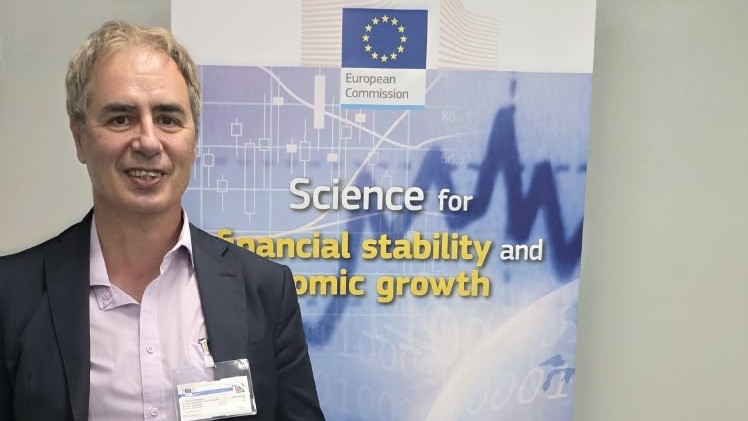
Europe faces a demographic challenge at a time when producing new knowledge is becoming harder for humans. Artificial intelligence could alter this equation in ways that reach far beyond automation. Prof. Dr. Guido Cozzi presented his research on this topic on 30 September 2026 at the European Commission’s Joint Research Centre in Ispra, Italy. In this interview, he explains how AI might influence research, technology and Europe’s long-term growth prospects.
What interested workshop participants most and how did the discussion unfold?
The discussion was very lively. What interested the European Commission most was the long-run potential of AI for growth, especially in an ageing Europe. We discussed whether AI can help compensate for a shrinking workforce and declining human research productivity by increasing the effective capacity of the research sector.
You relate population growth to the development of AI. What is the diagnosis of your study?
Europe faces two related problems: an ageing population and evidence that research is becoming harder for humans. Traditionally, fewer researchers would imply weaker innovation and slower growth. AI changes this picture because it can expand the effective capacity of the research sector even when the human workforce is no longer growing.
Your research considers economic growth, science, ideas and artificial intelligence. How are these factors related?
Economic growth depends fundamentally on new ideas. Science produces those ideas, and AI is increasingly becoming a tool of science itself. If AI helps researchers discover more, faster and better, it raises the economy’s technological level. And if this process becomes sufficiently powerful, it can also increase the rate at which knowledge grows.
Can you give a concrete example of this?
A good example is AlphaFold. Determining the three-dimensional structure of proteins traditionally required substantial experimental effort, time and highly specialized expertise. AI can now predict many protein structures much faster.
Scientists are still essential: they formulate the important questions, interpret the results and validate them experimentally. But AI allows each researcher to explore far more possibilities than before. Economically, this is exactly the mechanism we study: AI can multiply the effective productivity of research. The important point is not simply that AI replaces scientists, but that it can greatly expand what each scientist is able to discover.
What is the main message you would like European policymakers to take from your paper?
My main message is optimistic: Europe’s demographic decline does not have to mean economic stagnation. AI can raise the productivity of researchers, increase the level of technology, and in some cases also raise the long-run growth rate. Even without any “explosive” scenario, these gains would be economically very important for Europe.
How did you design your model, and which assumptions matter most for the results?
I start from a standard economic growth model in which researchers create new ideas and then introduce AI directly into the research process. The crucial question is how AI and human researchers work together. Even when they are complementary, AI can generate large technological gains. With greater substitutability and stronger feedback from knowledge to AI capability, the effects can become much larger still.
What should European policymakers prioritize while AI’s future research capabilities remain uncertain?
Europe should make sure that researchers, universities and firms have access to frontier AI tools, compute, data and skills. This is particularly important for Europe because AI can partly compensate for demographic weakness. A higher technological level alone can significantly improve Europe’s global competitiveness; faster technological growth would be an additional gain.
How do you see your role as a scientist advising the European Commission? Where can research help policy on AI and growth, and where are the limits of that advice?
My role is not to predict exactly what AI will be able to do in twenty years. It is to identify the economic mechanisms that matter and to show policymakers the consequences of different technological scenarios. Research can help Europe prepare early for opportunities that may have very large effects on productivity, innovation and long-run prosperity.
The interview draws on Guido Cozzi’s study “Can AI Sustain Long-Run Growth Amid Demographic Decline?” (papers.ssrn.com).
More articles from the same category
This could also be of interest to you
Discover our special topics