
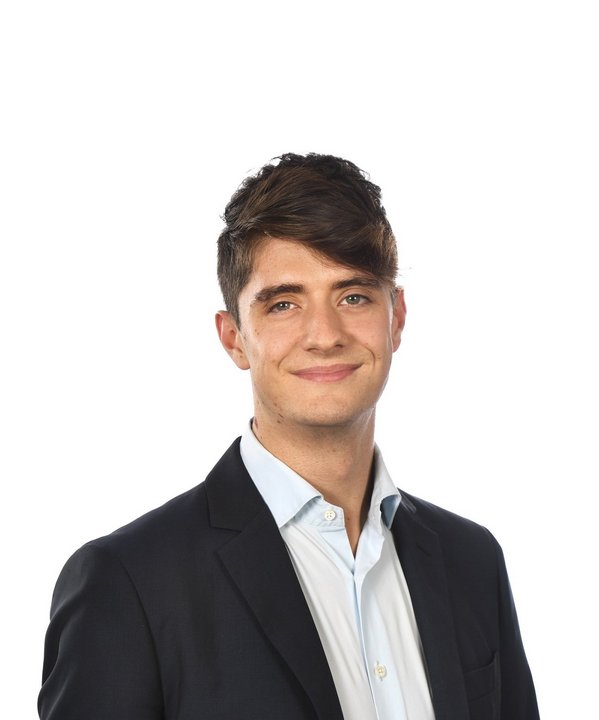
Could you briefly introduce yourself and tell us about your background before joining the MBF programme? What motivated you to pursue the MBF and the Double Degree Programme with Bocconi University?
I am Andrea Pellini, Co-Founder and CEO of wearefreemovers.com, the first global platform dedicated to free mover study abroad. Before the MBF I completed my bachelor at Bocconi University, which included an exchange semester at NUS Business School in Singapore. I chose Singapore on purpose, because its startup ecosystem was among the most advanced in the world and I wanted to understand a space that had fascinated me from the outside. There I took a venture building course, pitched my first startup idea to local venture capital investors through the group work, and had my first hands-on contact with entrepreneurship.
When it came to graduate studies, Switzerland drew me for the same reason. For years it ranked first in the world for innovation, and I wanted to be part of that ecosystem. At the time I was still deciding between two paths, founder or investor. The Double Degree was the perfect fit: the MBF at St. Gallen covered the finance and investment side, while Bocconi's International Management track covered the entrepreneurial side. Two programmes of real reputation that let me explore both directions at once.
Shortly after graduating, you co-founded wearefreemovers. What inspired you to launch the company, and what opportunity did you identify in the field of international student mobility?
For me it was a natural transition rather than a single decision. I wanted to test both sides of the startup world. Before the MBF I worked at a venture capital fund in Zurich, on the investor side. During my time at St. Gallen I worked at a venture builder, which sits between investing and building, and at the same time I was already developing wearefreemovers.com.
The opportunity became clear through our blog. We had launched the site years earlier because the free mover programme was becoming popular among students, yet almost no clear information existed online or from universities. One of our first pages simply explained the concept of a free mover, since that definition was hard to find anywhere at the time. Over the years it has become a widely referenced resource, appearing prominently in search results and cited by a number of universities on their own websites. The community grew quickly, and students kept asking for more universities and more features. Near the end of my MBF exams, universities started reaching out to partner with us formally, because they saw us as the reference point for this type of mobility. That demand, from students and institutions at the same time, is what made us incorporate.
wearefreemovers aims to simplify the free mover journey for students while helping universities expand access to international education. How has the company evolved since its founding, and what are some milestones you are particularly proud of?
We started as a passion project, a blog run by two brothers. Today we serve a community of more than 400,000 free mover students a year, and on the university side we reached around 100 partners in less than two years from incorporation. Convincing that many institutions, several of them with strong reputations, in such a short time is the milestone that surprised us most and pushed us to focus fully on this mobility.
The achievement I am proudest of is how we got there. We have never raised external investment. We reinvested our own capital, took calculated risks, and turned down funding that did not match the trajectory we wanted. The conventional route, the one most discussed during the MBF, is to raise venture capital and spend aggressively to grow fast. The MBF itself, the venture capital guest speakers it brought in, and my own work in the field helped me understand that the offers in front of us were not aligned with our vision. Growing without them turned out to be the healthier path for the company we want to build.
Looking back at your time in the MBF programme, what experiences, skills, or connections have been most valuable in your journey as an entrepreneur and CEO?
The guest speakers were the most valuable part. Many were relevant figures in the Swiss venture capital scene, and I could speak with them during the lectures and afterwards on a personal level. My thesis research extended that, because it let me interview several of these people directly. Those conversations, and the Swiss ecosystem they opened up, confirmed that this was the right place to build.
The courses themselves sharpened skills and an interest I had first discovered at NUS in Singapore. I chose the electives most focused on startups, which deepened both my knowledge and my conviction. Combined with my work in venture capital in Zurich, the MBF gave me a clear picture of how the Swiss startup and investment market worked, and that picture is a large part of why I decided to base the company here.
Building a startup comes with both opportunities and challenges. What has been the biggest lesson you have learned since founding wearefreemovers?
The biggest lesson is to not be afraid of taking an unconventional path. The bootstrapping route worried us at first, precisely because few people take it and it meant doing something different from our peers. Looking back, it was the right call.
The idea that a team of two founders could serve 400,000 students a year and 100 institutional partners, with no external capital and no additional headcount, could have stayed a fantasy. It became real. Following that calculated conviction, instead of the path everyone expected, is what gave us the freedom to grow in the direction we genuinely believed in. That freedom is now what lets us move to the next stage.
What advice would you give to MBF students who are interested in entrepreneurship or considering starting their own venture?
First, understand clearly what you want from your venture and which direction to take. Then do not be afraid to take a path that differs from convention or from what everyone around you is doing. It is a harder and more uncertain road, with fewer reference points, but in many cases it is the right strategy.
In their early stages, startups are a reflection of the founders, their idea, their personality, their culture. That is why the direction has to come from within, not from common conventions or someone else's playbook. The moment you borrow another person's path, you risk distorting the project you actually believed in.
The one condition is that the risk has to be calculated. Real study and planning have to sit behind the conviction. The MBF is an excellent entry door for exactly that: to understand what you want, find your own path, and then go and build it.