Campus - 17.09.2026 - 13:00
In 2019, HSG signed the Global Climate Letter for Universities and Colleges, which is a part of the UNFCCC Race to Zero campaign. On this basis, the University drew up a detailed climate plan that sets out the commitment in concrete terms and underpins it with specific measures.
To meet this ambitious commitment, the President's Board has decided to aim for net-zero direct operational emissions by 2030, as well as a 25 per cent reduction in all emissions by 2030 compared with the base year of 2019. To achieve the latter, HSG is focusing on measures in the areas of travel, procurement and catering. This clarification thus provides clarity regarding the University’s existing ambitions.
"HSG has already achieved a measurable reduction in its emissions since 2019 – with the next stage of the Net Zero Roadmap, we are continuing along this path. As a university, we want to contribute to solutions for the grand challenges facing the business and society”, says Prof. Manuel Ammann, President of the University of St.Gallen
(HSG).
During the implementation phase, which runs until the end of 2028, work will continue on the prioritised levers in the areas of travel, procurement and catering. The data foundations for greenhouse gas accounting will also be improved. In addition, the focus will shift to accompanying measures in other emission categories. These include, for example, increasing space efficiency in building use or addressing the commuting behaviour of students and staff, as well as considering current developments such as the increasing use of AI.
“Clear and measurable climate targets are crucial for coordinating joint measures to tackle major societal challenges. Furthermore, this ensures HSG’s long-term leadership role as a responsible and resilient university in a rapidly changing world. The collective progress made in recent years shows that our approach is paying off – yet there is still much to be done to achieve our climate targets”, says President’s Delegate for Responsibility and Sustainability Prof. Judith Walls.
Concrete success moving towards net-zero is already detected at HSG. In 2025, the University’s total emissions were around 10 per cent lower than in 2019. In terms of emissions per student or staff member, this corresponds to a reduction of over 20 per cent. This is a sign that, despite its growth in recent years, HSG has become noticeably more energy efficient.
“In our climate strategy, we deliberately avoid rigid regulations, relying instead on the entrepreneurial drive and innovative strength that characterise HSG. This is important to me, because giving people the freedom to devise their own solutions enables students, faculty members and staff to make the most creative and effective reports, articles and pieces”, said Vice-President for Innovation & Quality Prof. Dietmar Grichnik.
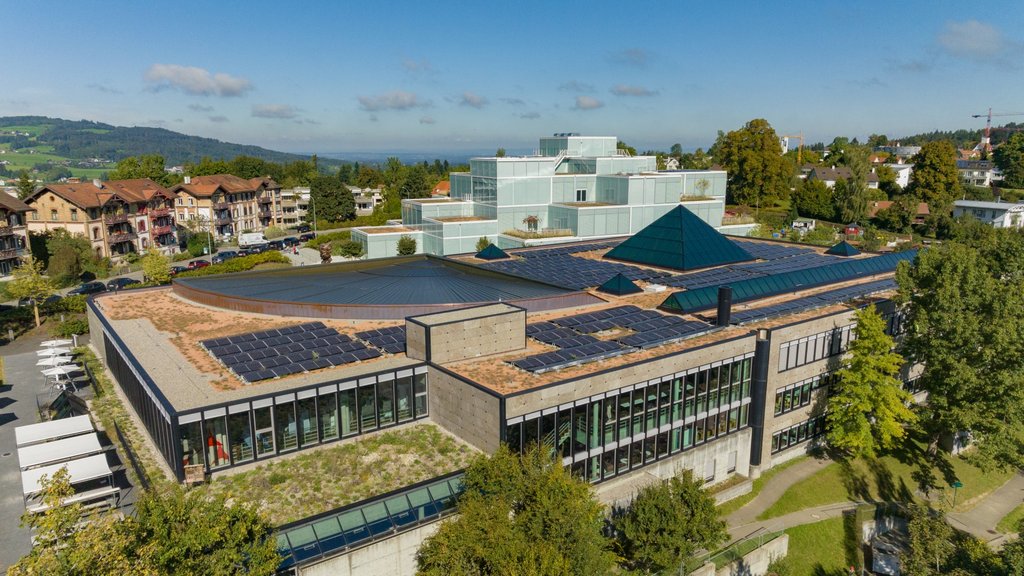
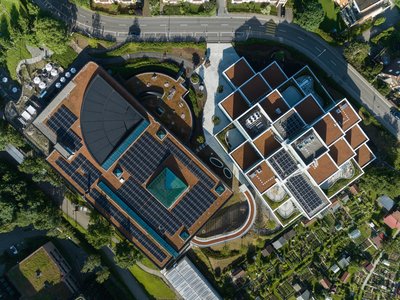
In terms of direct operational emissions, energy consumption in campus buildings was reduced by more than a third between 2014 and 2024, even though the number of students rose by almost 40 per cent over the same period. This makes the University a leader among the canton’s large energy consumers. At the same time, with five solar installations on campus, HSG generates a growing proportion of its electricity requirements itself, accounting for up to 20 per cent of consumption on the main campus.
Progress is also evident in emissions arising outside HSG’s direct sphere of influence, such as in procurement or through the travel of students and staff. Emissions from purchased goods and services, as well as from capital goods, fell by 21.6 per cent between 2024 and 2025. And although emissions from mobility remain the single largest factor in this category, emissions from business travel have been reduced slightly compared with 2024.
HSG is also consistently pursuing its climate targets in terms of building infrastructure. In close collaboration with the Canton of St.Gallen, as the owner of the campus properties, the existing fossil-fuel-based heating and cooling system is being gradually replaced by a system comprising geothermal probes and heat pumps. Furthermore, the new Platztor campus, based on the “Tsumiki” concept, is already incorporating sustainable construction principles into its planning and is set to become a model for building projects in the post-fossil fuel era.
The Sustainability Report and the Greenhouse Gas Report of HSG provide insights into further measures and details.
More articles from the same category
This could also be of interest to you
Discover our special topics