
HSG’s campus offers an inspiring learning and working environment. In line with its strategic goal of ‘walking the talk’, HSG strives towards sustainable operations incl. a net zero campus, providing an inclusive and diverse space for studying and work, and ensuring responsible investments. Furthermore, we aim to make sustainability visible on campus and beyond.


In 2019, the University of St.Gallen signed the Global Climate Letter for Universities and Colleges, part of the UNFCCC’s Race to Zero campaign. Based on this commitment, a detailed climate roadmap has been developed. It lays out the path of how HSG will achieve its commitment of achieving net-zero in core operational emissions (Scope 1 + 2) by 2030, and working towards a 25% reduction by 2030 across all Scopes (1-3) compared to the baseline year 2019.
To identify and prioritise emission reduction projects, it is important to understand one’s carbon footprint. HSG has implemented a university-wide GHG accounting project based on the GHG protocol - the global standard for measuring and reporting GHG emissions. Based on the operational control approach, the GHG inventory includes Scope 1, 2 and 3 emissions incl. downstream activities such as teaching off-site courses and student mobility travel.
The majority of HSG’s GHG emissions result from Scope 3 activities, with downstream transportation (student mobility), procurement, and business travel as major emission hotspots. As every GHG accounting, the calculations are an approximation partly based on assumptions and/or extrapolation.
The GHG accounting will be continued on an annual basis to track progress towards our climate goals. Reports from previous years can be provided upon request.
Increasing energy efficiency, decarbonizing heating and cooling, and boosting renewable power generation on campus are central goals of our climate action. HSG’s Buildings and Technology team has been optimizing energy use through innovative measures. Concretely, this led to a decrease of campus energy consumption by more than a third since 2013, despite the fact that the number of students has increased by almost 40% over the same period. HSG has significantly exceeded the cantonal energy reduction targets for the 2014-2024 period, making the University a leader among large energy consumers in the canton of St.Gallen.
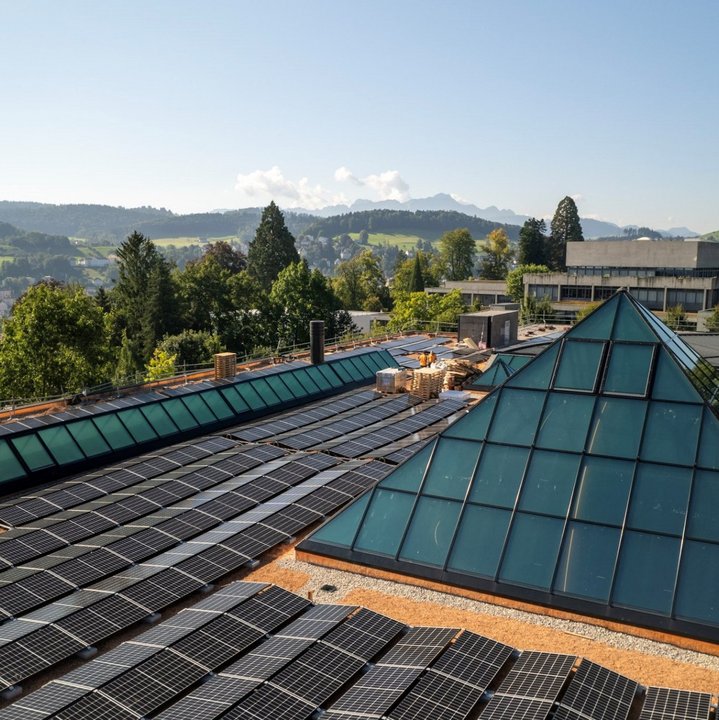
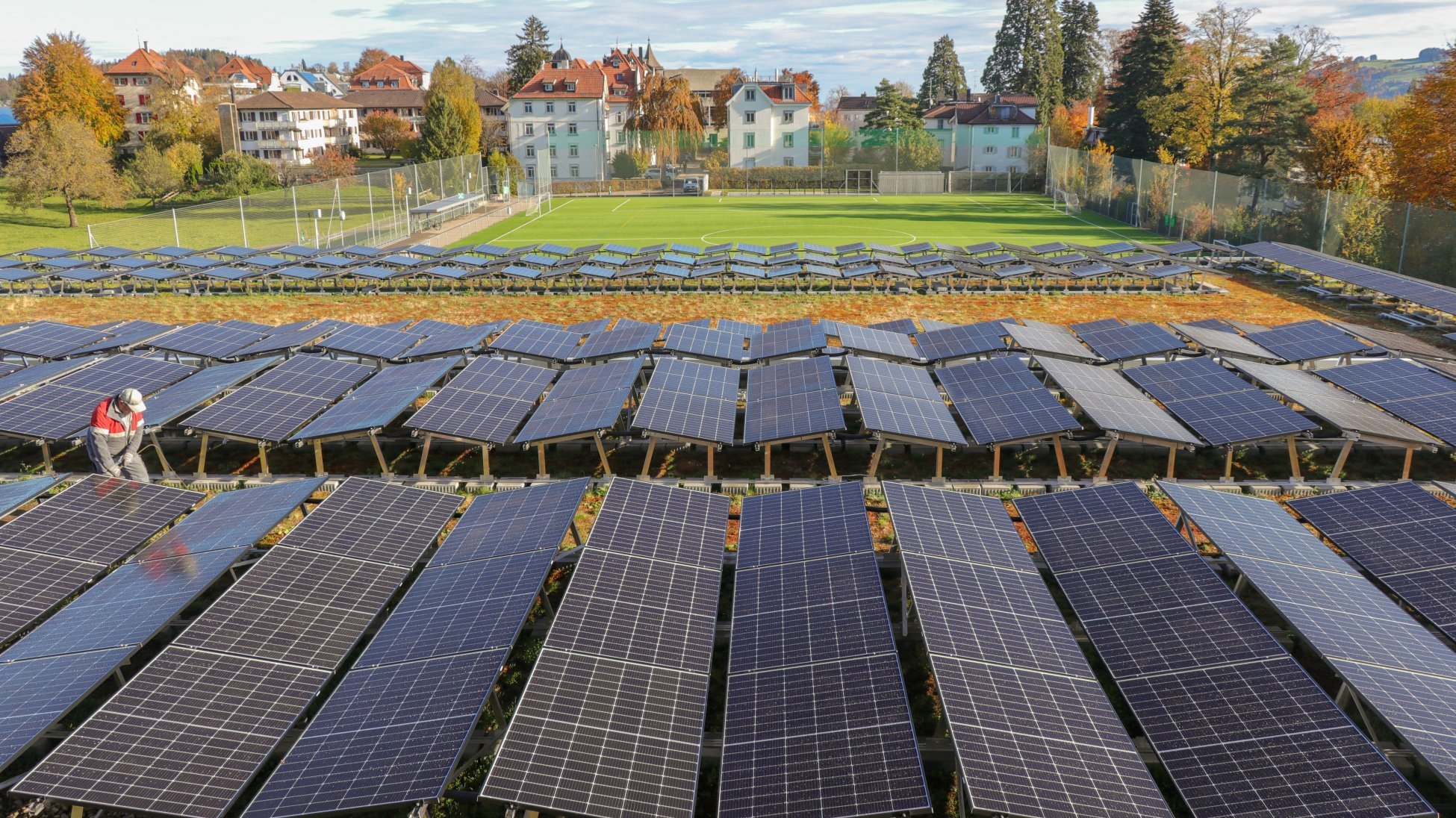
Lighthouse initiatives include the new SQUARE building which is heated entirely with geothermal energy, and the various PV installations that cover currently around 20% of HSG’s annual campus electricity demand. A remaining gas-fired heating system will be replaced in the next years.
Finally, a key opportunity for low-carbon infrastructure is the new Campus Platztor. With an expected delivery date of 2032, the implementation of the “Tsumiki” concept will serve as a model for construction projects in the post-fossil fuel era.
Based on the new cantonal public procurement law that allows sustainability as key criterion for procurement processes and decisions, HSG has revised its procurement policy to anchor sustainability aspects more firmly.
Various purchasing decisions are already informed by sustainability. For example, the university’s purchasing of electricity takes ecological criteria into consideration: 100% hydropower (market-based approach) is purchased for the main buildings on campus.
Mobility is part and parcel of any campus university. It is important to ensure connectivity and easy access while at the same time reduce environmental impacts. Several incentives for sustainable commuting are provided for employees, such as the SBB Travel App and a carsharing option.
Similarly, business travel plays an important role in academic life and career progression and accounts for around a fifth of HSG’s emissions. Some chairs have already introduced decentral low-carbon travel policies to reduce travel-induced carbon emissions. Measures are being taken to support more institutes and centres in developing tailored approaches to reducing emissions from business travel.
At the University of St.Gallen (HSG), downstream transportation emissions are related to student life, such as exchange travel, commuting, and participation in external events. These emissions represent almost 40% of the university's carbon footprint. A major contributor to this footprint is long-distance travel for exchange semesters and offsite courses, which saw an increase in the last few years due to a return to pre-pandemic activity levels.
Reducing downstream emissions is challenging. Nevertheless, HSG continues to explore ways to mitigate these emissions while maintaining its commitment to providing rich learning experiences for students. For example, this includes sensitising students to choose low-carbon modes of transport for inner-European exchange travel, and assessing the added value for the topic if a course seeks to take place abroad.
HSG undertakes various efforts to reduce emissions beyond the aforementioned emission hotspots. Many of those projects are student-driven, such as the implementation of an environmental impact labelling in the university canteen which has been introduced in 2024.
Also inspired by a student initiative, the University of St.Gallen’s financial department has updated HSG’s investment policy to consider sustainability aspects in the financial portfolio.
Beyond that, many HSG service units have optimised their processes and thereby reduced emission sources, for example by prioritising digital marketing material, or considering sustainability aspects in event settings.
Since 2007, HSG has been certified for the near-natural design of its landscape by the Nature & Economy Foundation, which promotes nature in residential areas and recognises exemplary areas and environmental planning. In the last years, various efforts were undertaken to further increase the biodiversity on campus, such as façade greenings or replacements of non-indigenous species with indigenous ones.
HSG has been a Blue University since 2016. As part of its Blue Community commitment, the university promotes the consumption of tap water and the recognition of water as a public good. Over the last years, several measures have been implemented to further reduce HSG’s water consumption and to promote awareness of water issues.
HSG aims to adopt circular economy practices on campus. Our university has a comprehensive waste management system and tracks and recycles different types of waste. Furthermore, if possible, old IT devices and furniture are reused or externally refurbished. Nevertheless, reducing waste and reaching more advanced levels of a circular economy remains a challenge. For example, a pilot project to implement a reusable cup system on campus had no long-term success, unfortunately.
Equal opportunities, diversity and inclusion are central aspects of HSG's pursuit of excellence, fairness and social impact. We see diversity as an opportunity, and respect as indispensable. To ensure this, specific advice centres work on further developing the University in this regard and ensure a comprehensive advisory service.
The University of St.Gallen uses various funds to support students financially to enable access to quality education, regardless of the financial background. The related activities are coordinated by the Advice Center for Study Funding.
Furthermore, the University of St.Gallen has a significant positive impact on the surrounding region. This includes monetary and non-monetary effects, such as positive purchasing power effects for SMEs, trade, and tourism, strengthening the regional labour market, as well as innovation opportunities and positives effects on the knowledge landscape and the attractiveness of the St.Gallen region.
Transforming towards sustainability does not only include operational measures but also creating a sustainability culture on campus. Our university is working towards that through various initiatives. This includes creating awareness for sustainability issues and ensuring visibility for existing measures.
Furthermore, the strong integrative approach of our university leads to numerous interconnections and overlaps between teaching, research, student engagement, and campus. The resulting initiatives for implementing campus sustainability make our campus a living lab where learning experiences and sustainability innovation come together. For example, students from the Master’s Certificate in Managing Climate Solution successfully initiated campus projects such as the PV installation on the gym roof financed by crowdfunding, or the climate stairs. Co-curricular student engagement is another driver in this field, with numerous successful implementation projects throughout the years.