Campus - 14.09.2026 - 16:00
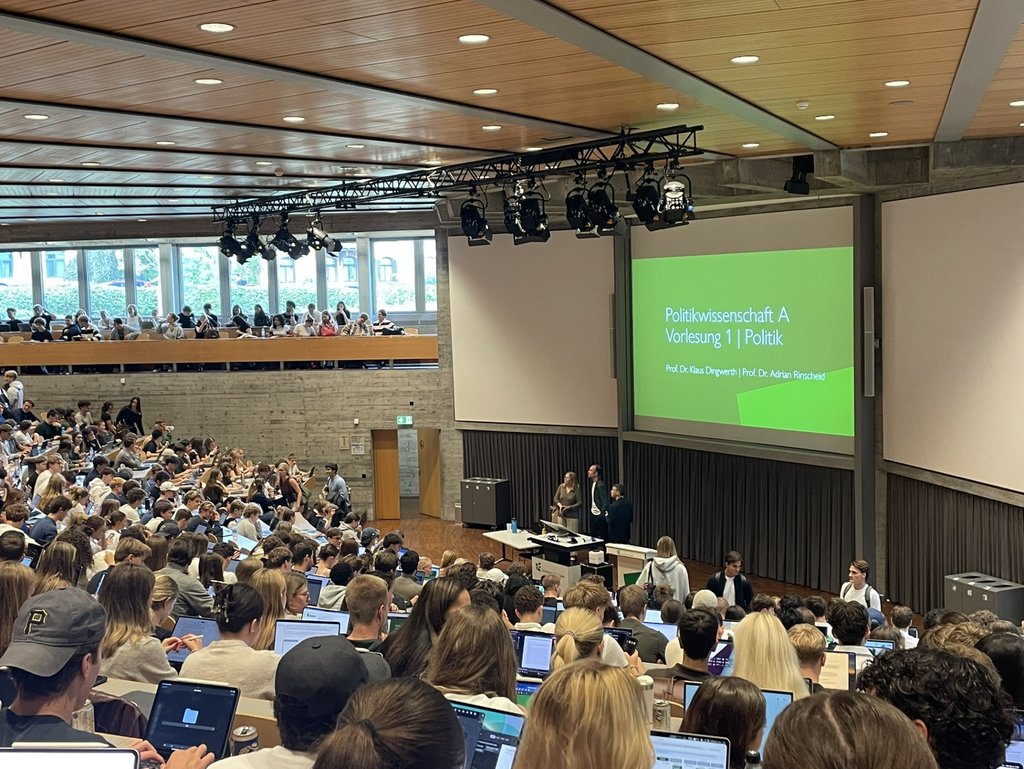
The Autumn Semester 2026 marks an important milestone for political science at the University of St.Gallen: for the first time, Political Science is part of the curriculum for all students in the Assessment Year.
Today, the first students gathered in the Audimax for the new lecture, taught by Professor Klaus Dingwerth and Professor Adrian Rinscheid from the School of Economics and Political Science (SEPS-HSG). With more than 2,000 students starting the Assessment Year this semester, the new course reaches a broad and diverse group of students right at the beginning of their studies. The lecture is offered in both German and English, with two groups in each language.
Politics takes place everywhere: in governments and parliaments, in international organisations and companies, on the streets and on social media. While we encounter political debates and decisions every day, understanding the structures and processes behind them requires a different perspective.
This is where the new Political Science course comes in. It provides students with an analytical toolbox for examining political phenomena beyond what is immediately visible. Students engage with fundamental concepts including politics, power, political ideologies, institutions, democracy and policy-making processes.
Rather than simply learning definitions, students are encouraged to adopt different perspectives, identify competing objectives and interests, and understand why political decision-making often involves negotiation and compromise.
The course applies these foundations to one of today’s major political challenges: climate policy.
Why are effective measures difficult to implement despite considerable pressure to act? Which actors and institutions facilitate political change – and which factors can hinder it? What roles do governments, social movements and private-sector companies play in the policy-making process?
By exploring comparative and international climate politics, students learn to apply political science concepts to a complex real-world policy field. Climate policy is particularly well suited to this approach because it connects different political levels, institutions, interests and theoretical perspectives.
The objective is not to provide students with simple answers. Instead, the course aims to sharpen their ability to analyse political challenges, recognise different perspectives and ask the right questions.
With Political Science joining Business Administration, Economics and Law in the Assessment Year, HSG is further strengthening the interdisciplinary foundations of its Bachelor’s education – and giving all new students an introduction to political science thinking from the very beginning of their studies.