Research - 30.09.2026 - 10:00
While billions of dollars are lost through disengagement at work, many organisations still respond by trying to fix employees rather than the conditions under which they work. Is there another way? An interview with HSG researcher, author and work transformation specialist Hans Rusinek.
What does work transformation mean, and what is your focus?
My ultimate goal is to change the world of work. I am interested in how organisations can reinvent themselves, how we can focus on work that actually matters, and how transformations such as AI can make human work better rather than simply faster.
Because work is much more than a way to earn a living. Anthropologically speaking, work has always been one of the ways in which humans transformed existential threats into solvable problems. Through work, we learned to take responsibility, cope with conflict, solve problems together and shape the future. In a sense, work is part of what made us human in the first place.
And today, work is perhaps one of the last places where we regularly encounter people we would not necessarily choose to spend time with. Much of the rest of our lives is increasingly curated: bubbles within bubbles. Work is different. We have to deal with our differences – and put them to good use. That can create social cohesion. At its best, work teaches us something fundamental: our actions can make a difference.
Many people feel exhausted or devoid of meaning in their jobs. Why is that?
We make a fundamental mistake when we treat exhaustion primarily as a problem of the individual. We tell people to become more resilient, manage their time better or practise mindfulness while leaving the organisation around them untouched.
But exhausted people are often a symptom of exhausted organisations. The constant acceleration of work creates the feeling that there is never a finish line. AI may intensify this if we simply use it to produce even more, even faster. At the same time, there has been a rise in what I call “Fake Work”.
Can you explain?
Fake Work keeps us busy but accomplishes very little: articles or presentations nobody reads, meetings that produce no decisions, endless trails of emails, reports that exist mainly because they have always existed.
We have confused productivity with activity and contribution with visibility. The tragedy is that Fake Work does not just cost time. It deprives people of something fundamental: the experience that their contribution matters. People need to see a connection between what they do and what happens because of it. The experience of having agency—the sense that our actions can make a difference—is one of the foundations of hope.
Why do we hear questions like this more now than 20 years ago? Are people really that much more unhappy?
I would be careful with the idea that there was once a golden age of work. Work has always contained frustration, hierarchy and meaningless tasks. What has changed is the contradiction.
We have more technology, more management tools and more knowledge about motivation than ever before – yet many people experience less control over their work. We have become very good at making individual tasks efficient without asking whether they should exist in the first place.
At the same time, expectations have changed. People increasingly expect work to provide not only income but also autonomy, development and a sense of contribution. I do not think that is entitlement. It forces organisations to confront a very useful question: What makes work worth doing?
What are concrete solutions?
My starting point is simple: fix the work, not the worker.
Instead of asking how we can make employees more resilient to dysfunctional work, organisations should examine the work itself. What can we stop doing? Which meeting, process, report or rule no longer creates value? Subtraction is one of the most underrated management practices.
Then we need to redesign work around three questions: Can I do it? Do I want to do it? Am I able to act? I describe these as skillset, mindset and toolset. People need the capabilities to contribute, a reason to care, and an environment that enables rather than obstructs them.
And finally, we should stop measuring productivity by how much activity we generate and start asking whether our work actually improves something.
It is often claimed that the younger generation is less willing to perform. Is that fair?
Simply put, no. I think many young professionals are less willing to perform tasks whose purpose nobody can explain. That is different.
The generational debate distracts from the fact that many organisations themselves can no longer convincingly answer why certain work is necessary. When young people ask, “Why do we do this?”, some managers hear a reproach. I hear a leadership question.
Perhaps Gen Z is not the problem in the world of work at all, but its most honest reflection.
Is there a way to turn this around?
Yes – and this is where hope comes in. Hope is not the same as optimism. Hope is the experience that a better future is possible and that our actions can contribute to it. In that sense, hope is a craft depending on the dimensions of mindset, skillset and toolset.
And then hope can create a loop: When we believe our actions can make a difference, we act. When we act and experience that difference, our sense of agency grows. And that, in turn, gives us more hope to act again. I call this the Hope Loop.
Work is one of the most important places where we can enter – or break – that loop. Every time people experience that they can change something, solve a problem together or make a meaningful contribution, the loop gains momentum. Every time they experience powerlessness, pointless bureaucracy or Fake Work, it stalls.
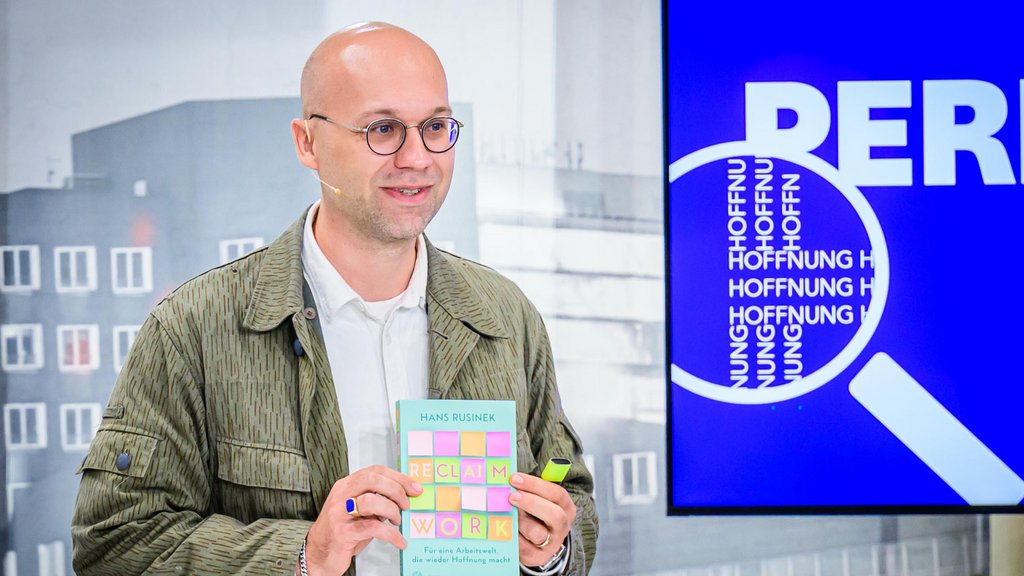
That is the idea behind my new book Reclaim Work. Reclaiming work means taking work seriously again as a place of human agency. We should not give up on work because so much of it is dysfunctional. We should reclaim it.
Dr. Hans Rusinek is a researcher and lecturer at the University of St.Gallen, advisor, keynote speaker and award-winning author focusing on the future of work, organisational transformation and meaningful work. His new book, “Reclaim Work – Für eine Arbeitswelt, die wieder Hoffnung macht“, was published in September 2026.