Campus - 22.05.2026 - 14:00
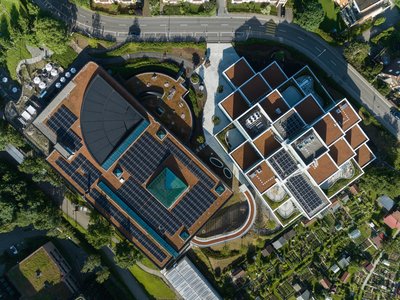
Perspective, vision and future: three words are enough to spark music in Stéphane Fromageots mind. His commission: celebratory music as a space for reflection on a place of learning to mark the university’s anniversary. After a stroll amongst the exotic giant trees through the Campus Park, the first melody began to dance in the musician’s ears. “The polyphonic chirping inspired me to view the university from a bird’s-eye perspective and to fly skywards, gazing at the Alpstein massif, which is often blanketed in snow in May,” recalls Fromageot.
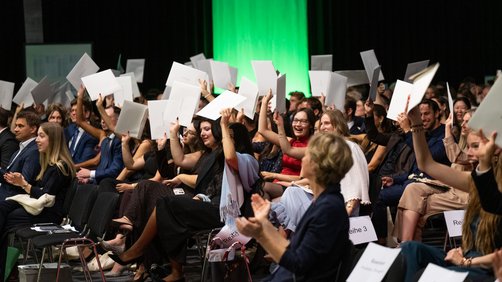
The composer created a sweeping orchestral piece which the guests at the Dies academicus experienced alongside Meinrad Keel’s bird’s-eye-view video on a large screen in the HSG auditorium. “I wanted to create a melody that would inspire and carry the listener along, towards the future,” says the musician. “The combination of the notes B-E-G gave rise to the first melody for the second work, Flying HSG.” The entrance music also quickly took on a life of its own. What began as restrained background music evolved into a proper ‘Academic Procession’. “The first sketch didn’t have enough presence,” he says. “On the second attempt, a march theme emerged that no longer wanted to be merely background music.”
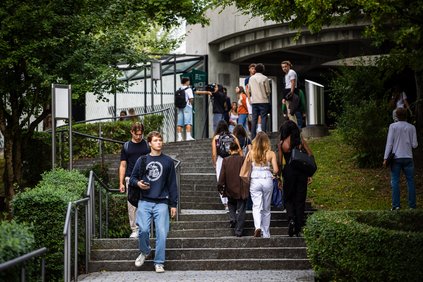
At HSG, the interplay of learning, knowledge, innovation and art is part of the character of this centre of thought. The campus lets the art in its architecture speak for itself. The cultural studies courses are not a side programme, but part of the broader educational philosophy at the University of St.Gallen. Numerous creative minds among students and lecturers shape campus life: Workshops on dance and leadership, seminars on philosophy and opera, the university choir, the university orchestra, and bands featuring researchers, alumni and students are all part of the fabric of campus life, as the “Art and Science” dossier highlights in part. Take, for example, the professor band B110 with their ironically affectionate song “HSG, you are so much more than your stereotype”.
The musical interpretation of the campus stems from the curatorial vision of Dr Gulnaz Partschefeld. She conceived the project for the Dies academicus and brought it to fruition with the HSG Events Office team. “A university is often described as a place of knowledge,” she says. “For me, knowledge arises where thought meets feeling.” Partschefeld sees HSG as a “resonance chamber” in which science, architecture, art and a vibrant atmosphere interact. That is why the three new compositions by Stéphane Fromageot are not intended as ceremonial decoration, but as an extended space for reflection. “Music articulates what scientific language leaves unsaid,” says Partschefeld. Art translates academic values into experience. And it is precisely this sonic experience that remains in the memory. Such as Stephane Fromageot’s works ‘Promenade Kirchhofer Park’ and ‘Flying HSG’.
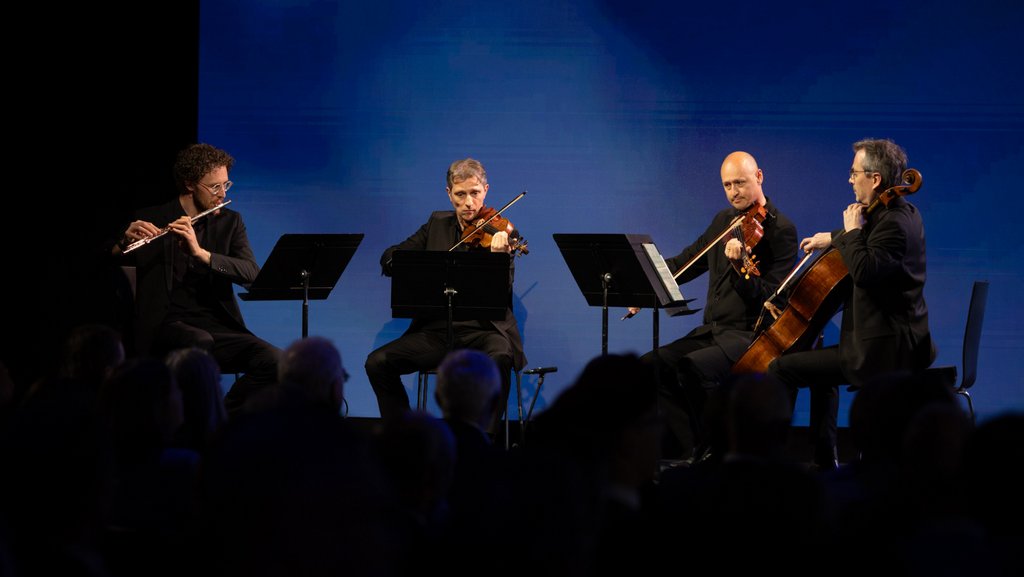
“Sound is the invisible architecture of a place,” says Dr. Gulnaz Partschefeld. A university has always had its own sound: footsteps in the foyer of the main building, the buzz of voices in the canteen or rustling leaves in Kirchhofer Park. Fromageot’s compositions make the ‘HSG score’ audible. This is particularly evident in the work “Promenade Kirchhofer Park”, a chamber music piece for string trio and flute. In it, the flute acts as a stylised bird, and the park itself as a resonating body. The composer played the violin himself at the world premiere. Originally trained as a violinist at the Conservatoire National Supérieur de Paris, he now works mainly as a pianist or conductor at the Theater St.Gallen. “Dies academicus was the ideal opportunity to perform as a violinist once again,” he says. “I enjoyed briefly transforming the HSG lecture theatre into a concert hall with my colleagues from the Symphony Orchestra St.Gallen.”
Composing may begin with freedom, silence and images in the mind, but later on, precise elaboration is what is required above all, explains Fromageot. “Once the structure and themes are established, I seek the utmost precision in orchestration, rhythm and harmony.” He likes to compare composing to cooking: “The ingredients must be just right, without excess or deficiency.” For this work, he needs peace and quiet above all else. “No music in the background,” he says. “And a piano nearby.” That is where ideas take shape, motifs are examined and further developed.
Humour also plays an important role for the musician. He likes the ironic self-reflection of the professors’ band B110. Good institutions need “the right balance between identity and the ability not to take oneself too seriously”. In “Flying HSG”, he therefore deliberately worked with a “dash of heroism”, though never quite without a wink. Music, art and culture do not appear as a counterworld to science, but as another way of observing reality: focused, open and present.
More articles from the same category
Discover our special topics