A research article on the divergence of ESG ratings has quickly become one of the most cited papers at the University of St.Gallen.
Sustainable finance has become an important phenomenon on the financial markets, but it is still a new field. "This means that new things are happening every day. It is important to continually introduce innovations in this area and critically evaluate what is happening," emphasises Julian Kölbel, who is both a financial scientist and an environmental scientist. Since 2022, he has been teaching and researching at the Center for Financial Services Innovation at the FSI-HSG.
His research on the divergence of ESG ratings is well known in the industry and frequently cited in academic literature. He came across the topic during his post-doc at the Sloan School of Management at the Massachusetts Institute of Technology (MIT). There, he co-founded the Aggregate Confusion Project, which aims to increase the transparency and comparability of ESG data. He is still a research partner at MIT Sloan today. Sustainability is very close to his heart, explains Julian Kölbel. "My goal is to conduct research that makes the world a more sustainable place." He investigates how moral values and beliefs influence financial decisions, asset prices and the real economy.
"ESG rating providers have become influential institutions. Sustainable investing has grown tremendously over the past decade, although the numbers are currently stagnating. Most investors rely on ratings to obtain a third-party assessment of companies' ESG performance," says Julian Kölbel, explaining his interest in the divergence of ESG ratings. A growing number of academic degree courses, degrees, and programmes have also based their empirical analysis on them. "As a result, ESG ratings are increasingly influencing decisions with potentially far-reaching implications for asset prices and corporate policy."
“My goal is to conduct research that makes the world a more sustainable place.”
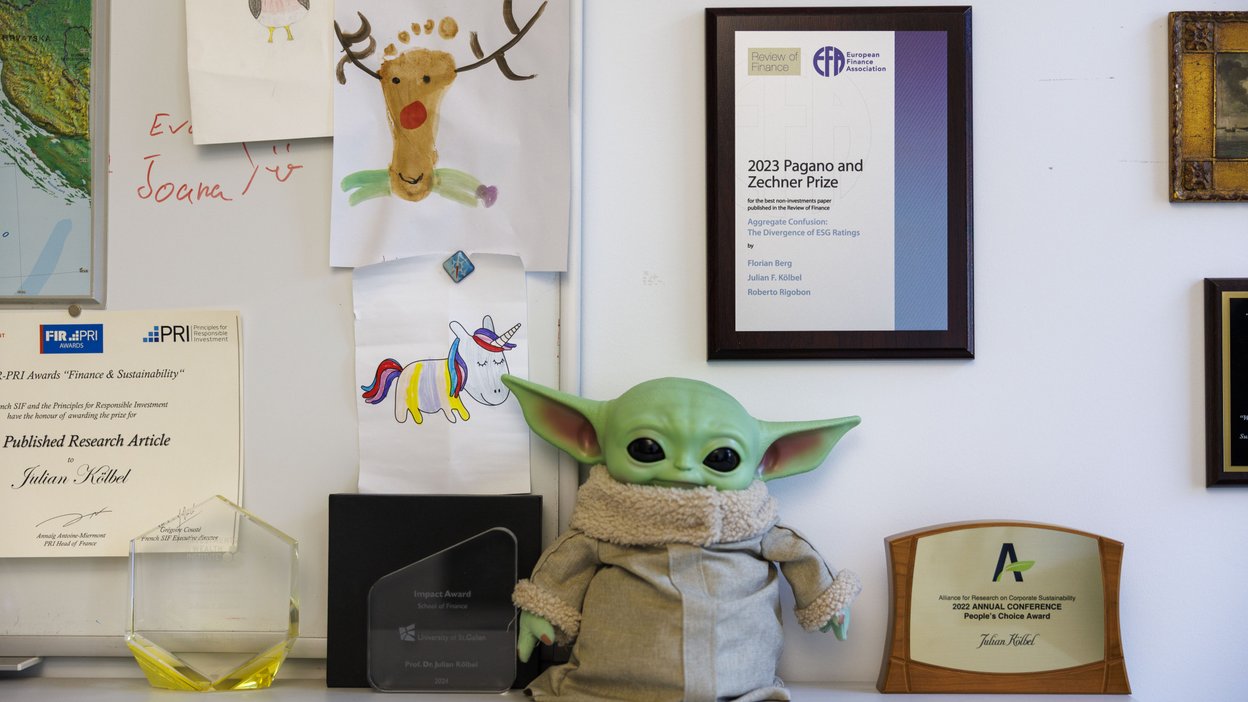
The problem, he says, is that ESG ratings from different providers vary considerably. "In our research article 'Aggregate Confusion: The Divergence of ESG Ratings', we identified three main factors that contribute to the differences in ratings. These are scope, measurement and weighting," emphasises the HSG professor. This disagreement has several important consequences. "First, it makes it difficult to assess the ESG performance of companies, funds and portfolios, which is the main purpose of ESG ratings. Secondly, the divergence of ESG ratings reduces the incentives for companies to improve their ESG performance. Companies receive mixed signals from rating agencies about what measures are expected and will be evaluated by the market."
Julian Kölbel cites other areas where the divergence of ESG ratings leads to misinterpretations. For example, there is a risk of weakening the effect of ESG performance on share prices, and it poses a challenge for empirical research, as the use of one rating over another could alter the results and conclusions of a study . "The divergence of ESG ratings leads to uncertainty in all decisions made on the basis of ESG ratings and therefore poses a challenge for a large number of decision-makers," he concludes.
The HSG professor makes it clear that the research article "Aggregate Confusion: The Divergence of ESG Ratings" does not present any solutions for the divergence of ESG ratings. However, the results have important implications for researchers, investors, companies, rating agencies and regulatory authorities. "As far as rating agencies are concerned, our results call for greater transparency. They show companies that opinions about their ESG performance vary widely. And they explain to investors why a company has received different ratings from different rating agencies." Researchers are advised to select the data underlying future ESG studies even more carefully.
Precisely because the topic of divergence in ESG ratings has yet to be resolved, he was particularly pleased that the publication of the research article in the Oxford Journal "Review of Finance" in 2022 sparked a broad discussion on the topic. "Not only did it quickly become one of the most cited papers at the University of St.Gallen, but it also received a lot of media coverage and was mentioned in many academic studies. We obviously struck a nerve," emphasises Julian Kölbel. Eugene Scalia, former US Secretary of Labor, used the results of the research article in a comment in the New York Times to express his concern about pension security for American workers, he cites as an example of the extensive media coverage. "On the other hand, some rating agencies also used the paper as an opportunity to distinguish themselves in the market through methodological transparency. Ultimately, the criticism has improved the industry, even if we did step on some people's toes."
According to Julian Kölbel, the attention the research article received opened several new doors. For example, he received a Starting Grant from the Swiss National Science Foundation for his ongoing research project on the topic of sustainable investing. This project aims to establish a scientific basis for ensuring that sustainable investments can deliver on their great promise. The goal is to understand whether and how individual preferences for sustainability are reflected in changes in the real economy.
Julian Kölbel emphasises that it is a stroke of luck for him to be able to advance his research as an HSG assistant professor and with a Starting Grant. However, he attaches great importance not only to research on sustainability, but also to teaching. "It is important to me to show students that classic virtues also count in the field of sustainability: looking closely, critically questioning data points, understanding the context, and making decisions on a solid basis."
Prof. Dr. Julian Kölbel works as an Assistant Professor in Sustainable Finance at the Center for Financial Services Innovation at the University of St.Gallen (FSI-HSG). He is Swiss Finance Institute (SFI) Faculty Member and a research fellow at MIT Sloan, where he is co-founder of the Aggregate Confusion Project.