

The Master in Computer Science is designed to be completed within four semesters (120 ECTS). You will attend compulsory courses in computer science, select among the specialisations, and enrich your curriculum with management and entrepreneurship courses as well as the electives from Contextual Studies.
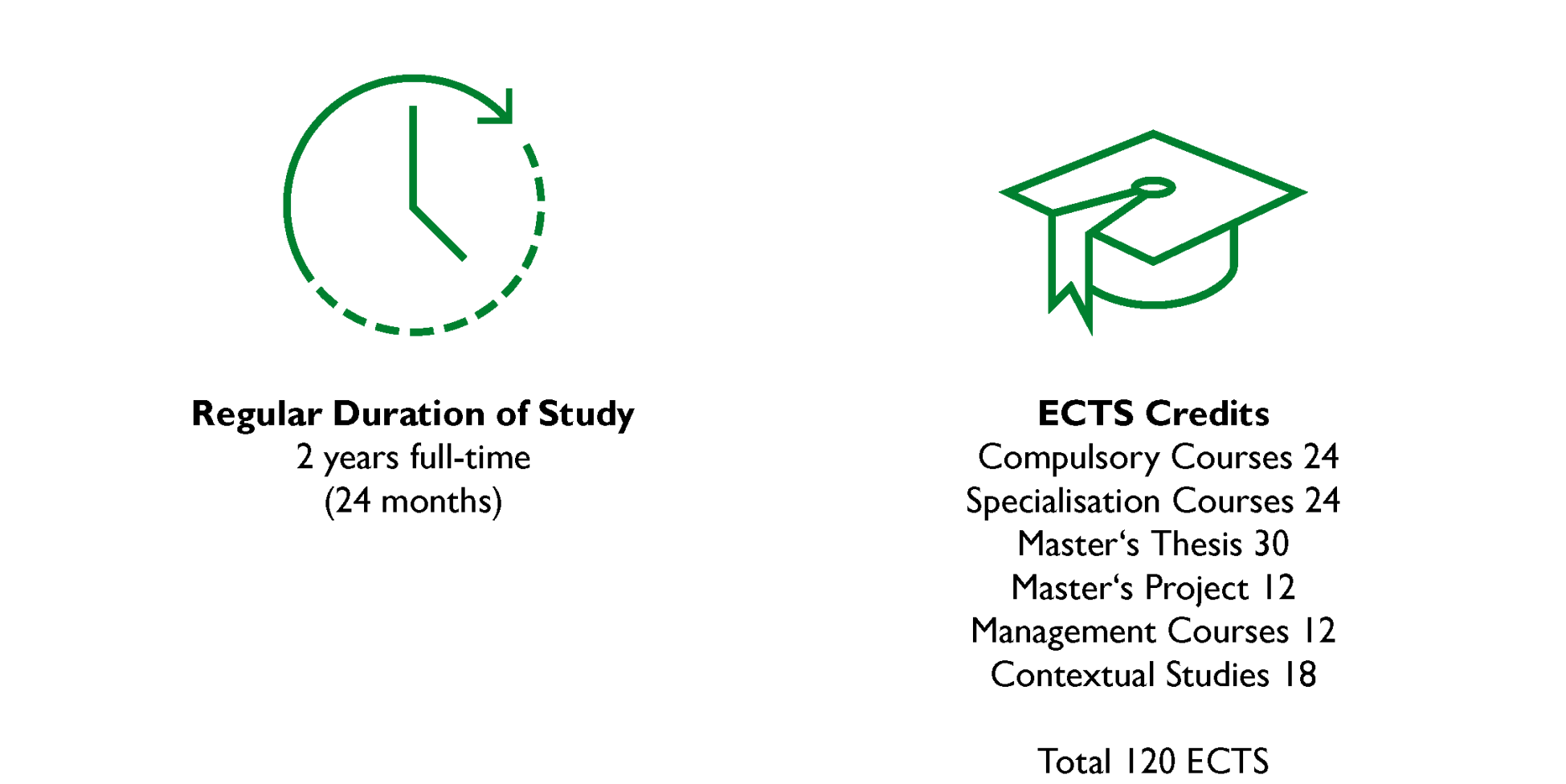

The curriculum of the Master in Computer Science is split into three main areas: Computer Science courses (90 ECTS, 75%); Management courses (10%); and Contextual Studies courses (15%). Each area focuses on developing different competencies.
Together, this combination of competencies creates a potent mix of practical skills, business skills and societal understanding.
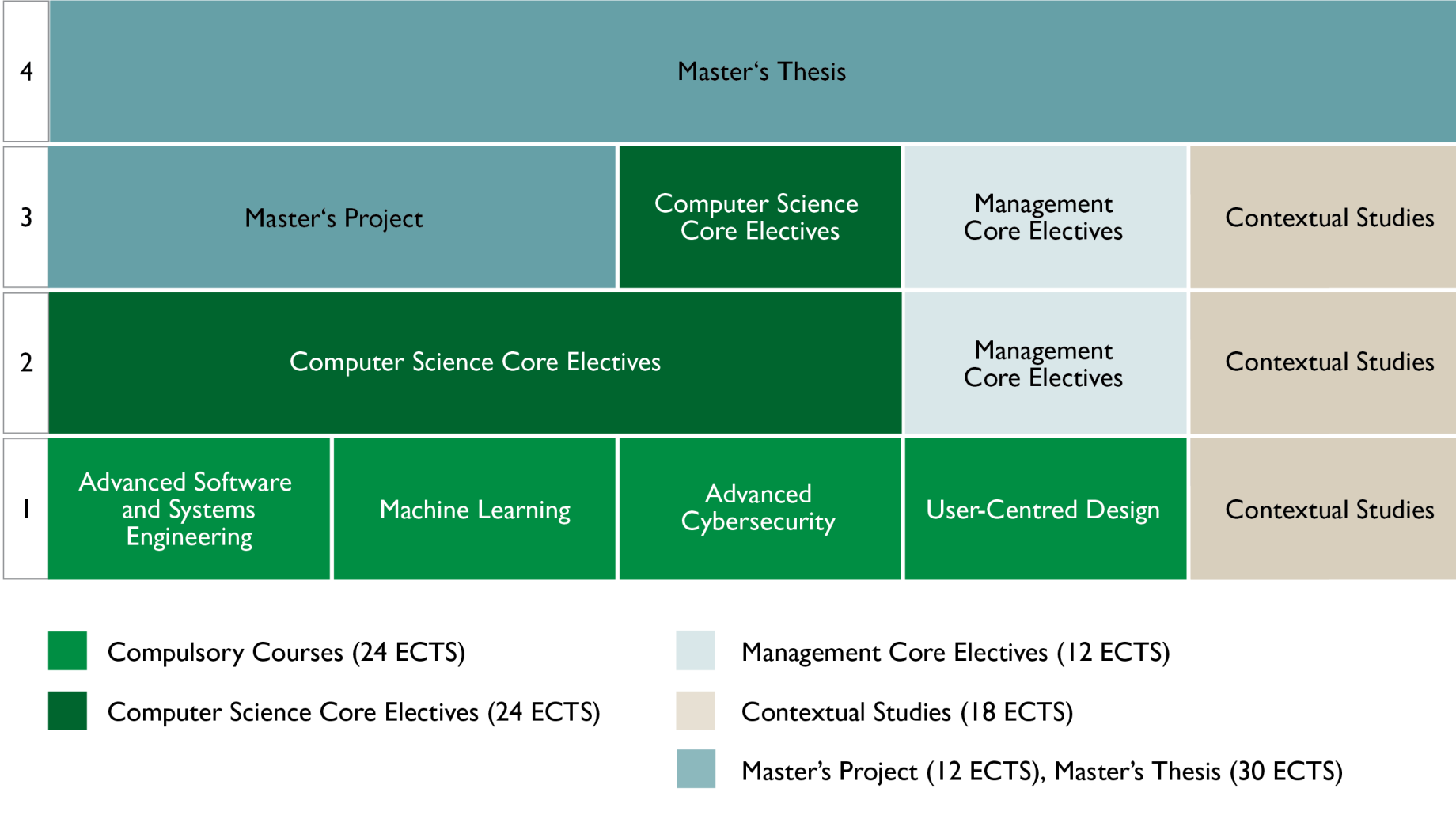
In the first semester you will attend four mandatory courses, which together form the basis of the programme.
Within the core electives for Computer Science you will visit 24 ECTS worth of courses and you may choose between one of the specialisations offered: AI & Data Science, Software and Systems Engineering or Strategic Cybersecurity. To achieve the chosen specialisation you need to earn 12 ECTS of courses offered within the specialisation as well as perform your Master's Project (or an additional 12 ECTS of courses) and Master's Thesis in the area of specialisation.
AI & Data Science, including Deep Learning, Natural Language Processing with LLM's, Computer Vision, Advanced Databases.
Software and Systems Engineering, including Software Assessment: From Planning to Experimentation, Event-Driven and Process-Oriented Architectures, Ubiquitous Computing and the Internet of Things, Web-Based Autonomous Systems, Advanced Programming.
Strategic Cybersecurity, including Testing and Security of AI Systems, Secure & Private Computing, Hacking Lab, Information Theory and Channel Coding.
The Master's Project will enable you to combine your skills and knowledge obtained during your studies in Computer Science and to apply them to a software engineering project. The project takes place in the third semester and is conducted in groups. During the project you will be supervised by one of our professors and her/his team of researchers. The project can be executed in collaboration with industry or partner institutions.
The master’s thesis covers the entire fourth semester and enables you to concentrate on a complex research question dealing with a topic in the field of computer science. While the Master's Project is geared toward practice, the master's thesis is research-oriented. You will work on the thesis individually, closely supervised by a faculty member and their research team. An excellent master's thesis gives you the opportunity to pursue an academic career.
For your management courses, you can choose between a wide range of courses offered in the HSG portfolio. Here you will find courses on topics such as leadership, entrepreneurship, finance, marketing and strategic management. Some of the courses are tailored to the Computer Science programme, while others are offered by other master's programmes at the University of St.Gallen.
As a unique and valuable element of each master’s programme in St.Gallen, the Contextual Studies offer a wide range of topics covering social, economic, and legal aspects of technology. The purpose of these courses is to foster critical thinking; you reflect on what you have learned in a different context. The courses may include fields such as history, philosophy, psychology or ethics. A wide selection of such courses is offered, and you will take these courses together with students from across all master's programmes, which helps to foster integrative thinking.
The Contextual Studies programme is another unique feature of the University of St.Gallen (HSG). It integrates knowledge across disciplinary boundaries and particularly strengthens your social and cultural competencies. You gain a holistic perspective by learning to see beyond the immediate. You will take courses offered in Focus Areas and also in the Skills section; in the latter, you acquire additional competencies and practical skills essential for success in the business world. The Contextual Studies programme complements your specialised studies and is rewarded with 18 ECTS credits.