close

Research - 11.12.2025 - 10:00 

Real customer value instead of marketing buzzwords

Smart products are booming. Examples include robot vacuum cleaners and smart speakers with voice assistants. Many companies still advertise these products using general buzzwords such as “AI-supported”, “algorithm” or “smart”. For users, however, it is not how “smart” a product is that matters, but what concrete added value it offers. This is the conclusion reached by HSG researchers in a recent Harvard Business Review publication.

Smart products have long been part of everyday life: robot vacuums clean independently, speakers respond to voice commands, thermostats learn user habits. Ten years ago, “smart” was still considered a selling point. Today, that is no longer enough. 

A team of authors investigated what users of smart products actually value today in the “Smart Products Report 2025”. To this end, 1,000 users were surveyed about smart products in 31 product areas. The participants evaluated eight specific advantages of smart products over conventional products. In addition, demographic data and general customer preferences were collected. The researchers then evaluated the information using a cluster analysis and identified customer types, known as “personas”. 

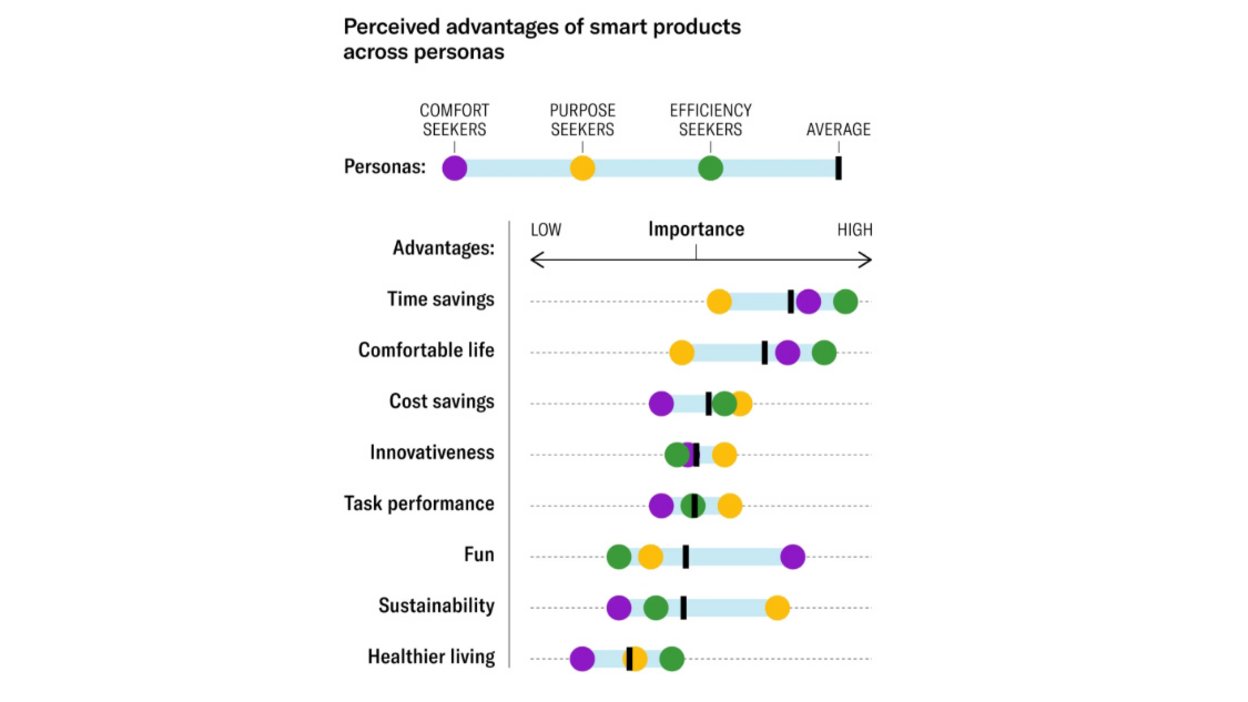
Figure: What buyers of smart products value

The analysis shows that users of smart products can be divided into three personas. They differ in particular in terms of the surplus value they expect from smart technologies – convenience in everyday life, meaning and social impact, or measurable efficiency gains in terms of time and costs. 
 

  • “Comfort seekers”: value through convenience 
    Comfort seekers (around 46 % of respondents) want products that offer convenience, enjoyment and time savings. For example, robot vacuums that work at the touch of a button or systems that adjust automatically. Effective marketing emphasises the “plug-and-play” nature of smart products (i.e. easy commissioning without complex installation) or focuses on messages such as “makes your life easier”. 
     
  • “Purpose seekers”: value through meaning 
    Purpose seekers (around 18 % of respondents) use smart products to pursue larger goals, such as reducing their carbon footprint, developing healthier habits or generally making a positive contribution to the world. When selecting products, this group of buyers pays attention to performance indicators and independent evidence of product promises, such as test certificates or external test reports. In communication, messages that demonstrate a concrete effect (e.g. “reduces energy consumption by 23 %”) or that highlight the connection to sustainability, health or fitness apps (e.g. services such as Apple Health) work particularly well. 
     
  • “Efficiency seekers”: value through time and money 
    The third customer type, efficiency seekers (around 36 % of respondents), opt for smart products if they demonstrably save time and money. Emotional aspects, design or the fun factor play hardly any role for them. Concrete, measurable benefits are decisive. This type of customer wants to know how quickly an investment will pay for itself (e.g. “pays for itself in 6 months”) and how much time they will actually save in their everyday lives (e.g. “saves an average of 2 hours per week”).  
“Customers of smart products can be divided into three personas, each with very different expectations and priorities. In the age of AI, marketing buzzwords such as ‘smart’ or ‘AI-powered’ are not enough. What counts is the benefit.”
Michele Russo und Sophia Prix, Institute of Behavioral Science and Technology (IBT-HSG)

Recommendations for companies 

For manufacturers and suppliers of smart products, this results in a clear framework for action that begins with product development and is geared towards different customer types (“personas”): 

  • Comfort seekers: intuitive user interfaces and simple direct access (“shortcuts”) 
  • Purpose seekers: impact overviews (“impact dashboards”) and transparent progress tracking 
  • Efficiency seekers: automation, individual presets and lean processes 


Recommendations can also be derived for marketing and sales: 

  • Product packages (“bundles”) tailored to individual personas 
  • Train sales teams to identify personas based on typical cluster questions – for example, by asking questions about daily routines (comfort seekers), long-term goals and values (purpose seekers) or priorities related to efficiency and control (efficiency seekers) 
  • Communicate content in the language of the respective persona: stories and case studies for comfort seekers; diagrams, evidence and expert opinions for purpose seekers; clear product comparisons work good for efficiency seekers 
  • Personalised introduction (“onboarding”): Comfort seekers appreciate quick-start guides and visual step-by-step instructions (“walkthroughs”), while purpose seekers need goal-setting tools and tutorials that focus on long-term results. 


The 3 Types of Customers Who Buy Smart Products—and How to Market to Them“ appeared in the November 2025 issue of the Harvard Business Review. The authors are Michele Russo, Sophia Prix and Prof. Dr. Emanuel de Bellis of the Institute of Behavioral Science and Technology (IBT-HSG) and Prof. Dr. Jonas Görgen of KEDGE Business School Bordeaux. 


Image: Adobe Stock / Konstantin Yuganov
north