Background - 12.02.2026 - 12:05
Involving nearly 50 Heads of State and Governments from all over the world, delegates will discuss the current status of global instability and escalating conflicts across the globe, European security and defence.
James W. Davis what issues will be at the forefront of this year’s conference?
Professor Davis: Topic number one will be the role of the United States in the world. Last year at the Munich Security Conference, Vice President J.D. Vance stunned allies by claiming Europe’s real threat wasn’t Russia or China, but civilizational decline from within — a theme later echoed in the Trump administration’s 2025 National Security Strategy, which warned of “civilisational decline” in Europe and urged strategic realignment.
But the U.S.’s actions since tell a chaotic, incoherent story: launching a trade war with key partners, striking Iran’s nuclear infrastructure, bombing terrorist targets across the Middle East and Africa, capturing Venezuela’s president, threatening to seize the territory of a NATO ally, and dressing down Ukraine’s leader for doing nothing more than defending his own territory — all while soft‑pedalling on the real security threat posed by Vladimir Putin and Russia’s aggression.
There are plenty of genuine challenges on the world stage, yet none will be easier to solve with an unpredictable or antagonistic United States driving policy.
You have chaired the Transatlantic Forum for the past 20 years. With the events surrounding U.S. President Trump and his treatment of Europe over the past year, will this year’s gathering have a different feel than previous years?
Over the past two decades, the transatlantic alliance has weathered its share of turbulence. Europeans and Americans argued — sometimes fiercely — over how best to defend shared interests and values. But beneath every disagreement was a bedrock assumption: we were on the same team.
Donald Trump’s re-election has shaken that premise. Washington now accuses Europe of abandoning democratic principles even as its own behaviour prompts Europeans to question how firm America’s commitment to democracy really is.
This is no longer a debate over tactics or policy. It is a confrontation over identity — who we are, what we stand for, and whether the Atlantic community still rests on common values. That makes today’s rift not just another alliance dispute, but a fundamentally different and far more consequential break.
This year, the MSC has released a booklet entitled "Selected Key Speeches – Volume III" that focuses on President Vladimir Putin’s address at the Munich Security Conference 2007. That speech was seen as a a turning point in European and international security debates and you contributed to this document, why do you think a speech from Putin in 2007 is relevant today?
Putin’s 2007 Munich speech matters today because it laid out, with striking sarcasm, a strategic vision fundamentally at odds with the post–Cold War order that was accepted as a fact in the West. He rejected the notion that there was a convergence toward Western values, insisted on the inevitability of multipolarity, and signalled Russia’s demand for a sphere of influence—including a veto over its neighbours’ domestic and foreign policy choices. What sounded at the time like familiar rhetoric was in fact a warning that Russia was prepared to accept confrontation if necessary to enforce its vision. The speech revealed that authoritarian consolidation at home and territorial revisionism abroad were not temporary deviations but elements of a coherent project—one that many leaders in the West were slow to fully recognize.
Does it provide us any insight into Russian foreign policy and the Ukrainian incursion that is currently taking place?
Yes — the speech provided important insights for understanding the war in Ukraine. As my account suggests, Putin was not simply cataloguing grievances; he was calmly rejecting the post–Cold War order and asserting Russia’s right to shape the security environment around it. His insistence on multipolarity and his implied claim to a sphere of influence pointed to a worldview in which the sovereignty of neighbouring states was inherently limited. The controlled tone and absence of concrete proposals further indicated that this was less an invitation to dialogue than a declaration of strategic direction. In retrospect, the manipulation of facts, the warnings about Western overreach, and the dismissal of democratic convergence all foreshadowed the rationale later applied to Ukraine: that borders could be revised, alliances contested, and force used to enforce Russia’s preferred order. What sounded at the time like rhetoric now reads as an early statement of intent.
The University of St.Gallen‘s Institute of Political Science (IPW-HSG), the Munich Security Conference, and the Centre for International Security at the Hertie School (Berlin) have jointly launched the European Nuclear Study Group (ENSG) in 2024 with you as the co-chair. Results from that study, Mind the Deterrence Gap: Assessing Europe’s Nuclear Options, have been launched in time for this year’s conference. What can you tell us? What did you look into? What did you find?
For two years, the European Nuclear Study Group examined how Europe can sustain credible deterrence in a rapidly changing nuclear landscape marked by Russian threats and growing uncertainty about the durability of U.S. security guarantees. Specifically, the group assessed five options, which we detail and evaluate in our report. Each carries significant trade-offs, risks, and is marked by important political constraints. But Europe can no longer afford strategic complacency or outsource its nuclear thinking to Washington. Our report is a wakeup call. European leaders must urgently confront these difficult choices to avoid a dangerous deterrence gap and the risk of strategic failure.
There has been a lot of doom and gloom projections in the past few months. Can you give us any reasons to be optimistic?
One reason for optimism is that people are rediscovering a fundamental truth: peace — and the prosperity it enables — cannot be taken for granted. History reminds us that there will always be actors who pursue their own security and wealth at the expense of others. The turbulence of the past year has clarified what is at stake when that logic prevails.
Yet there is also cause for confidence. We are not navigating uncharted territory. For more than seven decades, much of the world demonstrated that it is possible to resist those impulses and instead build a security order that delivered unprecedented levels of stability, cooperation, and economic progress. That experience matters. It shows that the path toward peace is neither mysterious nor unattainable — it is a choice. And having now been reminded of its value, societies may be more willing to defend and renew it.
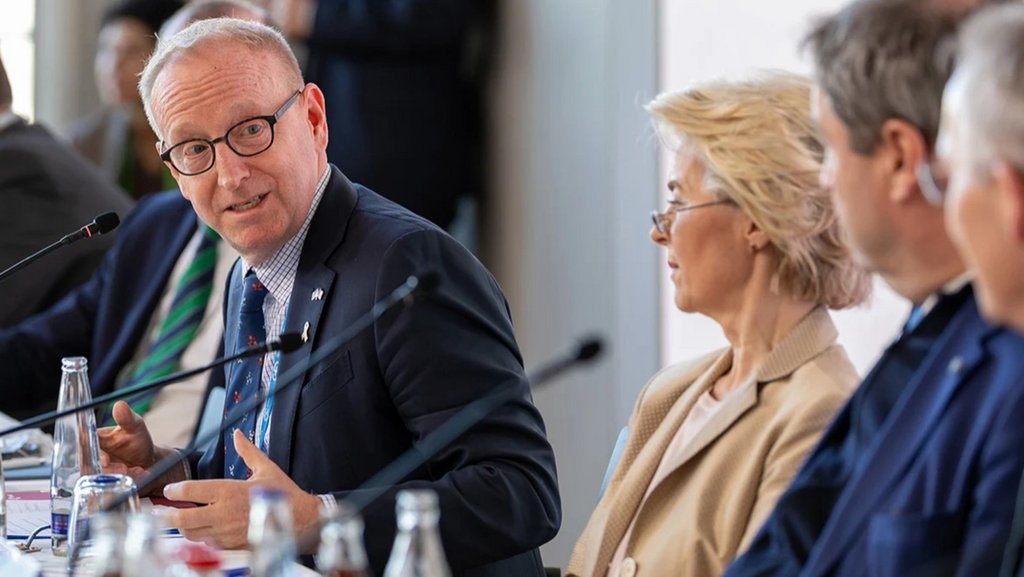
Image: Prof. James W. Davis at the MSC 2024