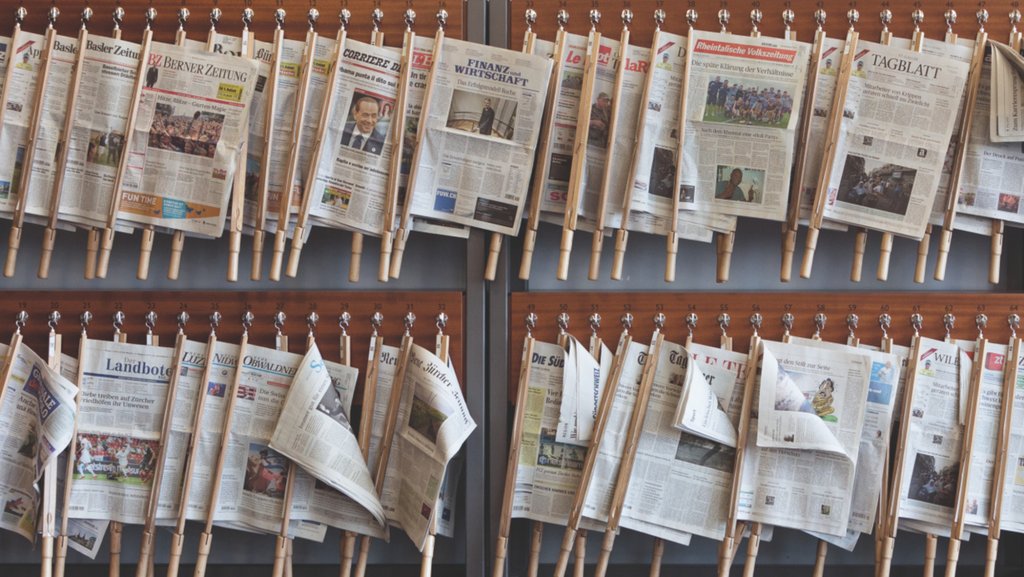
Background - 23.01.2026 - 11:00
The hothead in the White House is showing us how not to do it. For him, any journalist who does not simply trumpet his self-obsessed messages and infamous threats is a traitor, a failure or a fool. Trump refers to established media outlets as the “failing New York Times” or “fake news CNN”. This could be dismissed as one of the many aberrations of the erratic US president. Unfortunately, the truth is much more bitter: the deep contempt for a critical public is only a symptom of a profound crisis of republican democracy in the 21st century. As Evgeny Morozov showed in his book The Net Delusion: The Dark Side of Internet Freedom, the numerous virtual forums and social media did not bring about a surge in democratisation, but on the contrary often became state-instrumentalised echo chambers and sources of disinformation. Morozov knows what he is talking about: as a Belarusian intellectual, he witnessed Alexander Lukashenko's brutally enforced autocracy.
The situation in Russia is particularly worrying. Since the mass protests in the winter of 2011 and 2012, the Kremlin regime has increasingly restricted the independent media. Critical voices have been branded as “foreign agents” and opposition journalists have been silenced with court proceedings. Sociologists in Russia speak of a “Berlusconisation” of the media system: all important channels are either owned by the state or by state-affiliated holding companies. Since Russia's invasion of Ukraine, all independent editorial offices have been forced into exile. Reports of Russian war crimes, such as those in Bucha, are punishable by several years' imprisonment under a new law on “defamation of the armed forces”. Because the Kremlin also has to keep its population happy, YouTube was tolerated for a long time. Independent media outlets exploited this loophole and circumvented the blocking of their websites by publishing bulletins on YouTube. Now the Kremlin has artificially slowed down YouTube to such an extent that hardly any news flows on this channel either.
In his groundbreaking habilitation thesis from 1967, philosopher Jürgen Habermas drew attention to the “structural transformation of the public sphere” and the role of the media in the emergence of Western European democracies.
From a historical perspective, it was primarily the bourgeois reading circles that prefigured ideological values and political attitudes through the discussion of novels. Habermas was born in 1929 and, as a young man, experienced the catastrophe of the Nazi dictatorship first-hand. The core of his life's work consists of clarifying the discourse-theoretical prerequisites for democratic decision-making. His most important teaching is that democracy never functions without preconditions but is dependent on a public sphere.
The philosopher Isaiah Berlin also made an important philosophical report on the role of quality media in democracies. Berlin was born in Riga in 1909 as a subject of the Russian Tsar and later witnessed the red and brown tyrannies. As a professor at Oxford, he developed the fundamental distinction between freedom “from something” and freedom “to something”. The first freedom is purely negative: one is free from constraints and can follow one's own will. The second freedom is more complex: one must be empowered to make political decisions for the democratic community. This is not a given. And this is where Habermas' concept of the public sphere plays a decisive role: only those who have access to high-quality information can make competent decisions.
Prof. Dr. Ulrich Schmid is professor of Eastern European Studies at the University of St.Gallen (HSG). His research focuses on media and politics in Russia, culture and society in Ukraine, and historical politics in Poland.
On 27 January 2026, the ‘Erfreuliche Universität – first talk show on the SRG halving initiative’ will take place at the University of St.Gallen. Ulrich Schmid will participate as an expert on media and politics in Eastern European countries.