
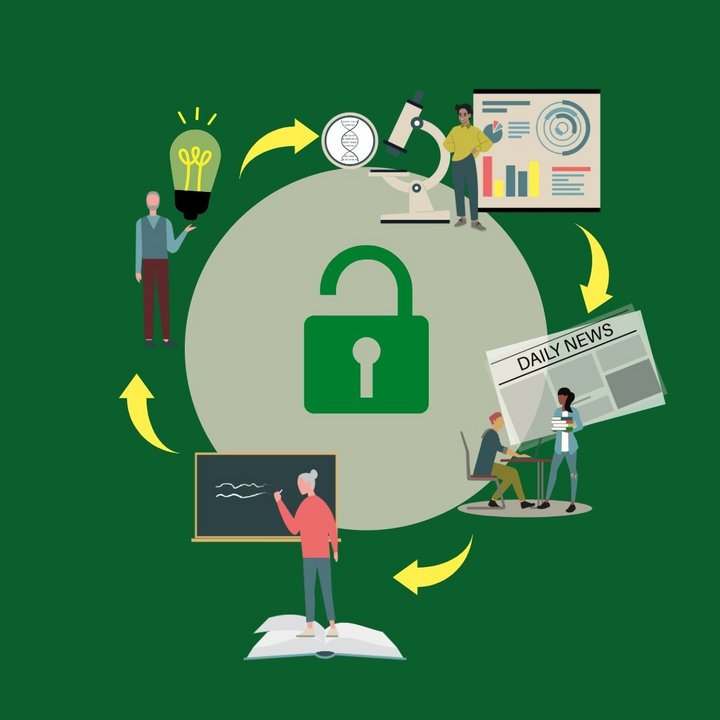
 | Developing an Open Science strategy for your research project helps you plan how to make your work transparent, collaborative, and accessible from the start. This section guides you through practical steps and considerations for integrating Open Science practices throughout your research cycle, from funding your study to sharing your results. By planning your Open Science activities early, you can increase the visibility, credibility, and impact of your research. This section offers tools and recommendations to help you build an Open Science strategy tailored to your project. |
 | Planning Your Research | |
 | Conducting & Interpreting Your Research | |
 | Reporting & Publishing Your Research | |
 | Sharing & Communicating Your Research |
Researchers need funding to make their work possible, and Open Science is no exception. Whether it involves sharing data openly, developing Open Educational Resources, or enhancing the transparency of research workflows, financial support is essential to make these efforts sustainable.
To support these efforts, the Open Science Office offers dedicated Open Science Grants that fund activities promoting Open Science in whichever way fits your research project.
Other funding institutions such as SNF also provide resources dedicated to supporting Open Science and Open Access.
You can find more information about Open Science Grants on our Grants page.
If you need additional support or this is not what you are looking for, reach out to us for a consultation.

By preregistering their research plan, researchers document their research design, hypotheses, and analysis plan before data collection or analysis begins. This increases transparency, helps avoid hindsight bias and data-driven “researcher degrees of freedom,” and strengthens the credibility of empirical findings.
Preregistration is not a binding contract: researchers can deviate from their plans when scientifically justified, as long as changes are transparently documented and clearly distinguished from confirmatory analyses.
There are several industry-standard platforms you can access to preregister your studies:
These and other platforms support transparent and trustworthy research practices across disciplines and are a well-regarded standard among many high-impact journals, which use preregistration as a quality indicator for rigorous and transparent research practices.
Preregistering studies supports researchers at the University of St. Gallen in publishing in top outlets:
"In recent years, I have seen a clear increase in expectations from editors and reviewers in leading Management journals, particularly FT50 outlets, to preregister studies. Preregistration supports researchers in thinking through key design decisions before data collection and strengthens the overall transparency and credibility of the research process. It has become an essential part of responsible and rigorous scholarship."
Prof. Dr. Anna Jasinenko, Assistant Professor of Organizational Behavior
Citizen Science refers to research activities in which members of the public voluntarily contribute data, ideas, or effort to scientific projects, often in collaboration with professional researchers. Citizen Science offers significant benefits to researchers by enabling access to large and diverse data sources, accelerating data collection at scale, and providing real-world insights into consumer behavior, organizational practices, or market dynamics.
It can also enhance stakeholder engagement, brand trust, and the societal relevance of research by directly involving citizens and conducting research in real-world conditions.
One crucial aspect of Citizen Science is the citizens. Schweiz Forscht indexes Citizen Science projects from institutions all over Switzerland to connect researchers with citizens.
Open Notebooks are digital records of your research that document your ideas, methods, data analyses, and results. By maintaining an Open Notebook, you make your research process transparent, reproducible, and easier to share with collaborators or the wider scientific community. Open Notebooks also help you keep a structured, version-controlled record of your work, which can be invaluable when revisiting analyses, writing papers, or responding to peer review.
Two popular tools for creating Open Notebooks are Jupyter Notebooks and Quarto:
Both platforms make it easy to share notebooks publicly or with collaborators, fostering transparency and encouraging others to reproduce and build upon your work.
While Git and GitHub themselves are not tools to create Open Notebooks, they are very valuable for sharing your code and notebooks publicly.
Open Source is a collective term for software and tools whose underlying code is freely available for anyone to view, use, modify, and share.
When you use open tools in the sense that they are openly and freely accessible, others can inspect the underlying code, evaluate the assumptions behind analytical methods, and independently verify results. This openness reduces barriers for scientists in resource-limited settings and accelerates innovation by allowing anyone to adapt or extend existing tools.
There are many widely used Open Source tools that embody this spirit. For data analysis and visualization, programming languages such as R or Python enable transparent, shareable workflows.
For document preparation and version control, you can use LaTeX, Markdown (e.g., Quarto Markdown or Hugo), and Git (GitHub) to openly share methods and writing.
By choosing these tools, researchers strengthen the ecosystem of Open Science and help build a more equitable and reproducible scientific future.
When you plan your research, thinking about how you will collect, organize, document, store, and share your data ensures that your materials can be understood and reused by others and by your future self.
This includes creating clear file structures, defining metadata and documentation standards, deciding on formats that remain accessible over time, and identifying suitable repositories for long-term archiving and sharing.
Platforms like the OSF emphasize data management as part of Open Science because well-planned data workflows make it possible to share data responsibly, comply with ethical and legal requirements, and ultimately increase the reproducibility and impact of your research.
Doing this early in the process enables you to share your data openly during the publication process. When data is openly shared, it becomes possible for other researchers to reproduce analyses, identify methodological issues, and build directly on previous work. Open Data also expands the lifespan of research: datasets continue to generate citations and new discoveries long after the original study is published.
One common standard for Open Data is the FAIR data (Findable, Accessible, Interoperable, Reusable) principles.
While sharing data openly is not always feasible, you should, at a minimum, ensure that your research metadata, such as the abstract, authors, and keywords, are publicly available to make your work discoverable.
At the University of St. Gallen, we support you in making your research data and metadata openly available through our dedicated team specialized in Research Data Management.
Open Data and Open Code enable researchers at the University of St. Gallen to produce reproducible and replicable research:
"In the spirit of transparency, reproducibility, and replicability, we published a permanently accessible online appendix, which includes the complete set of process models used in the study, a detailed report on the models’ complexity metrics and how they have been computed; the specific guideline violations and the resulting ambiguities; the list of tasks performed by the study participants; and more."
Dr. Marco Franceschetti, Senior Researcher at ICS-HSG
Learn more about this exemplary research, which provides both an Open Access publication and an Open Data and Open Code repository, here:
Open Materials provide the actual instruments, stimuli, questionnaires, or analysis scripts used in your study, while Open Protocols are detailed, publicly shared plans for conducting research studies, experiments, or surveys. Often, the two concepts are addressed together by providing stimuli along with detailed experimental plans to ensure full reproducibility.
By preregistering your materials and protocols or sharing them openly, you increase the credibility of your findings. Open Protocols also make it easier to collaborate with colleagues, communicate methods clearly to stakeholders, and align with funder requirements for transparency and reproducibility.
When sharing Open Materials, it is important to consider copyright and licensing issues. Use materials that you own, have permission to share, or are openly licensed, and provide clear licensing information for any items included. Platforms like the OSF or institutional repositories support this practice, allowing you to share materials responsibly while ensuring proper attribution and legal compliance.
The University of St. Gallen provides dedicated support services regarding questions about the copyright of materials, protocols, and more. If you are unsure what and where you can make your materials and protocols available, reach out to the Open Access team at the University Library.
Open Access ensures that knowledge can be accessed and read by anyone with an interest in the materials. This approach expands the reach of scientific work beyond universities and well-funded institutions, enabling students, researchers, policymakers, and the public to engage with cutting-edge discoveries regardless of their resources or location. Open Access aligns with the fundamental principle that publicly funded research should be publicly accessible.
In Switzerland, Open Access is increasingly embedded in the policies of major research funders: The SNSF requires that all articles and books (or book chapters) published with SNSF funding be made openly accessible. Furthermore, the joint Open Access strategy of SNSF and swissuniversities reports the goal of making all publicly funded scholarly publications immediately and freely accessible in a machine-readable format, under an open licence.
At the University of St. Gallen, we support you in publishing Open Access through various means. For further information on Open Access practices and support options, consult the dedicated Open Access page of our University.
Publishing Open Access has helped researchers at the University of St. Gallen convey their findings to industry partners freely and in a timely fashion:
"Our research study on learning from collaboration failure was published Open Access in Organization Science. It was critical for us that the generated insights are accessible to all types of audiences.
Given our close collaboration with industry and the generated insights with high practical relevance, choosing an Open Access option allowed, for example, our industry partners to freely access and share the paper and thereby contribute to HSG’s mission to translate the generated insights into practical impact.
The generated insights have further been shared through joint workshops and symposia with our pharmaceutical collaboration partner."
Prof. Dr. Zoe Jonassen, Assistant Professor of Assessing Innovation in Healthcare
Open Code refers to the practice of making your research code publicly accessible so that others can inspect, reuse, and build upon it.
Open Code benefits you as a researcher by increasing the credibility and transparency of your findings, reducing errors, and enabling faster cumulative knowledge creation, all while lowering replication costs for others. It can also enhance trust in your research and the practical relevance of your work, as practitioners, policymakers, and other scholars can directly examine and adapt your methods.
When planning to share Open Code, you should consider how to document it clearly for non-specialist users, choose appropriate platforms and licenses, protect sensitive or proprietary data, and ensure that your code is organized, reproducible, and aligned with the expectations of both academic and applied audiences. Popular ways to share Open Code in the scientific community and beyond are Git and GitHub, OSF, or Zenodo.
Science Communication is the practice of translating your research into clear, engaging messages that reach audiences beyond academic peers, helping society understand why your findings matter and how they can be used in real-world decision-making. It is especially valuable in contexts where communicating insights on markets, organizations, and policy can influence executives, policymakers, and the public, strengthening the visibility and impact of your work.
Platforms used to communicate scientific research can range from sharing your research with a wider community on LinkedIn to disseminating it in accessible formats, such as sharing it with more general news outlets.
Open Educational Resources (OER) are teaching and learning materials such as slides, cases, datasets, videos, or full courses that are freely accessible and openly licensed so others can use, adapt, and share them.
As a researcher, you can use Open Educational Resources to enrich your teaching and research communication by drawing on high-quality materials from peers, reducing preparation time, and integrating diverse perspectives into your courses or executive education. At the same time, providing Open Educational Resources allows you to extend the impact of your own work beyond publications by translating research insights into reusable learning resources for students, educators, and practitioners worldwide.
To do so effectively, accessible platforms such as institutional repositories or dedicated OER platforms are at your disposal. Examples are Switch OER or OER Commons.
By both using and contributing Open Educational Resources, you help strengthen open, equitable knowledge exchange while increasing the visibility and real-world relevance of your research.
Didn't find what you are looking for, or would you like to contribute an example of your own?
We look forward to hearing from you!
Much of the content on this page has been based on existing resources provided by the sources linked in the respective sections. We sincerely thank these organizations and their contributors for making this valuable information freely available.
We also wish to sincerely thank our colleagues across HSG providing valuable input on these important aspects of open science along the research cycle and for providing their testimonial and statement.