Research - 17.03.2026 - 12:00
Even the most brilliant and insightful strategy can be ineffective unless employees understand it and commit to it. Strategy implementation is seen by many as the Achilles heel of strategic management, with numerous examples of execution falling short of plan—from the “One HP” strategy to Bumble’s refocus strategy.

With their new study on strategy communication, Prof. Martin Eppler, along with the founder of Zense Andri Hinnen and HSG lecturer Dr Fabienne Bünzli wanted to gain insight into effective ways of conveying strategies. In their research and work with dozens of organizations, the researchers found that when it comes to internal strategy communication, clarity alone does not ensure employee engagement and success.
For employees to support and implement a strategy, they must not only understand it, they must connect with it. This requires more than abstract diagrams. It requires effective metaphors and storytelling.
Abstract visualizations are great at showing the big picture and reducing cognitive overload. They help people grasp strategic priorities. But clarity itself does not inspire employees to move in a different strategic direction. To build real commitment, strategy visuals must be concrete, inspiring, and capable of triggering the imagination.
Metaphors play a crucial role in this process. When an organization is depicted as a ship navigating rough seas, a team climbing toward a summit, or a machine being upgraded for the future, strategy becomes tangible. Such symbolic representations turn abstract plans into relatable experiences. Storytelling strengthens this effect by framing strategy as a journey—from a current state to a desired future.
To test whether this approach makes a difference, the team conducted two large-scale online experiments involving over 2,000 working professionals and experienced managers from the United States. In the online experiments, participants were randomly assigned to view one of two versions of a strategy visualization for a fictitious bank. Both versions followed the same design principles and were identical in content and visual quality. The only difference was the style: One presented the strategy as a structured diagram, while the other used a visual metaphor and narrative structure.
After exposure to one of the versions, participants reported how interesting, exciting, and engaging they found it.
Across both experiments, participants exposed to the metaphor-based visualization reported significantly higher engagement than those who saw the diagram-based version. At the same time, there were no meaningful differences in how the strategy itself was perceived. Participants reported similar levels of understanding and felt it was equally easy to retrieve information across both versions. The only difference was engagement—and higher engagement was significantly associated with stronger intentions to support strategy implementation.
Simply stated, Martin Eppler noted that, ”the study clearly shows that storytelling did not change what people understood. It changed how much they cared. And that is a significant difference.”
These findings mirror what Eppler, Hinnen and Bünzli observed in practice. In working with organizations such as Coca-Cola, Lufthansa, UBS, BMW, and several insurance providers, leaders consistently report that metaphor- and story-based strategy visualizations help translate abstract strategic goals into a plan that employees could get behind.
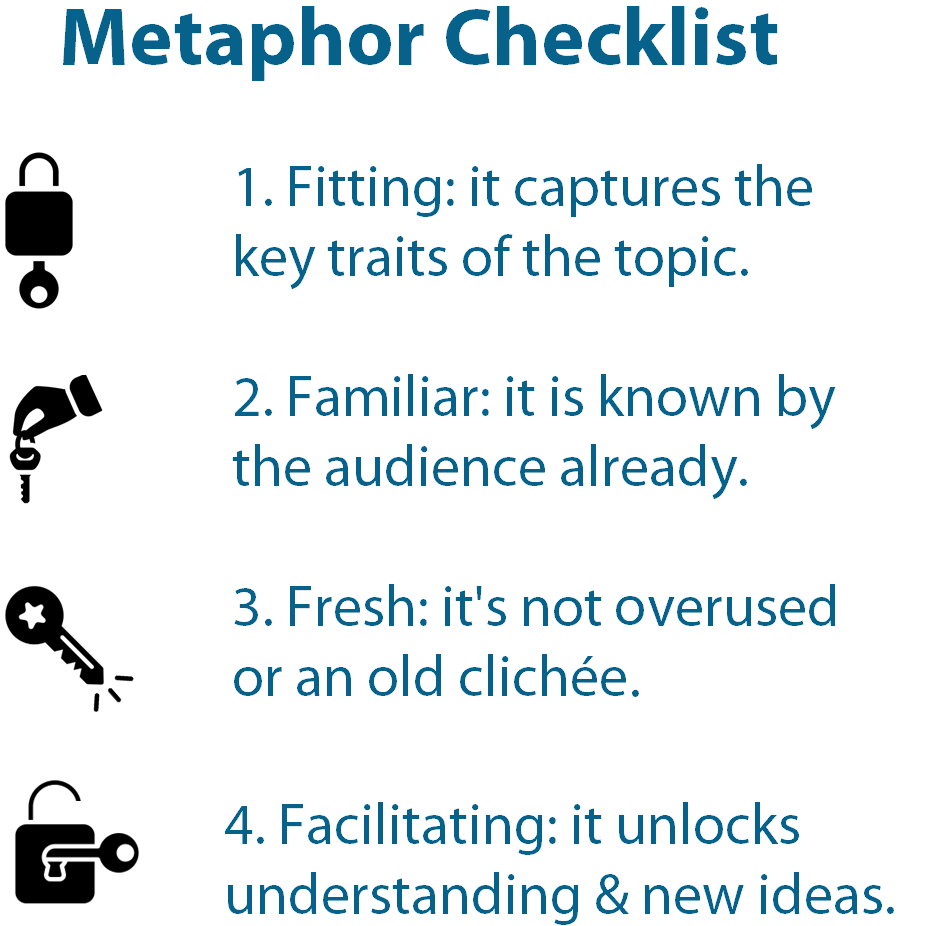
A successful visual strategy metaphor has to pass what Eppler calls the 4 Fs test, a quick checklist that he originally developed to teach managers visual thinking: It must fit the leadership style, culture, and situation of the organization; feel familiar, yet fresh to employees; and (most importantly) facilitate understanding about the strategy and its elements. “I’ve never met `aphor´ I didn’t like, but not all metaphors work in all contexts. The 4F test helps to keep that in mind” Eppler says.
Visual metaphors are not universally effective. Metaphors should be related not only to the strategy itself but also to the organization’s industry, culture, and leadership style. Ideally, they are found within the organization.
In one company, external consultants developed a complex jungle metaphor together with the strategy and communications teams. When the concept was presented to the CEO, he was not convinced. He felt the metaphor was not appropriately connected to the company. As the strategic ambition was to become the third-largest insurer in Switzerland and the company was a well-known sponsor of winter sports, he opted for a narrative about conquering the country’s third-tallest mountain: the Matterhorn.
Some metaphors run the risk of feeling overused and culturally exhausted. Good ideas can be found on the “edge of familiarity.” The concept that the stories are widely recognisable but still possess enough novelty to keep people engaged.
Examples from the realms of team sports, mountaineering, or vehicles (CEOs seem to love sailboats and rockets) can be helpful when it comes to explaining and engaging audiences in a strategy, but how they are used can feel a bit old. So, paradoxically, the act of familiarizing yourself with a metaphor can make it feel fresh again. Which is why one approach, after you’ve found a fitting image, is to dig beneath the surface and explore storytelling possibilities.
Another way is to choose a metaphor that has a good cultural fit but employs a counterintuitive narrative arc. A cost-cutting strategy, for example, does not have to be framed in terms of limitation or austerity; it can be communicated as a journey of exploration or reorientation. By contrast, a strategy cantered on expansion and large-scale investment can appear more credible and actionable when visualized through a grounded, sober metaphor, rather than imagery of heroism or excess.
A strategy metaphor must actively support understanding and facilitate its execution. Its visual elements and internal structure should clarify strategic priorities and relationships and ideally enhance memorability.
Metaphors such as journeys, races, expeditions, or treasure hunts naturally put a journey in the foreground. Static metaphors, like the overused strategy temple or strategy house, spark little engagement.
Ideally, the metaphor can then be used over the course of several strategy periods and become part of the organization’s ongoing sensemaking practices. Case in point from: Following the merger of two organizations operating homes for elderly people, two airships became one large airship traveling to a distant planet. Several years later, leadership reused the same story and imagery: The organization had arrived on said planet but was now facing the challenge of making it more inhabitable.
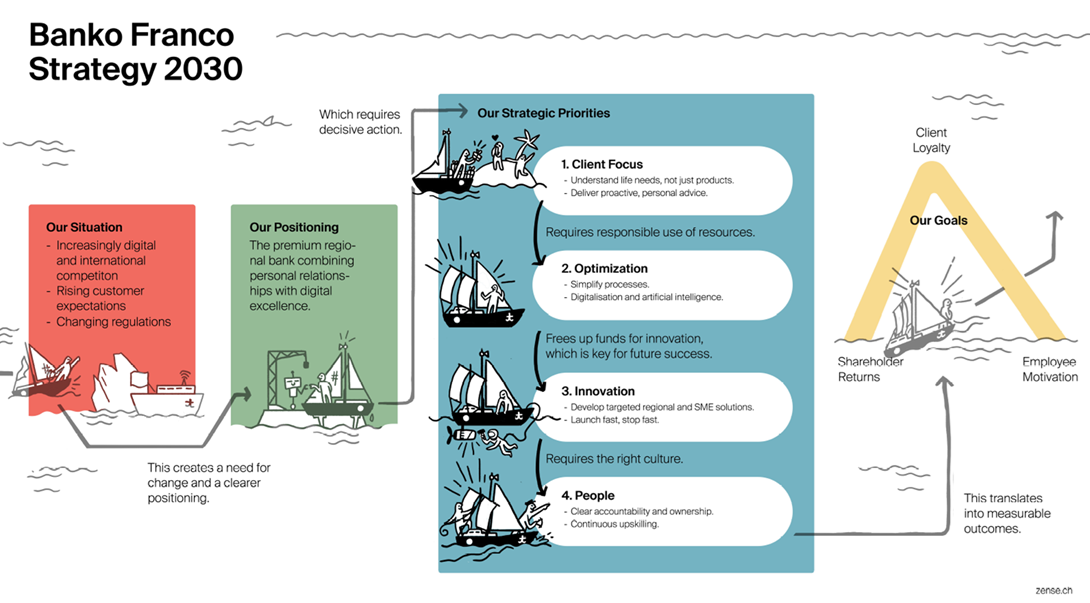
Paying attention to these elements can increase the chances that the strategy visualization will resonate with employees and spark useful dialogues about how to advance the strategy. In applying the 4 Fs to real-world strategy implementation processes, the following roadmap can be useful:
The bottom line: Abstract strategy visualizations create clarity. But successful strategy implementation requires more than understanding—it requires engagement. By combining clear design with resonant metaphors and compelling story structures, organizations can engage not only minds, but also hearts and hands. That engagement, in turn, makes the difference between a strategy that is merely understood and one that is implemented.
The article “Your Strategy Needs a Visual Metaphor” was originally published by Harvard Business Review by Martin Eppler, and Fabienne Bünzli from the University of St.Gallen and the founder of Zense, Andri Hinnen.
More articles from the same category