

The BIA curriculum combines a strong interdisciplinary foundation with the freedom to shape your individual academic profile. Core courses, specialised electives, contextual studies and practical experiences prepare you to understand and address complex international challenges from multiple perspectives


Courses in economics, political science, business administration, and law prepare you for a successful and responsible career in the international arena.
The Major in International Affairs follows the assessment year and comprises 120 credits. It is designed for a standard duration of 4 semesters. By selecting the appropriate courses, the programme can be predominantly studied in either English or German. However, a minimum of 9 ECTS credits must be completed in the opposing language.
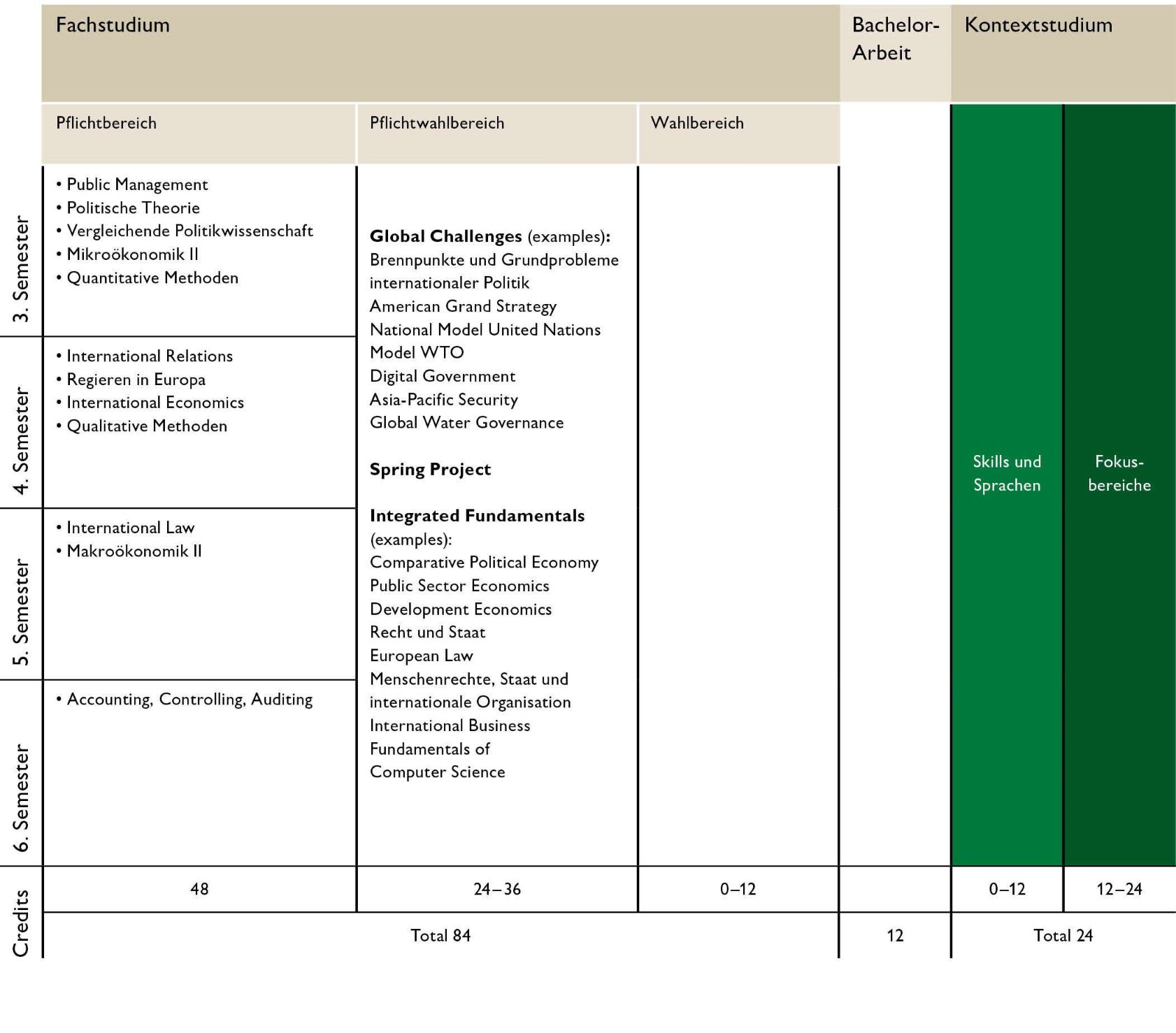
The curriculum of the Major in International Affairs consists of three parts:
While the core studies focus on subject-specific competencies, the contextual studies aim to expand social and cultural skills.
The semester recommendations for the courses are flexible. Particularly when planning exchange semesters, it may be useful to complete the courses in a different order.
You can find the current study plan for the Major in International Affairs (O20) here.
Courses
The following courses are part of the International Affairs programme:
| Compulsory Courses | Elective Core Courses |
|
|
In addition to the compulsory courses (48 ECTS), the BIA includes an elective core area with courses on specific global challenges (24 ECTS), a free elective area where students can choose from the course offerings of all HSG majors (12 ECTS), as well as the contextual studies with humanities and social sciences courses (24 ECTS).
An integral part of the programme is the Bachelor's thesis, which provides an opportunity for students to link and apply the knowledge gained throughout their studies.
In the International Affairs major, we pursue the following programme objectives:
As a result, they acquire the following core competencies:
The assessment year at HSG is the first year of the Bachelor’s programme, during which students acquire a broad foundational knowledge in economics and law. The curriculum includes core studies and contextual studies, totaling 60 credits.
In the core studies, compulsory courses such as business administration, economics, and law are taught. Depending on the chosen specialisation, students also have an elective core course, either in mathematics or law II. The contextual studies cover areas such as skills development, cultural and social sciences, as well as foreign languages.
Throughout the year, students are required to complete various exams, including written exams, seminars and group work, as well as oral exams and presentations.
The Contextual Studies is another unique feature of the University of St.Gallen (HSG). It integrates knowledge across disciplines and strengthens the social and cultural competencies of our students distinctively. Students take a holistic approach by "thinking outside the box" and enrol in courses within focus areas and skills areas. The cultural and social science offerings in the focus areas are highly diverse and aligned with the study programme. In the skills area, students acquire additional competencies and practical skills necessary for success in the business world, e.g. presentation and negotiation techniques or programming. The Contextual Studies complements your main field of study and is awarded with 24 ECTS credits.
learn more about the Contextual Studies
The Major in International Affairs is a self-contained, multi-disciplinary degree course. After you have successfully completed the Assessment Year, you will attend the Compulsory Subjects and Core Electives of this Major in Economics, Political Science, Law and Business Administration for four semesters.
Do you want to study the Major International Affairs in German or English? You can decide for yourself by choosing the appropriate courses. Our students are thus excellently prepared for a career in German- and English-speaking companies or organisations. In addition, you must complete at least 9 ECTS credits in the respective contrasting language.
Foreign languages are important to us. By the time you complete your Bachelor's degree programme, we require proof of proficiency in two foreign languages (in addition to the school language), whereby English must be demonstrated at proficiency level C2 (CEFR). You will attend a first foreign language in the assessment year, and learn a second during the Bachelor's degree programme. The range of foreign languages is broad; in addition to European languages, there are courses in Arabic, Chinese and Japanese at various levels
Your studies in the Major International Affairs consist of the compulsory area, the compulsory elective and the elective area.
Building on the University of St.Gallen's Assessment Year (60 ECTS), in which students get aquainted with the basics in economics and legal studies, the Major in International Affairs subsequently focusses on Compulsory Subjects (48 ECTS), which ensure the necessary fundamental formation in the four core disciplines. In addition, the programme offers three modules of Core Electives, which deal with integrative thinking, specific global challenges as well as research on selected areas in International Affairs (24-36 ECTS).
The following courses are compulsory and include contact and self-study.
Course | Compulsory course area | ECTS | Language | Semester |
Political Science | 4 | EN / DE | Autumn | |
Political Science | 4 | DE | Autumn | |
Economics | 4 | EN / DE | Autumn | |
Law | 4 | EN / DE | Autumn | |
Business Administration | 4 | DE | Autumn | |
Methods | 4 | EN / DE | Autumn | |
Accounting, Controlling, Auditing | Business Administration | 4 | EN / DE | Autumn / Spring |
Political Science | 4 | EN | Spring | |
Political Science | 4 | EN / DE | Spring | |
Economics | 4 | EN | Spring | |
Methods | 4 | EN / DE | Spring |
This course offering corresponds to the current planning status. You can find the entire course offering in the official Course Catalogue Online.
The Major in International Affairs offers you a large choice of core electives. As a BIA student you may choose 24 - 36 ECTS of Core Electives, comprising Integrative Fundamentals, Global Challenges and a Spring Project:
Interdisciplinarity and breadth: These courses build on the fundamental compulsory courses, developing your ability to recognize linkages between disciplines and analyze political and economic challenges in more integrated ways. You may choose between 12 to 24 ECTS of Integrative Fundamentals, which include the following:
Course | ECTS | Language | Semester |
4 | EN | Autumn | |
International Management (BBWL) | 4 | EN | |
4 | DE | Autumn | |
4 | EN | Autumn | |
6 | EN | Autumn | |
4 | EN | Autumn | |
6 | DE | Autumn | |
4 | EN | Spring | |
4 | EN | Spring | |
European Law / Europarecht (BLaw) | 4 | EN / DE | Spring |
4 | EN | Spring | |
Introduction to Programming (BVWL) | 6 | EN | Spring |
Interdisciplinarity and depth: Dealing with specific global challenges, you will deepen your knowledge in selected areas of international affairs and develop integrative thinking competences. You may choose between 8 - 20 ECTS of Global Challenges core electives which include the following:
Kurs | ECTS | Sprache | Semester |
6 | DE | Autumn | |
4 | EN | Autumn | |
4 | EN | Autumn | |
4 | DE | Autumn | |
4 | DE | Autumn | |
4 | EN | Autumn | |
National Model United Nations | 6 | EN | Autumn & Spring |
Model WTO | 6 | EN | Autumn & Spring |
4 | EN | Spring | |
4 | EN | Spring | |
4 | EN | Spring | |
4 | EN | Spring | |
4 | EN | Spring |
You can choose among several guided writing projects worth 4 ECTS predominantly offered in the spring semester: This format allows you to practice your research skills in a selected area of International Affairs, preparing you for your Bachelor's thesis.
Course | ECTS | Language | Semester |
4 | DE | Spring | |
4 | EN | Spring | |
4 | EN | Spring | |
Empirical Research in International and Development Economics | 4 | EN | Spring |
Qualitative Research in Issues of Public Management and Governance | 4 | EN | Spring |
| Citizen Support for Liberal Democracy | 4 | EN | Autumn |
| Interest groups and lobbying | 4 | EN | Autumn |
This course offering corresponds to the current planning status. You can find the entire course offering in the official Course Catalogue Online.
In the elective area (0-12 ECTS credits), you can either complete further economics courses from a diverse range or supplement your curriculum with courses from other majors. In this way, you can structure your studies with the offers of the compulsory elective area and the elective area according to your individual preferences - either through a broadly composed portfolio of courses or by focussing on courses offered in a specific subject area.
The complete range of courses can be found in the official Course Catalogue Online.
The Contextual studies complements your specialized studies and is compensated with 24 ECTS credits.
The Contextual studies is another strong factor of the programmes' curriculum. It integrates knowledge across disciplinary boundaries and strengthens the social and cultural competencies of our students in a special way. They will holistically "think outside the box" and take courses in focus areas as well as in the skills area. The contextual studies also teaches skills such as presentation and negotiation techniques or programming languages. The cross-cultural and cross-social science programme courses offered in the focus areas are extremely diverse and can be tailored to the Major Economics degree programme. In the skills area, you will learn complementary competencies and practical skills for success in the corporate world.
The Bachelors' Thesis (12 ECTS credits) is a scientific paper. You deal in depth with a question from a subject area of your own choice. In the Bachelor's thesis, you are guided by the relevant scientific research designs and principles.
Internationalisation and intercultural exchange are important topics in the Major Economics. Many of our students are drawn to study abroad in the fifth or sixth semester and we very much welcome you to spend an exchange semester either at one of our many partner universities or at a university of your choice. You can also receive credit for courses abroad and, most importantly, gain intercultural skills without having to pause your academic progress. You can find more information about exchange opportunities here..
Here you will find a compilation of the most important programme regulations.
Practice Credits are awarded for practical activities that are closely related to your studies. These may be, for example, internships at political agencies, NGOs and other institutions as well as other qualified activities in politics, business and law. As a first priority, Practice Credits are credited to Leadership Skills; as a second priority to Electives. BIA students may apply for 4, 6 or 8 Practice Credits. In the past BIA students have earned Practice Credits for their work at the following institutions.
Please note that the list is not exhaustive:
Caritas Schweiz
Swiss Embassy San José, Costa Rica
Swiss Mission to the UN, New York
Bundesministerium für wirtschaftliche Zusammenarbeit und Entwicklung der Bundesrepublik Deutschland
Department of Disarmament, Federal Foreign Office, Berlin
Austrian Consulate General, New York
DEKRA e.V. Brussels
United Nations Relief Works Agency in the Near East, Lebanon
NGO SUTRA, India
Thura Swiss Ltd, Myanmar
Internationale Organisation für Migration (IOM), Tadzhikistan
SAP Schweiz AG
arf GmbH Nürnberg
Hans Seidel Stiftung, Lima, Peru
UBS Wealth Management & Swiss Bank
Credit Suisse Private Banking
KPMG Zürich
PricewaterhouseCoopers, Zürich