Research - 16.03.2026 - 10:30
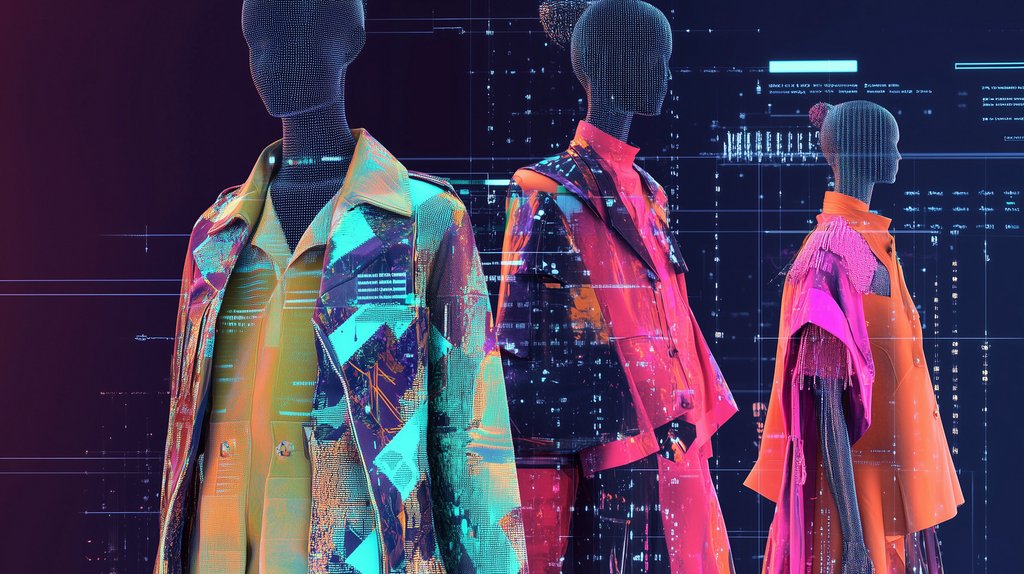
The images look deceptively real: models pose in new collections, smile for the camera, present clothing in perfect lighting. Yet increasingly, these people are fictional. Fashion firms are experimenting more and more with a new means of production: the algorithm. Without a photo studio, without a travel budget, sometimes even without real people in front of the camera.
The fact that this development is not merely a vision is demonstrated by the first campaigns from major brands. Media reports from the BBC, SRF and the NZZ, for example, show how designers are having entire collections created on computers. The economic appeal is obvious: digital models are available at any time, incur no travel costs and can be varied as desired – by age, skin colour or pose. For online retailers with thousands of products, tools such as Midjourney or ChatGPT can significantly speed up image production.

As the quality of AI-generated images improves, so too does the question of responsible use. This is precisely where a new study by the University of St.Gallen comes in. Researchers Simon Sturm, Florian Krause and Benjamin van Giffen examine, using the example of the German mail-order retailer OTTO, how companies organise the responsible use of AI-generated fashion images.
The study builds on the fundamental ambivalence of such technologies: generative AI opens up new possibilities for efficiency and design, but at the same time raises new ethical and organisational questions. Their conclusion: responsible use of AI cannot be defined by rigid rules and principles.
For the mail-order company OTTO, this is not about marketing experiments, but about the industrial production of thousands of product images for online retail. The study shows that it is precisely here that the extent to which generative AI can transform existing workflows becomes apparent. Companies must continually decide to what extent they deploy the technology and where they draw the line.
These decisions are not made by a single person, but through the interaction of various roles within the company, such as in management, technology, content production and governance. Responsible AI use is thus both a process and the result of social evaluation. Within one’s own company and beyond.
The researchers describe responsible AI use using the example of fashion image generation at OTTO and refer to the decision-making process there as “continuous proportionalisation”. Accordingly, organisations must continually reassess:
This is because it is becoming increasingly difficult for consumers to distinguish between real and AI-generated images. Critics warn that digital models could reinforce unrealistic body images or displace human jobs. In the fashion industry, this aspect is particularly sensitive: images shape not only purchasing decisions, but also notions of beauty, identity and physicality.
The study reaches a cautionary conclusion: guidelines and regulation may offer direction, but they cannot possibly replace the necessary interpretative work within an organisation itself. Companies must decide for themselves how far they wish to go with the use of AI – which applications they can justify to their stakeholders, and which technical possibilities they consciously choose to use (or not).
Responsibility thus arises less from technical possibilities than from organisational decisions and societal expectations. And whilst generative image technologies are developing rapidly, the public debate on their consequences is still in its infancy.

Monika Kritzmöller is a lecturer in fashion sociology at the University of St.Gallen. She sees the shift towards AI-generated fashion as the logical continuation of the trend towards filtering and optimisation: “With digital photography and image-editing programmes, the once-laborious manual brush retouching can now be done at the click of a mouse; photo filters eliminate every pore and ‘optimise’ proportions. Trends such as the current ‘Clean Girl Chic’ take this as their model, as a prototype of impersonal levelling in the real world.”
AI-generated fashion images disembody both models and clothes – yet at the moment of wearing the clothes, the visual-media discourse is abandoned: the physical garment meets the body and the sentient self. “The living body is still what we use to negotiate our identity.” Added to this are quality considerations: mass-produced clothing is depicted using mass-generated images. At the other end of the scale are highly artificial and handcrafted photographs featuring real models, whose aura and – in Georg Simmel’s words – “cultivation” cannot be achieved with AI. It is precisely this contrast that sees, for example, daguerreotypes by the artist Chuck Close – depicting a pore-deeply unretouched Kate Moss – fetching considerable prices on the art market.
The study by Simon Sturm, Florian Krause and Benjamin van Giffen appeared in the Swiss Journal of Business under the title “Responsible Use of Artificial Intelligence as Continuous Proportionalisation: Fashion Image Generation at OTTO”.
Image: Adobe Stock / William