Background - 20.03.2026 - 10:00
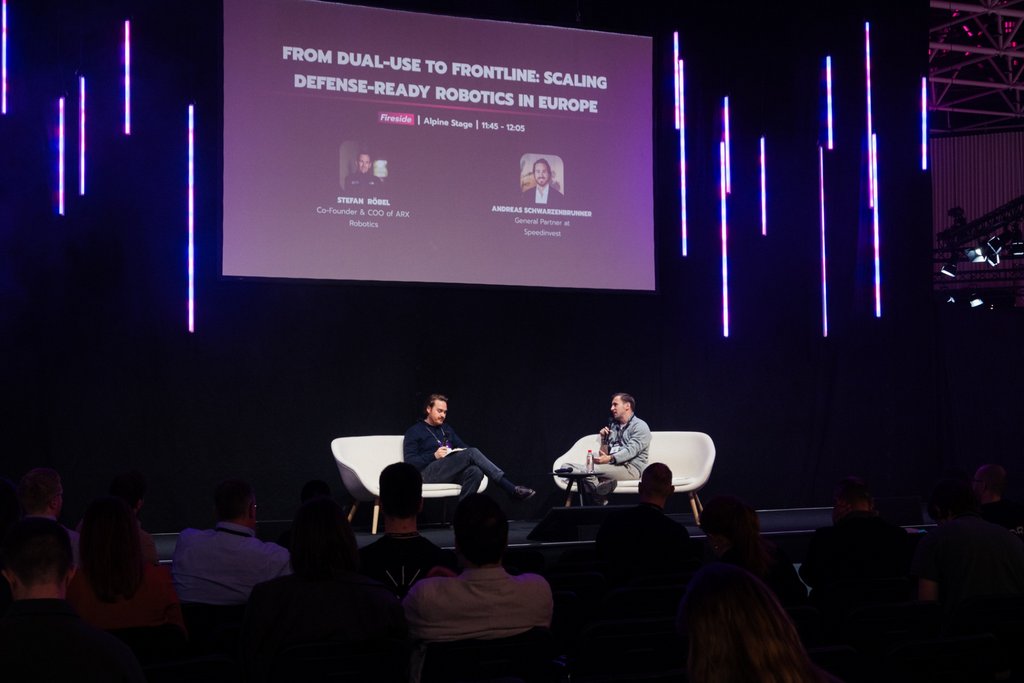
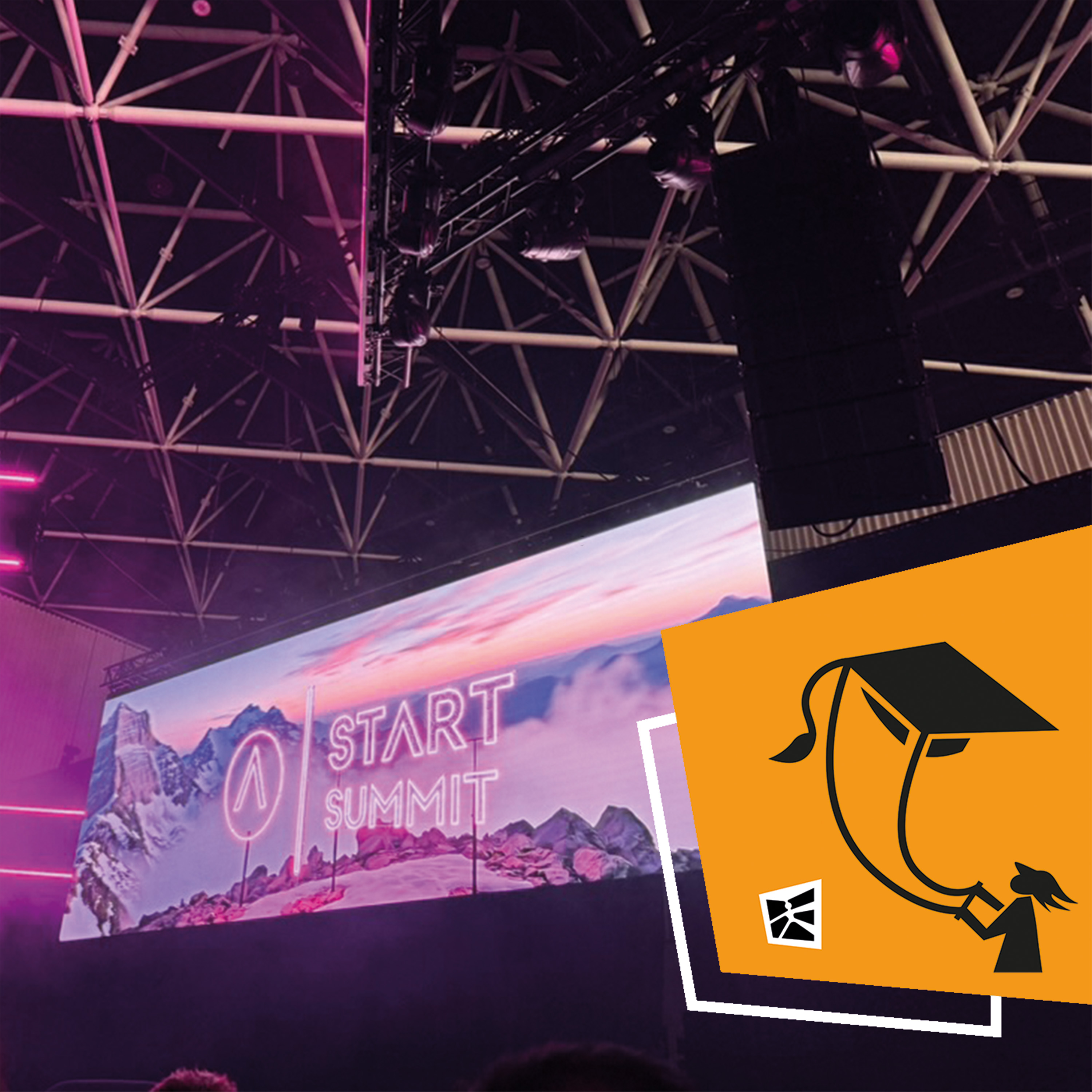
Guests from all over the world have gathered in front of the "Alpine Stage" at the START Summit in St.Gallen. On stage, Andreas Schwarzenbrunner, General Partner at Speedinvest, and Stefan Röbel, co-founder of the start-up ARX Robotics, are discussing "Defence-Ready Robotics in Europe". Whilst founders and investors at the START Summit in previous years primarily discussed apps, platforms and software models, the focus is now shifting more strongly towards industrial technologies. And with it, so-called dual-use systems: technologies that can be used for both civilian and military purposes.
One reason for this trend: the geopolitical situation. In Europe, political pressure is growing to become more technologically independent. Russia’s war of aggression against Ukraine demonstrates the strategic importance that comparatively simple technologies, such as small drones, now hold. Investment in defence tech start-ups is rising sharply, as reported by various media outlets (Forbes/ DefenseNews): globally, around 29 billion US dollars of venture capital flowed into the sector in 2025, with particularly high growth rates also in Europe, where the volume has recently increased significantly according to the NATO Innovation Fund. At the same time, the gap with the US remains wide: around 80 to 85% of investment still originates from the United States, and a significant portion of the capital for European start-ups even comes directly from there. Nevertheless, a growing ecosystem is taking shape in Europe, now comprising several hundred defence and dual-use start-ups, particularly in clusters such as Munich, Paris and London.
The guest list for the START Summit reflects this development: amongst investors, students and young founders is ETH graduate Johannes Aicher, a former Sauber employee. The mechanical engineer is CEO and co-founder of the start-up Avientus, which enables unmanned transport using small drones. This is possible in military operations as well as in civilian logistics. In combat zones, the transport system supplies people on military missions with essential goods.
The key feature is the system, as Innovationpark Zurich reported: autonomous loading and unloading thanks to a clever loading station and a smart aircraft. "It looks a bit like a drone and an aeroplane had a baby," says Aicher. "Switzerland is a great place to develop a product like this and set up a start-up," he adds. The business training at the HSG START Accelerator in autumn 2025 helped him to further develop the business model. With success: Avientus is among the Top 100 Swiss Start-ups in the 2025 Public Vote in the robotics category.
Swiss export regulations and the lack of NATO membership pose a challenge for the start-up. In the long term, Aicher therefore also sees good opportunities in Munich as a second location, where there is plenty of ‘defence capital‘. “Investor interest in defence technologies in Europe is growing noticeably,” says Aicher. This is also confirmed by HSG alumnus Stefano L. Saeger of Arctos Capital on the sidelines of the conference: "Venture capital follows the herd. We are currently seeing a shift away from investments in ESG solutions towards defence start-ups," says Saeger.
Venture capitalists in Europe such as Klaus Hommels are now speaking openly about defence tech. A topic long considered politically sensitive in the European tech scene, but which has taken on new significance due to Russia’s war of aggression against Ukraine. According to industry reports, Klaus Hommels is planning to set up a fund worth several hundred million euros for defence and deep tech start-ups.
Hommels has been involved in success stories such as Spotify and is one of Europe’s best-known venture capitalists. One of the start-ups he is investing in is the small drone company Twentyfour Industries, founded by two graduates of the University of St.Gallen: Clemens Kürten and Erik Linden. They also belong to a generation of founders who build physical technologies. "Many start-ups begin with a pitch deck," says Kürten. "We started by producing." As the Handelsblatt reported, the company had already built its first prototypes and established customer contacts before going public.
For many investors, the debate is part of a larger strategic question: Can Europe build its own technology industry? Or will the continent remain primarily a training ground for founders who later move to the US?
In fact, a large proportion of the world’s leading technology companies continue to emerge in the US. According to the Silicon Valley Index 2025, hundreds of billion-dollar start-ups are concentrated there. Overall, the US is home to around 45% of the world’s unicorn companies. Whilst Europe has strong universities and a large number of well-trained engineers, the US still leads by a wide margin when it comes to venture capital and scaling. At the same time, some observers see new opportunities for Europe, particularly in the field of industrial technologies.
A nation’s defence capabilities also depend on digital sovereignty. Consequently, there is also demand for the relevant software. Leonardo Moretti is one of the young founders at the START Summit representing the Alpine region who, out of a deep-seated conviction, wish to work in and for Europe in the long term. Moretti grew up on Lake Constance alongside his co-founder. The pair gained entrepreneurial experience in Düsseldorf as partners with established IT service providers, developing software projects for listed corporations and regulated organisations such as the Cantonal Hospital of St.Gallen.
Their latest venture: Adminity. The start-up has built its team in St.Gallen and, as a finalist in the STARTFELD Rohdiamants competition, ranks among the top three start-up ideas in Eastern Switzerland."With the explosion of drone and sensor data, the pressure to integrate military systems is growing."
"Adminity addresses precisely this issue," explains Moretti at the START Summit trade fair, describing his start-up’s defence tech application, whose platform is also relevant for networked e-government solutions. "We develop software that enables systems to communicate securely and in compliance with regulations. Designed to meet the specific requirements of the military and public administration."
Currently, St.Gallen is "the place to be" for Moretti and his team, as they view the city and the canton as one of the national pioneers in the field of public sector digitalisation. For although much works very well: as the European Commission’s 2024 eGovernment Benchmark Report shows, Switzerland ranks 31st out of a total of 37 countries. The report compares how countries deliver digital public services. This leaves Adminity plenty of scope to develop even better solutions for public administration. With a view to customers for its defence tech software and the upcoming market entry into the EU, Estonia would also be an interesting region.
Whilst platform models benefit greatly from network effects and large domestic markets, other factors come into play in robotics, manufacturing or drone technology. These include engineering expertise, industrial know-how and access to manufacturing. Countries such as Germany and Switzerland are considered strong in precision technology and mechanical engineering. According to data from the industry association VDMA, Germany is Europe’s largest mechanical engineering hub, as Stefan Röbel, co-founder of the start-up ARX Robotics, emphasised on the Alpine Stage at the START Summit: "There is strong industrial muscle in Germany." But is a new generation of technology companies actually emerging in the European Alpine region between Geneva, Lausanne, Zurich, St.Gallen and Munich?
Compared to the rest of the world, European start-ups often struggle to secure large funding rounds or to grow internationally quickly. Gabriel Vasquez, Investment Partner at the US venture capital firm Andreessen Horowitz, is always on the lookout for promising start-ups in Europe. During a panel discussion at the START Summit, he challenges the widespread notion that start-ups can only really make it big in the US. He encourages founders to rely on their own strengths with an "entrepreneurial spirit" and to make use of the global network: "Silicon Valley is a state of mind that can be found anywhere in the world. Global companies can also be founded in small towns far from the well-known start-up hubs."
Conclusion: If start-ups such as Twentyfour Industries, Adminity or Avientus continue to develop so successfully, they could demonstrate how companies can grow successfully even in Munich or St.Gallen. And thereby inspire other young talents to try their hand at starting a business in the Alpine region.
Image: START Summit, Andreas Schwarzenbrunner (Speedinvest), Stefan Röbel (ARX Robotics)
More articles from the same category
This could also be of interest to you
Discover our special topics