Campus - 07.04.2026 - 11:00
For Murat Abdullin, Dalia Shaaban, Max Neuwinger (all three ETH), Danylo Koza (Zaporizhzhya National Technical University) and many others, what made this year's START Hack special was that teams were working with similar technological foundations. LLMs and copilots were everywhere. That was precisely what made the competition interesting: It wasn't the tools themselves that made the difference, but rather the question of how they were used. To win over the judges, teams had to understand the user and turn that understanding into something that could be communicated as a product.
Technically, the team relied on a mix of Antigravity with Gemini, VSCode, IntelliJ and Claude Code. The key was not to stick to a single stack, but to use the right tools for each phase.
In the Belimo case, anomaly detection initially seemed to be the obvious focal point. However, in discussions with the company, the team quickly realised that this was not the core problem. Actuators continuously send technical signals regarding, for example, position, torque, temperature or status codes. Whilst this data is good to read for engineers, it is significantly harder for non-specialists to interpret. For the team, having no prior knowledge of the case, it took time to initially grasp the significance of the data in practice.
That is why the four of them invested a lot of time in asking questions of Belimo. It was crucial to understand how people within the company work with the data and what the company's expectations were. This gave rise to the actual task: not only to detect anomalies, but to make the data accessible to a stakeholder group. The solution was to translate complex hardware signals into clear, actionable insights.
The team was not short of ideas. On the contrary: there were plenty of building blocks right from the start. The difficulty lay in combining these into a coherent product and a compelling narrative. The decisive moment therefore came halfway through the hackathon. The team took a step back, structured what they had, and made a conscious decision about what to keep, what to cut, and how everything should fit together. Once the framework for the product and pitch was in place, everything else fell into place. Looking back, there is only one thing they would do differently at the next hackathon: start this structuring step a little earlier.
For the team, the key to creating a working prototype in a short time lay in a kind of 80/20 thinking: first identifying the few things that really matter and implementing them properly. It was just as important to meet the company's expectations precisely, rather than getting lost in unnecessary features. According to the team, the major technical challenge lay in the art of making everything visually intuitive. They realised early on that the solution would miss the mark if the user interface wasn't right. The four describe their product as a holistic (end-to-end) approach: from raw hardware signals to clear, concrete steps for action. They didn't want to stop at technical outputs, but rather to make visible what needed to be done and which stakeholders were involved in each case.
The team had come together through overlapping friendships. Everyone already knew at least one other person well. Murat Abdullin brought the group together. For most, it was one of their first hackathons. Accordingly, they started with a rather playful attitude: as a learning experience, not just a competition.
It was precisely this starting point that made the team efficient. Because trust was already in place, they could communicate openly, make quick decisions and maintain a relaxed atmosphere at the same time. The division of tasks remained flexible. The team constantly coordinated and decided on a case-by-case basis who would work on what. Not everything can be sensibly divided up in a hackathon; sometimes one person takes on an area entirely, then they switch again. The whole thing was complemented by deliberately built-in Mario Kart breaks.
The competition was clearly palpable, the four explain. You find yourself in a room full of very clever and capable people, with constant building, testing and discussion. The pressure was less of a burden than a motivator, provided you didn't unnecessarily heighten it yourself. The four deliberately kept the mood light, laughed a lot and didn't take themselves too seriously.
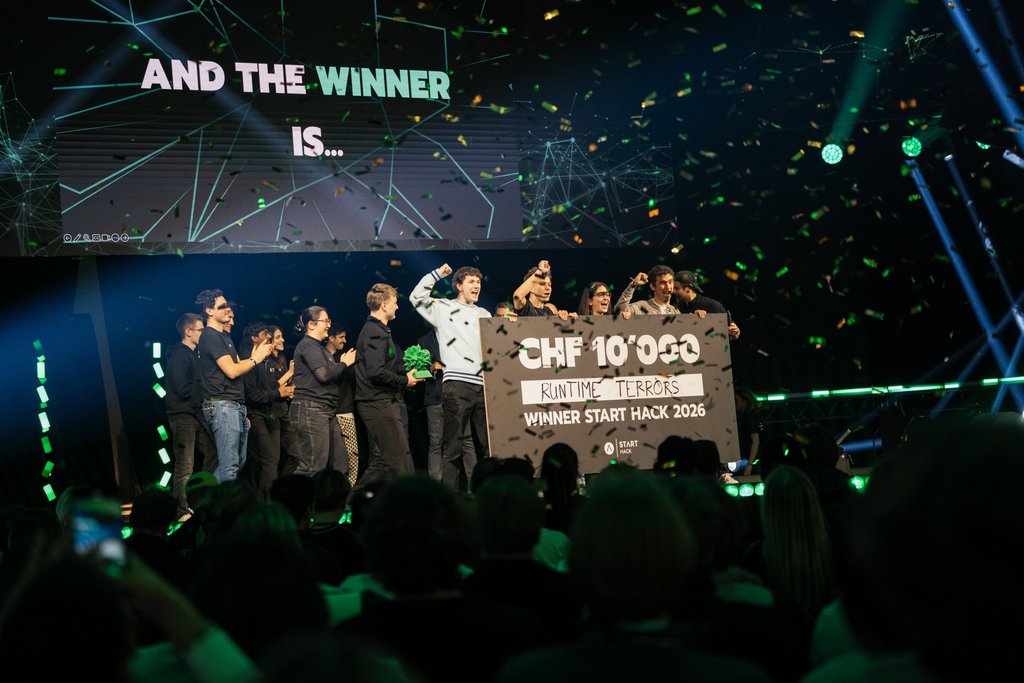
Winning was an incredible moment for everyone, especially as the team hadn't expected it. The emotional highlight, however, was the process itself.
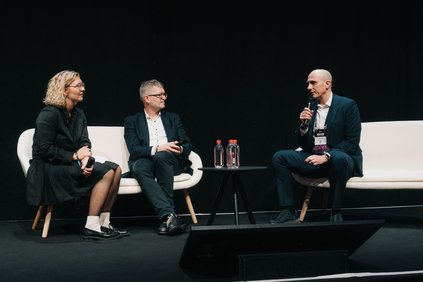
From the perspective of HSG alumna Tetyana Drobot, the central idea behind START Hack 2026 was to bring together tech and business talent in a collaborative environment. This was precisely what was evident in the teams' work: technical implementation was combined with thoughtful design and sound business logic. At the same time, the hackathon struck a good balance between ambition and a light-hearted atmosphere. Side activities, robot shows at half-time and meme challenges kept energy levels high.
Compared to previous editions and hackathons at other institutions, Drobot highlights two points in particular: the larger scale of the event and the increased expectations of the case partners.
Drobot cites agent-based AI, orchestration and system design as technological trends. At the same time, data preparation had been a key challenge for many projects. She was particularly impressed by teams from PostFinance's gaming challenge, who had found ways to convey complex financial topics in a playful and accessible manner. When evaluating entries, the juries focused not only on functionality, but also on completeness, usability and storytelling. Unlike more open formats, which tend to yield unconventional but less feasible ideas, the focus here was on practical applicability.
Drobot describes it as impressive that an event of this scale is organised entirely by students. Every year, despite a changing team, partners, speakers, mentors, volunteers, security, the venue and catering are coordinated. It goes without saying that with an event of this scale, there are areas for learning, and this has even found its way into this year's meme challenge. This makes the slogan on the T-shirts all the more apt: "running on caffeine, deadlines and adrenaline".
Drobot also highlights the event's international growth. Participants from continents such as Latin America had travelled to the event and were welcomed by the university in its role as host in various capacities, including students, organising teams, alumni, speakers and spin-offs.
For Drobot, the START Hack is more than just a competition. In her view, the event strengthens the European start-up scene and Switzerland's position as a tech hub, as it creates visibility and attracts talent. It is quite possible that some participants met their future co-founders during these 48 hours.
Her advice to those interested in next year's event is accordingly straightforward: don't think twice, just take part. You'll be surprised at how much is possible in two days, and above all, don't forget one thing: to have fun.
Adria Pop is in her fourth semester of a Master's degree in Computer Science at the University of St.Gallen.
More articles from the same category
Discover our special topics