Campus - 05.12.2025 - 09:00
The vision of the HSG START Accelerator is to build a pan-Alpine bridge between technological excellence and entrepreneurial implementation. The programme specifically prepares European tech start-ups in the early growth phase for scaling and access to capital and markets.
‘Our mission is to accompany the next generation of European tech champions,’ said Prof. Dr. Dietmar Grichnik, President of the Board of Trustees of the HSG START Accelerator Foundation. ‘The first batch has impressively demonstrated the power of combining technological excellence, scientific expertise and entrepreneurial implementation. We are creating a platform here on which European innovations can grow.’
This strong foundation and network are the result of a joint initiative between the University of St.Gallen (HSG), the START Foundation and Switzerland Innovation Park Ost (SIP Ost). It is financially supported by the Canton of St.Gallen, other foundations and private donors.
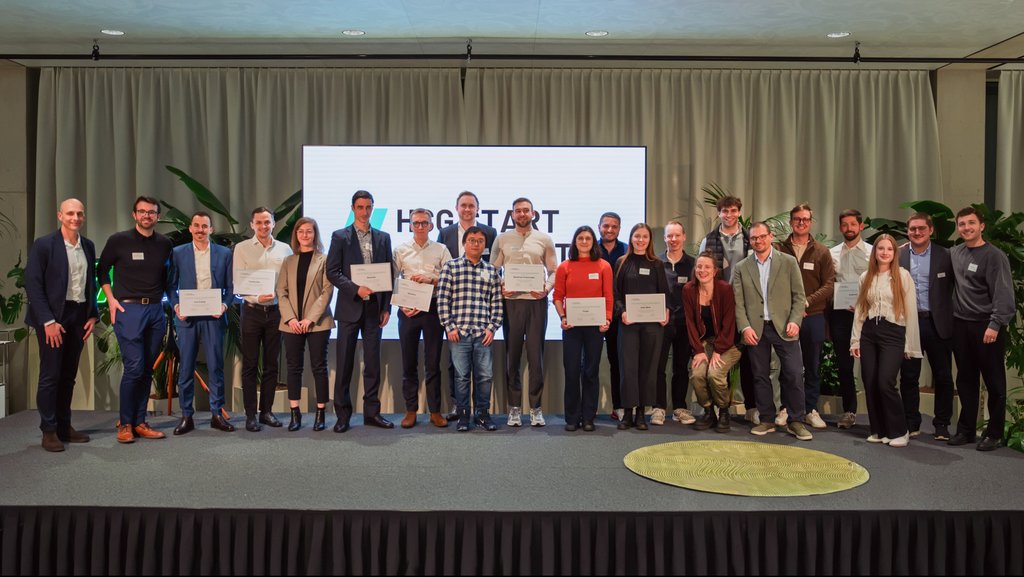
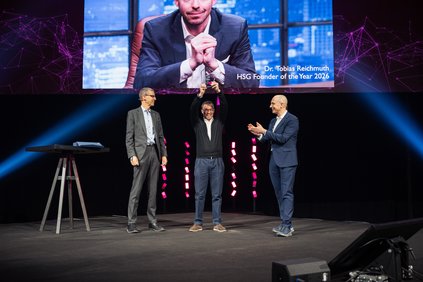
The Demo Day at the University of St.Gallen's SQUARE marked the end of the first batch, which had started in September 2025. Eight start-ups from the fields of ClimaTech, drones, artificial intelligence, MedTech and robotics were selected from more than 130 applications from over 30 countries. The founders come from all over Europe and leading research institutions such as ETH Zurich, EPFL in Lausanne, Empa, the University of Zurich and the University of St.Gallen.
‘The last few weeks have shown how the founders have sharpened their positioning and worked on their business models to become investor-ready,’ said Nicolas Blanchard, CEO of the HSG START Accelerator. ‘At the same time, our experts and industry partners from our ecosystem have been heavily involved. We were able to establish numerous relevant connections that will provide concrete help to the teams.’
In total, the start-ups were supported by around 60 experts and mentors in refining their business models, developing market strategies and preparing to seek investors. Over 130 connections were made with companies, institutions and investors.
The following start-ups presented their progress on Demo Day:
● Augmedi: A learning platform that uses hyper-realistic 3D models and artificial intelligence to support medical training in anatomy and orthopaedics.
● Avientus: A spin-off from ETH Zurich that enables fast, cost-effective and flexible drone logistics for industrial applications and defence.
● Dexterous Endoscopes: An EPFL spin-off that develops surgical endoscopes that can reach areas that are inaccessible with conventional instruments.
● Forgis: An AI-based development environment in which AI agents program, test and commission industrial robot systems.
● Ionic Wind: An Empa spin-off that has developed airflow technology for the energy-efficient cooling of high-performance electronics and computer chips.
● Iron Energy: An ETH spin-off that is developing a patented technology for long-term energy storage based on iron oxide, thereby addressing the seasonal energy gap in winter.
● Neurovia: An EPFL spin-off that manufactures minimally invasive implants that communicate with the nervous system via blood vessels to treat severe drops in blood pressure and can be used for other specialised therapies in the future.
● TreeScatter: An AI-based platform that creates accurate, digital 3D clones of forests at the tree level to support sustainable forestry.
Against this backdrop, the independent investment committee, together with the Board of Trustees, selected Dexterous Endoscopes for funding and made the team an offer. The EPFL spin‑off is developing a flexible surgical endoscope and impressed with its innovative product, which addresses a real clinical problem and will bring tangible benefits to patients in the future. A convincing market‑launch plan, the strong team and great growth potential were ultimately decisive for the start‑up.
The next batch will start in March 2026. The application window is currently open for European tech start-ups that are ready for their next growth step and want to benefit from the pan-Alpine ecosystem. Interested start-ups can apply now at www.hsgstartaccelerator.com.
About the HSG START Accelerator
The HSG START Accelerator start-up support programme, based in St.Gallen, was founded by the University of St.Gallen (HSG), the START Foundation and Switzerland Innovation Park Ost (SIP Ost). The aim of the accelerator is to prepare European start-ups in the early growth phase for scaling up through professional support and a dedicated programme. It is financially supported by the Canton of St.Gallen, the Ernst Göhner Foundation, the Metrohm Foundation and Swisscom. Further information is available at: www.hsgstartaccelerator.com
More articles from the same category
This could also be of interest to you
Discover our special topics