Campus - 04.02.2026 - 12:52
“While preparing for this course, I became a real game nerd. I went to game fairs, read specialist magazines, and invited friends and family to game nights again and again,” says Julian Eckl. The HSG political scientist led a new course entitled “Games and World Politics” in the autumn semester of 2025. He spent over a year researching the course and received a grant from the HSG's Teaching Innovation Lab.
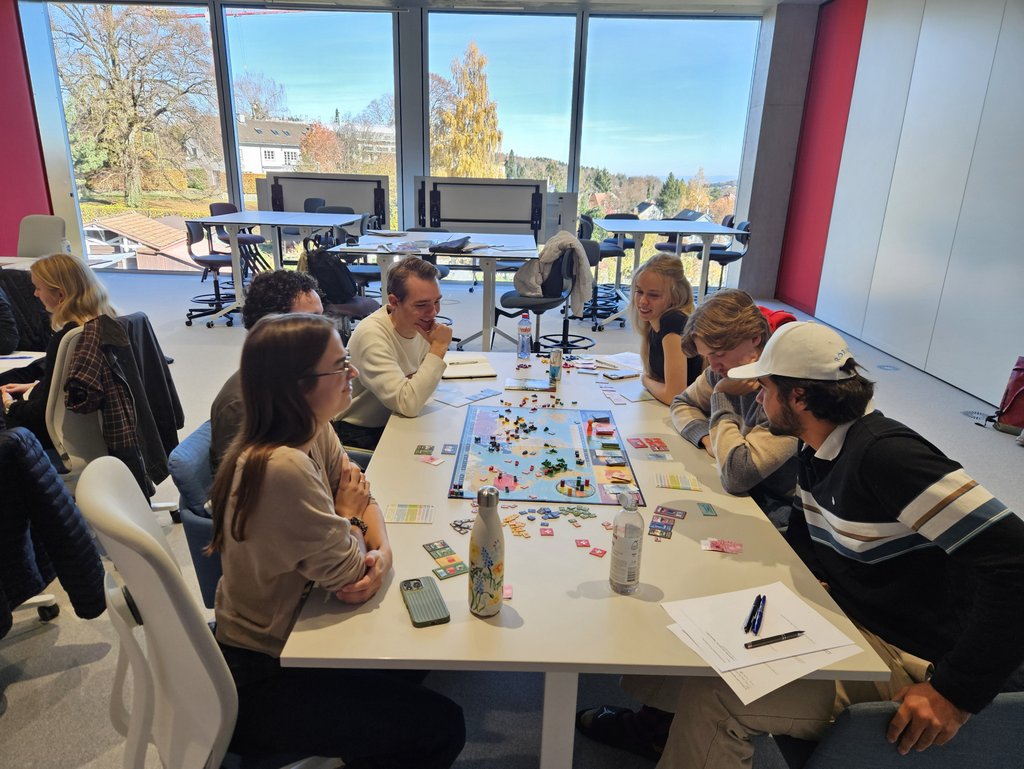
In the course, HSG bachelor's students learned about political science theories as well as the processes and principles of global politics – explained using four board games. Following several weeks of preparatory sessions, three block days in November formed the core of the course. During these days, the students played intensively, interrupted by regular reflections on the course of the game and theoretical input from Eckl. “Simulations have long been established in political science. The advantage of games is that they take less time than simulations. This allows participants to play several rounds, compare results and apply what they have learned immediately,” says Eckl.
Eckl's research at HSG focuses on among other things, the forms in which politics are organised. According to Eckl, there is a connection between games and scientific theories: “Both reduce the complexity of the world by highlighting individual aspects.” With this simplification, games also offer powerful learning experiences for adults. This is reinforced by playing in a group with other students. “Learning is not only cognitive, but also has strong social and emotional aspects,”says Eckl.
The HSG students played four games in the course. “I deliberately chose board games because the students' everyday lives are heavily influenced by digital technology,” says Eckl. One of the games was “Kyoto”, which revolves around global climate negotiations. Players must reduce emissions and bear financial costs in order to achieve common climate goals. At the same time, they attempt to give up less prosperity than the other players. The game shows states as the most important power factors in world politics.
The game “Diplomacy”, which revolves around security policy, has a similar focus. In this game, the students took on the roles of heads of state who make agreements while keeping their own interests in mind.
The game “Imperial 2030” showed a different perspective: players are investors and countries become pawns of the financial industry. The fourth game, “Spirit Island”, is set on an island: the players are spirits who help an indigenous population defend themselves against colonial rulers. “This game shows the perspective of those who are globally underrepresented or oppressed,” says Eckl. And it illustrates that there are still widespread worldviews today that cannot be grasped by Western science.
The seminar included an introduction to key political science and other scientific theories such as liberalism, realism, social constructivism and international political economy. "After the course, several students told me that the games had given them a whole new understanding of familiar theories," says Eckl. He now plans to offer an additional course based on games on the topic of creativity in the Contextual Studies program of HSG. This comprises a quarter of the compulsory studies of all students and focuses on social, historical or cultural topics.
‘We then experienced some of the theories and processes covered in the course in the games themselves, which was helpful for understanding,’ says Juri Peters, who studies International Affairs (IA) at the HSG. The students had to play through the games in groups before the multi-day block course in order to practise the rules. ‘This resulted in several game evenings, and thanks to the course, I also made new contacts at the university,’ says Peters.
And IA student Quentin Wyss emphasises, ‘The course taught us a new way of learning. The highlight for me was the block course lasting several days, during which we played and at the same time linked the theories to the games.’ At the same time, the block course days were intensive and some of the games were highly complex. ‘That was also challenging.’ After playing, however, he realised how realistic the processes and dynamics that occur in a board game are. ‘The games were the bridge between theory and practice. I was able to look at the theories from new perspectives and thus evaluate them better.’
More articles from the same category
This could also be of interest to you
Discover our special topics