Campus - 23.12.2025 - 09:00
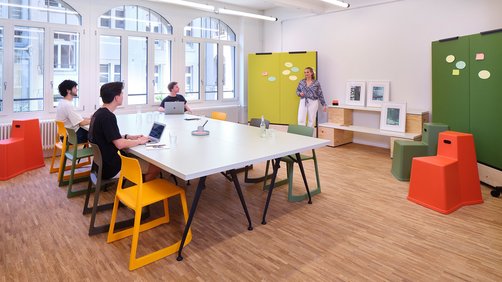
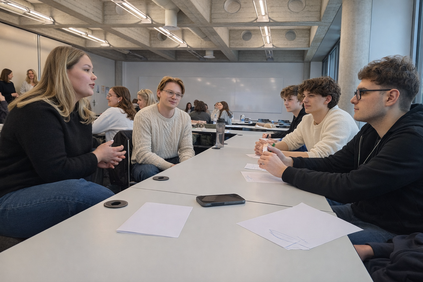
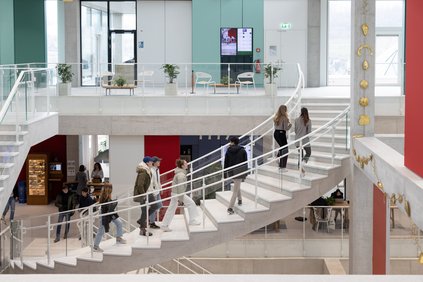
Around 40 students have gathered in the seminar room of SQUARE on the campus of the University of St.Gallen. Outside, the Lake Constance fog is rolling by, while inside, everyone is wide awake and a little nervous – there are many deadlines to meet before the holidays. What brings the students together on this day in Dr. Andreas Krafft's bachelor's course “Positive Futures – Hope and Purpose Workshop”… and it fits in well with the Advent season as they try to find out how confident thinking can have a positive effect on the common good.
Course instructor Dr Andreas Krafft invites students to the final presentation. The motto of the seminar: We don't just live on what we have. We live on what we plan to do. The fact that the students had more in mind for their course than just chasing credits is evidenced by the videos they shot for their practical projects, in the police station, in a nursing home, among other places. The challenge they set themselves was to step out of their comfort zone and immerse themselves in an unfamiliar environment in order to gain new perspectives. They organised themselves into small groups and equipped themselves with the theory and methodology that Andreas Krafft had given them in the first part of the course.
The course's approach combines insights from futurology with positive psychology in order to not only think about desirable futures, but also to develop concrete steps for shaping our society, both locally and globally. The students thus became acquainted with a field of research that deals with the conditions for a successful life, well-being and positive expectations for the future. In the teaching format, hope does not stand for ‘blind optimism’ or a cheerful mood. It is considered an essential source of courage, creativity and social responsibility. An “action-oriented, psychologically based resource” that enables individuals and communities to develop positive visions of the future and actively realise them.
During the autumn semester of the bachelor's course, the partners from the realm of working life included the St.Gallen city police, the Living Museum of Psychiatry St.Gallen, the Heiligkreuz nursing home and the Schänis youth club. There were also three schools: the Rorschach primary school, the Buben-Flade St.Gallen, the Steiner School St.Gallen and the Neue Stadtschule St.Gallen. Working in mixed teams, the students addressed issues from practice ranging from creative communication to community building. For example, they developed workshops for young people and schoolchildren in which they compiled visions of the future or a Wall of Hope for their lives. They also wrote the scripts for a project day of hope in collaboration with the city police. And they organised an art workshop at the Living Museum of Psychiatry in St.Gallen, focusing on inner strengths and resilience after setbacks.
Roberta Meyer visited children at a primary school in Rorschach with her fellow students. They approached the topic of hope in a playful way, letting the children talk about what they are grateful for and think about what they want for their future. In a game, they learned how to deal with different emotions so that they can react confidently in difficult situations – without hurting themselves or others. “We learned a lot from the children. I was inspired by their carefree, open and creative approach to the games,” says Roberta Meyer. "And I found it very inspiring that they showed so much appreciation for the little things in everyday life when making the gratitude tree. A warm home, parents who cook for them, feeling protected by friends and siblings. That inspired me to follow their example of gratitude," sums up Roberta Meyer.
Her fellow student Mattia Thoma, together with another group, sought access to young people at the Schänis youth club. A place without parents and school, where young people can hang out. More and more young people became curious about the HSG students' Wall of Hope and joined in to talk about their dreams, problems and ideas for the future. “It was cool that in the end, almost 30 young people voluntarily participated in our project. They got fully involved and came up with fresh ideas.” Ski club leader Mattia Thoma found the experience so enriching that he decided to get involved with the Schänis youth club on a long-term basis. He wants to stay in touch and follow the kids' development. "So much happens at this stage of life and almost everything is still open. That's when it's cool to create spaces of hope, to encourage kids to follow their own path and be creative. I want to be the contact person for young people that I would have liked to have had myself as a teenager,” says Mattia Thoma.
Another group of students familiarised themselves with the life experiences of older people. They invited elderly residents of the Heiligkreuz nursing home to a Day of Hope. “It was exciting to hear how our conversation partners viewed the challenges facing our generation. They encouraged us not to be intimidated by crises, wars and climate change, and to always look for ways to make a difference ourselves.” Many of them shared their life stories, which showed that even loss, war and crises can be overcome with time. “Learning what gave them hope in moments of despair strengthened us. They were also delighted to have such young conversation partners and that we were curious about what they had to tell us,” said the students.
At the end of the final presentation, the fog outside has cleared and the sun is shining into the seminar room. What the students take away from their course is a piece of life experience thanks to knowledge transfer: hope arises when people know their strengths, work together constructively in groups and understand that the future can be shaped by taking responsibility for their actions. “These are competences that will be effective beyond their studies,” says teacher Andreas Krafft happily.
More articles from the same category
This could also be of interest to you
Discover our special topics