Campus - 15.12.2025 - 12:00
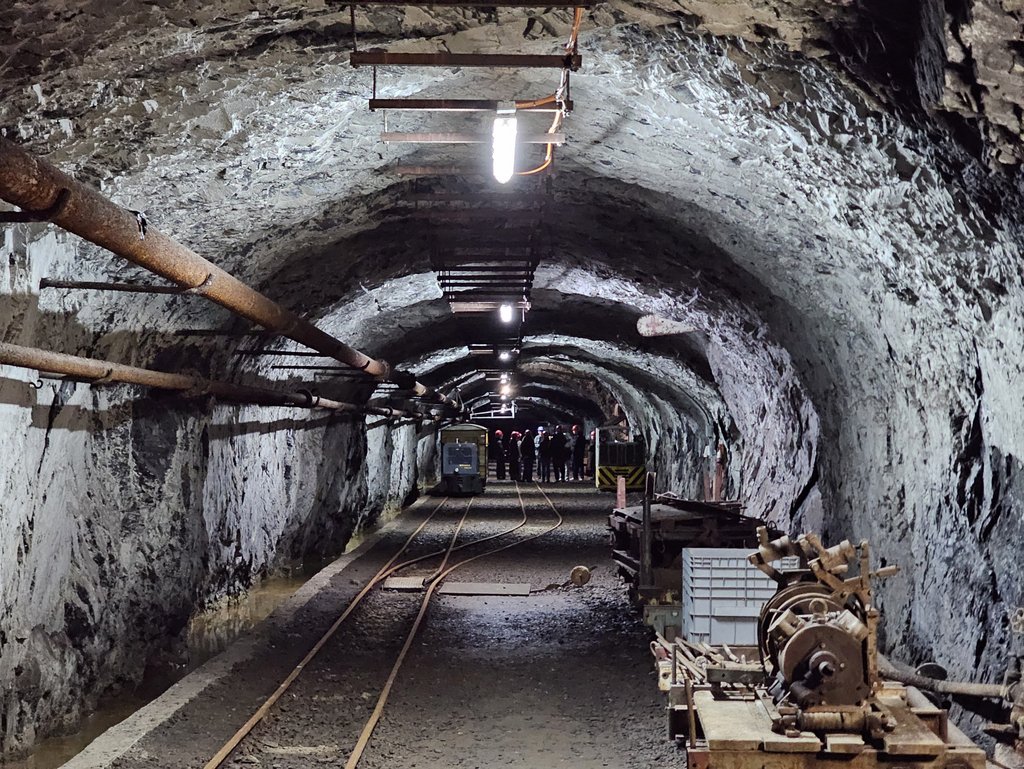
‘Visiting a mine made some of the seminar topics more tangible on a physical level: how does it feel to be in a narrow shaft? Where does the air in a mine come from? What is a silo and how does a drill feel?’ says Rita Kesselring. She is a professor of urban studies at the University of St. Gallen and a social anthropologist. In the autumn semester of 2025, she taught the bachelor's course ‘Mining in Society’. On 9 December 2025, the students and Kesselring visited the disused Gonzen iron mine in Sargans.
The excursion was intended to supplement the topics covered in the course with practical experience. After a two-kilometre journey into the mountain on the so-called ‘Gonzen-Zügli’ train, a two-hour tour began: narrow shafts, damp walls, the question of air circulation underground. Where iron ore was once mined, it became clear how closely work, risk and technology were intertwined. Historical gender roles also became apparent: women sorted out the so-called ‘fool's gold’ while men drilled underground. Small details made the distance to the present day palpable – such as the dependence on light, which in the past could simply go out.
The bachelor's course in the HSG context study programme aims to sensitise students to how the extraction of fossil raw materials is influenced by social decisions. ‘Mining has ecological, social, political and economic consequences that are very unevenly distributed globally in terms of their extent and assessment,’ says Kesselring.
She herself has conducted field research in the Global South and published a book on the subject in 2025. During the course, students also read ethnological works on topics such as environmental pollution, raw materials trading, corporate responsibility and the energy transition from the perspective of the populations affected. ‘Over the course of the semester, a dense picture of regional perspectives emerged, spanning from Chile to South Africa, the USA, the Gulf States and Switzerland. The students learned to think about raw materials both locally and globally,’ said Kesselring.
‘The visit to Gonzen also raised bigger issues,’ said Kesselring. These included questions such as: why is it no longer economically viable to mine iron ore in Switzerland? Why were working conditions before the closure in the 1960s already better than those in many mines in the Global South today?
More articles from the same category
This could also be of interest to you
Discover our special topics